Department of Physics, Faculty of Science, Universiti Putra Malaysia, Serdang 43400, Malaysia.
Functional Devices Laboratory, Institute of Advanced Technology, Universiti Putra Malaysia, Serdang 43400, Malaysia.
Molecules. 2020 May 30;25(11):2548. doi: 10.3390/molecules25112548.
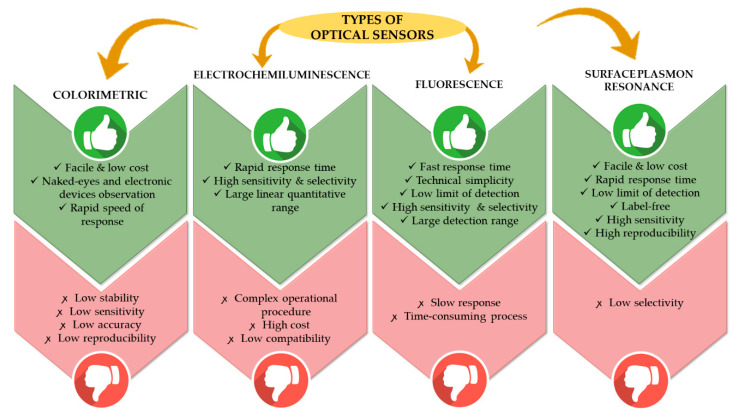
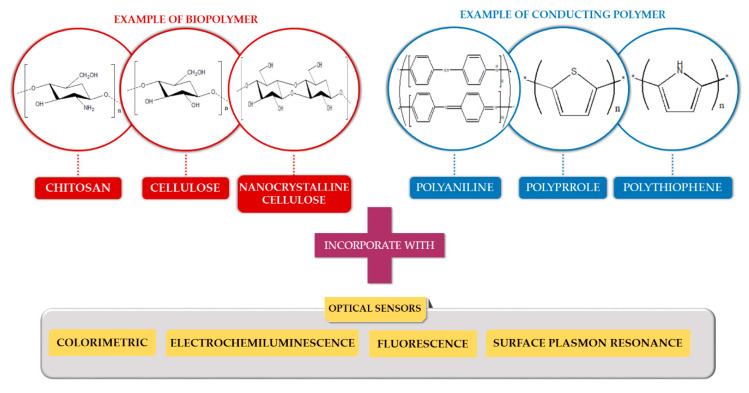
Great efforts have been devoted to the invention of environmental sensors as the amount of water pollution has increased in recent decades. Chitosan, cellulose and nanocrystalline cellulose are examples of biopolymers that have been intensively studied due to their potential applications, particularly as sensors. Furthermore, the rapid use of conducting polymer materials as a sensing layer in environmental monitoring has also been developed. Thus, the incorporation of biopolymer and conducting polymer materials with various methods has shown promising potential with sensitively and selectively toward heavy metal ions. In this feature paper, selected recent and updated investigations are reviewed on biopolymer and conducting polymer-based materials in sensors aimed at the detection of heavy metal ions by optical methods. This review intends to provide sufficient evidence of the potential of polymer-based materials as sensing layers, and future outlooks are considered in developing surface plasmon resonance as an excellent and valid sensor for heavy metal ion detection.
近年来,随着水污染的增加,人们致力于发明环境传感器。壳聚糖、纤维素和纳米晶纤维素是已经被深入研究的生物聚合物的例子,因为它们具有潜在的应用,特别是作为传感器。此外,导电聚合物材料作为环境监测中传感层的快速应用也得到了发展。因此,通过各种方法将生物聚合物和导电聚合物材料结合在一起,对重金属离子具有敏感和选择性的潜力。在这篇专题论文中,综述了近年来关于生物聚合物和导电聚合物基材料在传感器中用于检测重金属离子的光学方法的最新研究进展。本综述旨在提供聚合物基材料作为传感层的潜力的充分证据,并考虑了将表面等离子体共振作为重金属离子检测的优秀和有效的传感器的未来展望。