School of Health and Related Research (ScHARR), University of Sheffield, Sheffield, United Kingdom.
Nivel (Netherlands Institute for Health Service Research), Utrecht, Netherlands.
Euro Surveill. 2020 May;25(21). doi: 10.2807/1560-7917.ES.2020.25.21.1900221.
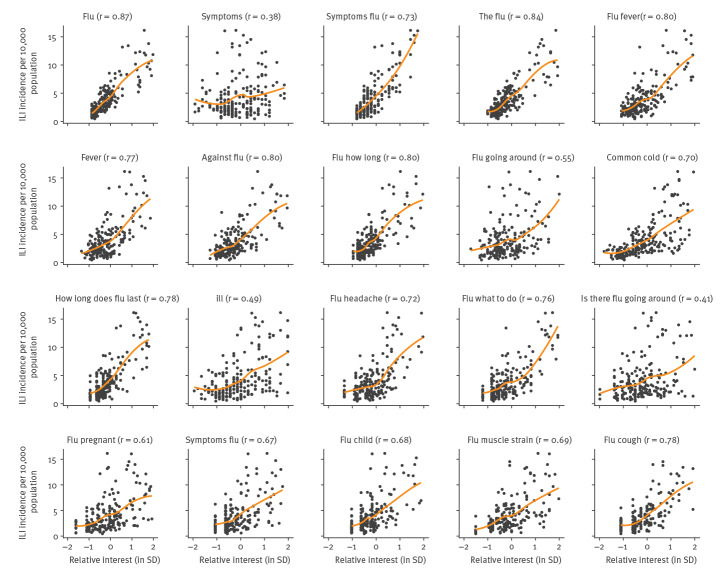
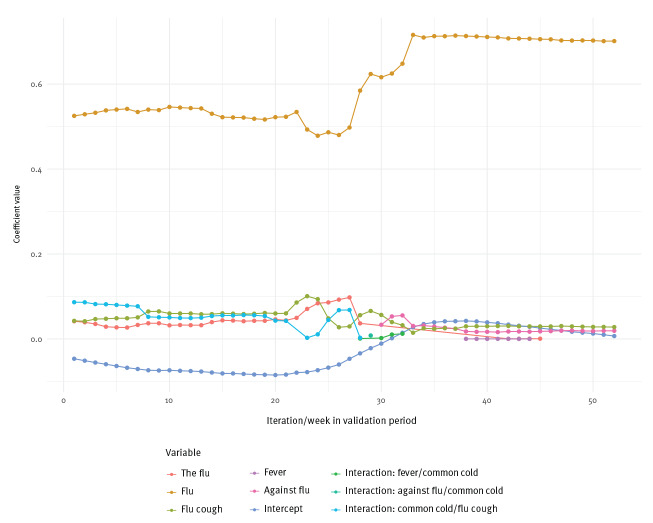
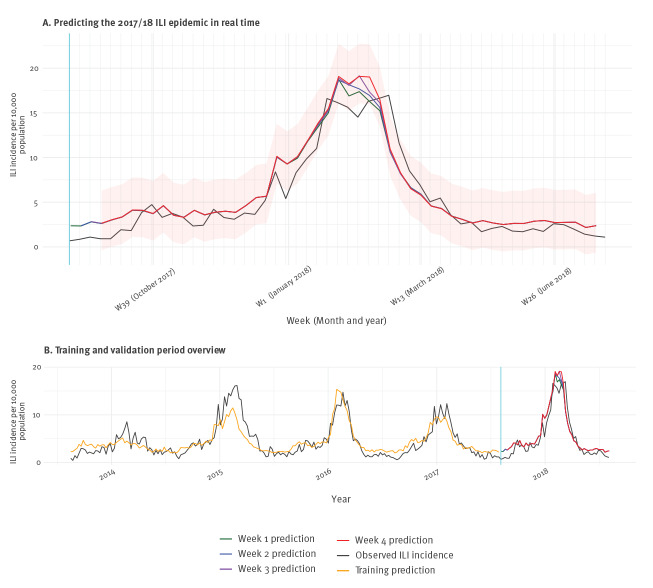
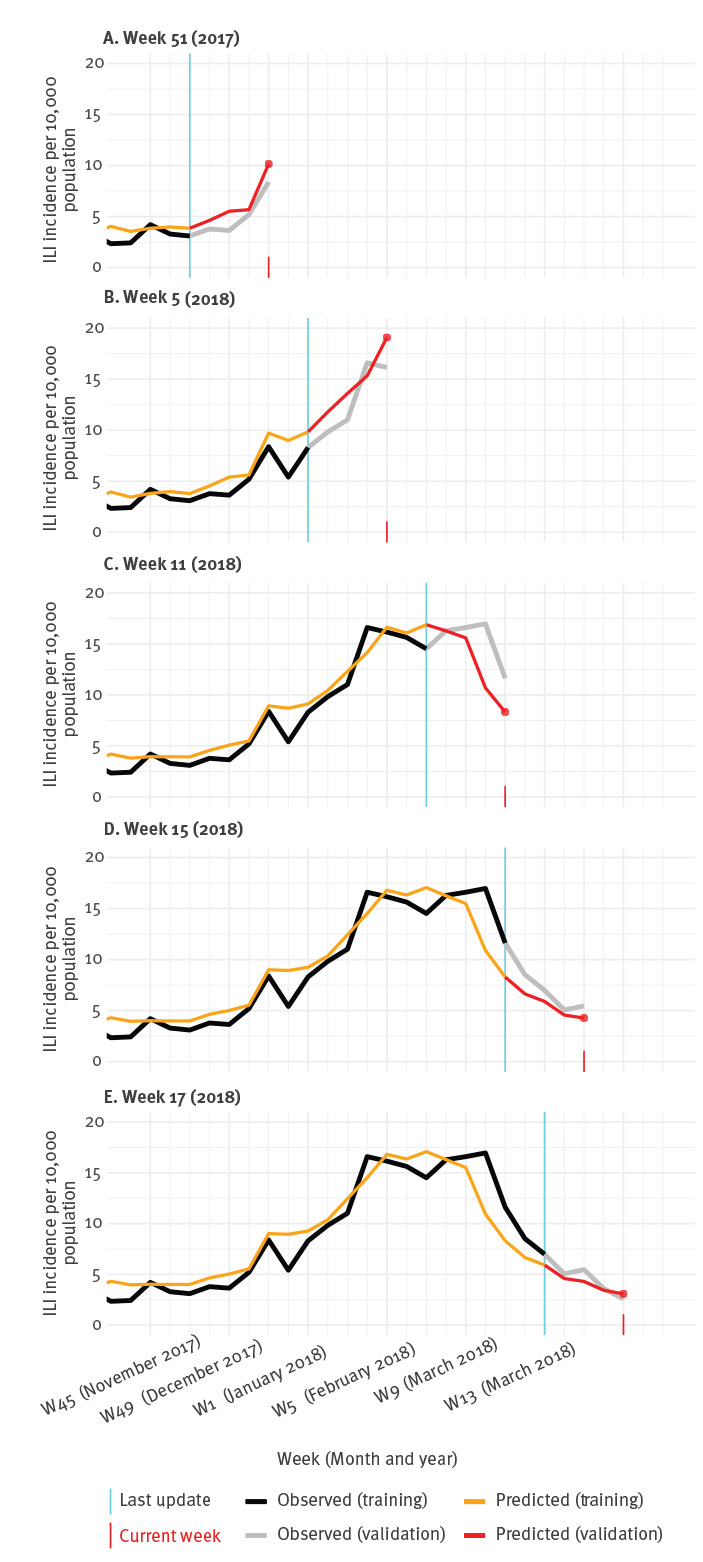
BackgroundDespite the early development of Google Flu Trends in 2009, standards for digital epidemiology methods have not been established and research from European countries is scarce.AimIn this article, we study the use of web search queries to monitor influenza-like illness (ILI) rates in the Netherlands in real time.MethodsIn this retrospective analysis, we simulated the weekly use of a prediction model for estimating the then-current ILI incidence across the 2017/18 influenza season solely based on Google search query data. We used weekly ILI data as reported to The European Surveillance System (TESSY) each week, and we removed the then-last 4 weeks from our dataset. We then fitted a prediction model based on the then-most-recent search query data from Google Trends to fill the 4-week gap ('Nowcasting'). Lasso regression, in combination with cross-validation, was applied to select predictors and to fit the 52 models, one for each week of the season.ResultsThe models provided accurate predictions with a mean and maximum absolute error of 1.40 (95% confidence interval: 1.09-1.75) and 6.36 per 10,000 population. The onset, peak and end of the epidemic were predicted with an error of 1, 3 and 2 weeks, respectively. The number of search terms retained as predictors ranged from three to five, with one keyword, 'griep' ('flu'), having the most weight in all models.DiscussionThis study demonstrates the feasibility of accurate, real-time ILI incidence predictions in the Netherlands using Google search query data.
背景
尽管谷歌流感趋势(Google Flu Trends)早在 2009 年就已问世,但数字流行病学方法的标准尚未建立,欧洲国家的相关研究也很少。
目的
在本文中,我们研究了使用网络搜索查询实时监测荷兰流感样疾病(ILI)发病率的方法。
方法
在这项回顾性分析中,我们仅基于谷歌搜索查询数据,模拟了一个用于估计 2017/18 流感季节当前 ILI 发病率的预测模型每周的使用情况。我们每周使用欧洲监测系统(TESSY)报告的 ILI 数据,从我们的数据集删除了当时最后 4 周的数据。然后,我们基于谷歌趋势中最新的搜索查询数据拟合了一个预测模型,以填补这 4 周的差距(“即时预测”)。我们应用套索回归和交叉验证来选择预测因子,并拟合 52 个模型,每个模型对应季节中的一周。
结果
这些模型提供了准确的预测,平均和最大绝对误差分别为 1.40(95%置信区间:1.09-1.75)和 6.36/10,000 人口。疫情的开始、高峰和结束分别预测误差为 1、3 和 2 周。保留为预测因子的搜索词数量从三个到五个不等,所有模型中权重最大的一个关键字是“griep”(“flu”)。
讨论
本研究表明,使用谷歌搜索查询数据在荷兰进行准确、实时的 ILI 发病率预测是可行的。