Bandaru Srinivas, Sano Shunji, Shimizu Yurika, Seki Yuka, Okano Yoshikazu, Sasaki Tamaki, Wada Hideho, Otsuki Takemi, Ito Tatsuo
Department of Public Health, Okayama University Graduate School of Medicine, Dentistry, and Pharmaceutical Sciences, Okayama, Japan.
Department of Surgery, Division of Pediatric Cardiothoracic Surgery, University of California San Francisco, San Francisco, CA, USA.
Heliyon. 2020 May 25;6(5):e03942. doi: 10.1016/j.heliyon.2020.e03942. eCollection 2020 May.
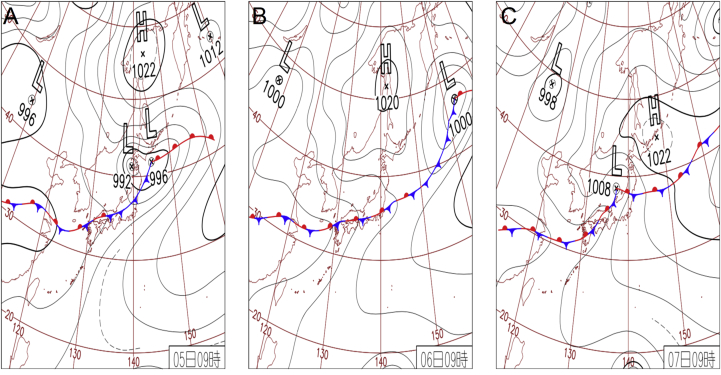
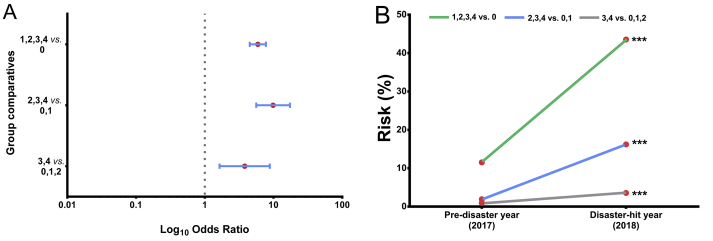
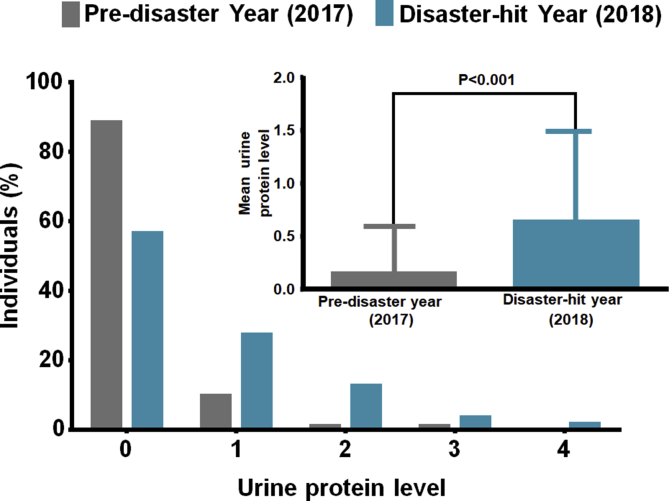
Southwestern Japan suffered its worst rains in 2018 causing floods and mudslides, claiming 225 lives and forcing millions for evacuations. Referred as "Heisei san-jū-nenshichi-gatsugōu", the disaster was the result of incessant precipitation caused by the interaction of typhoon "Prapiroon" with the seasonal rain front "Baiu". The present epidemiological study aims to investigate disaster-induced health issues in 728 residents of Innoshima island in the Hiroshima Prefecture by comparing their clinical data in pre-disaster (2017) and disaster-hit (2018) years which was obtained from annual health screening. Comparison of data showed a significant increase in the urine protein concentration in victims following the disaster. Probing further into the household conditions, showed that a total of 59,844 households were affected with water outage during the heavy rains, which was accompanied by severe damage of sewerage pipelines with complete recovery process taking two weeks. This two weeks of the crisis forced victims to refrain from using restrooms which in turn led to infrequent urination, thereby explaining the increased urine protein concentration in victims following the disaster. The present study addresses the acute health implications caused by the water crisis and serves as a precautionary measure for disaster management council to provide enhanced aftercare services in victims in further events of natural disasters.
日本西南部在2018年遭遇了最严重的降雨,引发了洪水和泥石流,造成225人死亡,数百万人被迫撤离。这场被称为“平成三十七年七月连雨”的灾难,是台风“派比安”与季节性雨带“梅雨”相互作用导致持续降雨的结果。本流行病学研究旨在通过比较广岛县因岛市728名居民在灾难前(2017年)和受灾(2018年)年度的临床数据(这些数据来自年度健康筛查),调查灾难引发的健康问题。数据比较显示,受灾后受害者的尿蛋白浓度显著增加。进一步探究家庭状况发现,暴雨期间共有59844户家庭停水,同时污水管道严重受损,完全恢复过程耗时两周。这两周的危机迫使受害者避免使用卫生间,进而导致排尿次数减少,从而解释了受灾后受害者尿蛋白浓度增加的原因。本研究探讨了水危机引发的急性健康影响,并为灾害管理委员会提供了一项预防措施,以便在未来发生自然灾害时为受害者提供更好的后续护理服务。