Department of Science Research and Information Management, Shanghai Pudong New Area Center for Disease Control and Prevention, Shanghai, 200136, China.
Fudan University Pudong Institute of Preventive Medicine, Shanghai, China.
BMC Public Health. 2020 Jun 3;20(1):839. doi: 10.1186/s12889-020-08932-x.
To address change in the gender gap of life expectancy (GGLE) in Shanghai from 1973 to 2018, and to identify the major causes of death and age groups associated with the change over time.
The temporal trend in GGLE was evaluated using retrospective demographic analysis with Joinpoint regression. Causes of death were coded in accordance with the International Classification of Diseases and mapped with the Global Burden of Disease (GBD) cause list. The life table technique and decomposition method were used to express changes in GGLE.
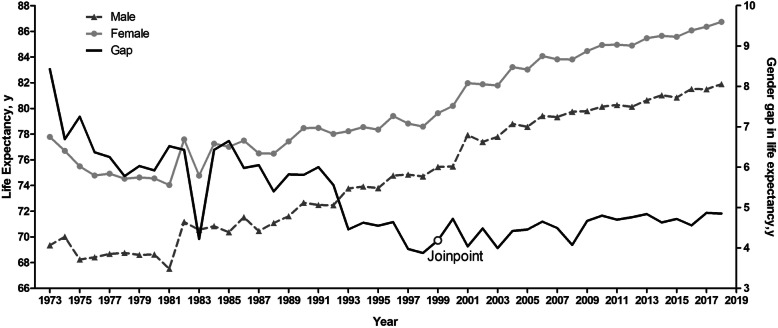
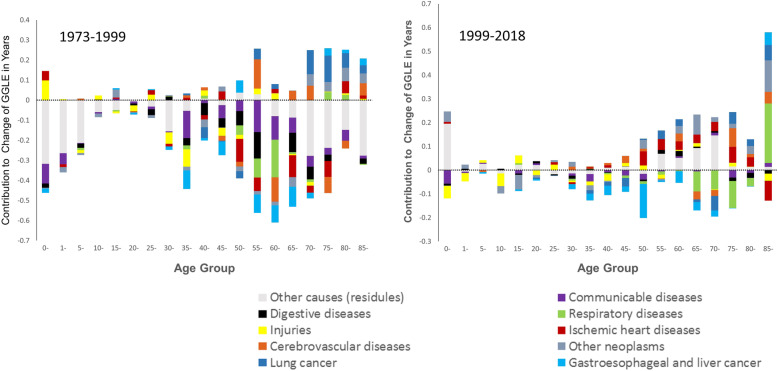
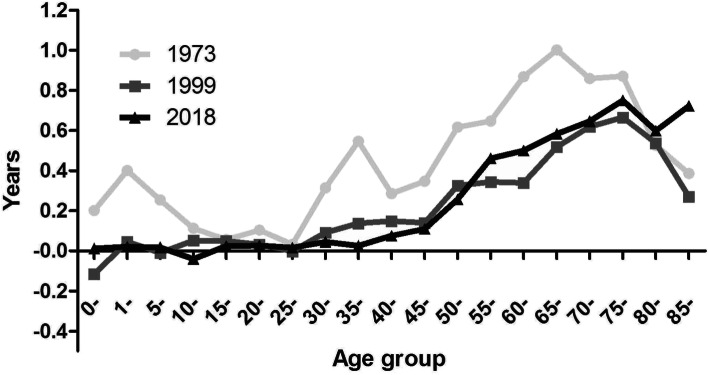
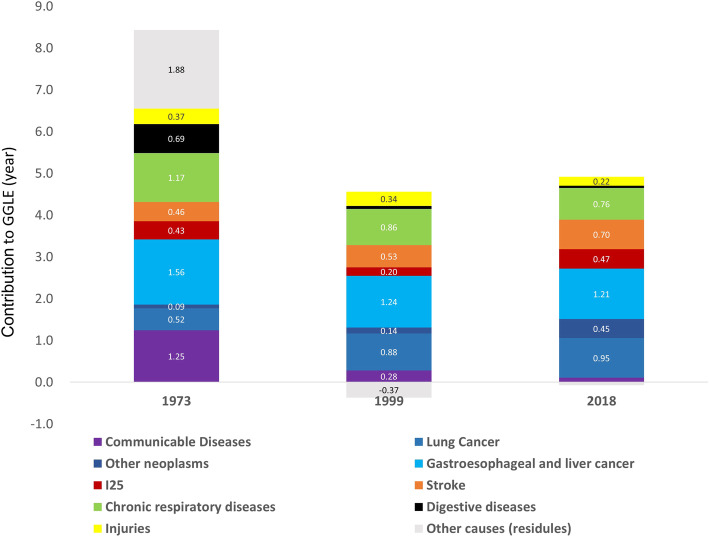
The trend of GGLE in Shanghai experienced two phases, i.e., a decrease from 8.4 to 4.2 years in the descent phase (1973-1999) and a fluctuation between 4.0 and 4.9 years in the plateau phase (1999-2018). The reduced age-specific mortality rates tended to concentrate to a narrower age range, from age 0-9 and above 30 years in the descent phase to age above 55 years in the plateau phase. Gastroesophageal and liver cancer, communicable, chronic respiratory, and digestive diseases were once the major contributors to narrow GGLE in the descent phase. While, importance should be attached to a widening effect on GGLE by lung cancer, cardiovascular diseases, other neoplasms like colorectal and pancreatic cancer, and diabetes in the recent plateau phase.
Non-communicable diseases (NCDs) have made GGLE enter a plateau phase from a descent phase in Shanghai, China. Public efforts to reduce excess mortalities for male NCDs, cancers, cardiovascular diseases, chronic respiratory diseases, and diabetes in particular and health policies focused on the middle-aged and elderly population might further narrow GGLE. This will also ensure improvements in health and health equity in Shanghai China.
本研究旨在探讨 1973 年至 2018 年上海市预期寿命性别差距(GGLE)的变化,并确定与时间变化相关的主要死亡原因和年龄组。
采用回顾性人口分析结合 Joinpoint 回归评估 GGLE 的时间趋势。死因按国际疾病分类编码,并与全球疾病负担(GBD)病因清单相匹配。寿命表技术和分解方法用于表示 GGLE 的变化。
上海 GGLE 的趋势经历了两个阶段,即下降阶段(1973-1999 年)从 8.4 年降至 4.2 年,以及平稳阶段(1999-2018 年)在 4.0 年至 4.9 年之间波动。年龄特异性死亡率下降趋势趋于集中在更窄的年龄范围,从下降阶段的 0-9 岁和 30 岁以上到平稳阶段的 55 岁以上。在下降阶段,胃癌、食管癌和肝癌、传染性疾病、慢性呼吸道疾病和消化系统疾病一度是缩小 GGLE 的主要原因。而在最近的平稳阶段,肺癌、心血管疾病、结直肠癌和胰腺癌等其他肿瘤以及糖尿病对 GGLE 扩大的影响值得关注。
非传染性疾病(NCDs)使中国上海的 GGLE 从下降阶段进入平稳阶段。减少男性 NCDs、癌症、心血管疾病、慢性呼吸道疾病和糖尿病等男性 NCDs的超额死亡率的公共努力,以及特别关注中年和老年人口的卫生政策,可能会进一步缩小 GGLE。这也将确保改善中国上海的健康和健康公平。