Department of Cancer, Injury Prevention and Vital Statistics, Shanghai Pudong New Area Center for Disease Control and Prevention, Fudan University Pudong Institute of Preventive Medicine, Shanghai, 200136, China.
BMC Public Health. 2018 Feb 14;18(1):256. doi: 10.1186/s12889-018-5112-7.
Life expectancy at birth (LE) is a comprehensive measure that accounts for age-specific death rates in a population. Shanghai has ranked first in LE in China mainland for decades. Understanding the reasons behind its sustained gain in LE provides a good reflection of many other cities in China. The aim of this study is intended to explore temporal trend in age- and cause-specific gains in LE in Shanghai and the probable reasons lay behind.
Joinpoint regression was applied to evaluate temporal trend in LE and the long time span was then divided accordingly. Contributions to change in LE (1973-2015) were decomposed by age and cause at corresponding periods.
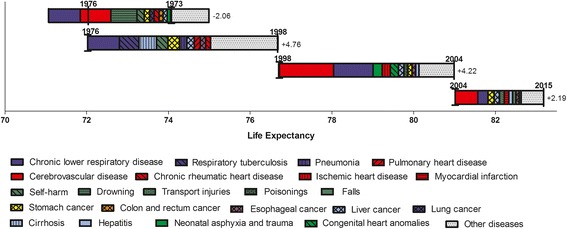
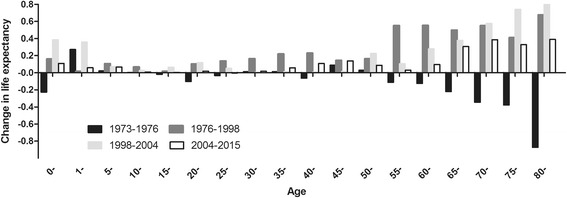
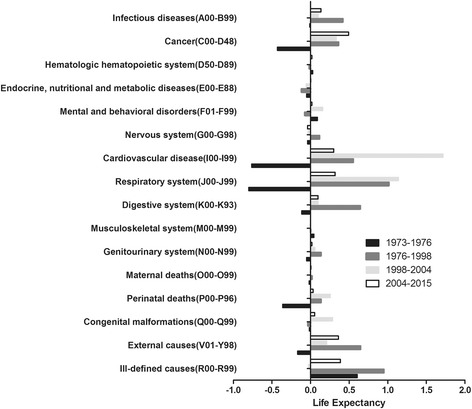
LE in Shanghai could be divided into four phases ie., descent (1973-1976), recovery (1976-1998), rapid rise (1998-2004) and slow rise (2004-2015). The growing LE was mainly attributed to reductions in mortality from the elderly populations and chronic diseases such as cerebrovascular disease, chronic lower respiratory disease, and gastrointestinal cancers (stomach, liver and esophageal cancer).
The four-decade sustained gain in LE in Shanghai is due to the reductions in mortality from the elderly and chronic diseases such as cerebrovascular disease, chronic lower respiratory disease, and gastrointestinal cancers. Further growth momentum still comes from the elderly population.
出生期望寿命(LE)是一种综合指标,它考虑了特定年龄人群的死亡率。几十年来,上海的 LE 一直位居中国大陆之首。了解其 LE 持续增长的原因,为中国其他许多城市提供了很好的借鉴。本研究旨在探讨上海 LE 按年龄和死因分类的变化趋势及可能的原因。
应用 Joinpoint 回归评估 LE 的时间趋势,并根据相应时期将长时间跨度进行划分。对 LE 变化(1973-2015)的贡献进行分解,按照相应时期进行年龄和死因分类。
上海的 LE 可分为四个阶段,即下降期(1973-1976 年)、恢复期(1976-1998 年)、快速上升期(1998-2004 年)和缓慢上升期(2004-2015 年)。LE 的增长主要归因于老年人和慢性疾病(如脑血管病、慢性下呼吸道疾病和胃肠道癌症(胃癌、肝癌和食管癌))死亡率的降低。
上海在过去四十年中 LE 的持续增长归因于老年人和慢性疾病(如脑血管病、慢性下呼吸道疾病和胃肠道癌症)死亡率的降低。进一步的增长动力仍来自于老年人口。