Kalsoom Furkhanda, Mahmood Muhammad Shahid, Zahoor Tahir
Dr. Furkhanda Kalsoom, Institute of Microbiology, University of Agriculture, Faisalabad, Pakistan.
Prof. Dr. Sajjad-ur-Rahman, Post Doc, Director, Institute of Microbiology, University of Agriculture, Faisalabad, Pakistan.
Pak J Med Sci. 2020 May-Jun;36(4):825-830. doi: 10.12669/pjms.36.4.1883.
The aim of study was to investigate the association of IL 1B gene polymorphism with involvement of and other gastric diseases.
Blood samples of dyspeptic patients were collected from endoscopy department of Allied Hospital Faisalabad from January 2017 to January 2019 and were qualitatively assayed for serological detection of CagA antibodies. PCR followed by direct sequencing was performed for proinflammatory IL-1B gene polymorphism detection. Sequence analysis was performed in software SnapGene viewer for haplotypes.
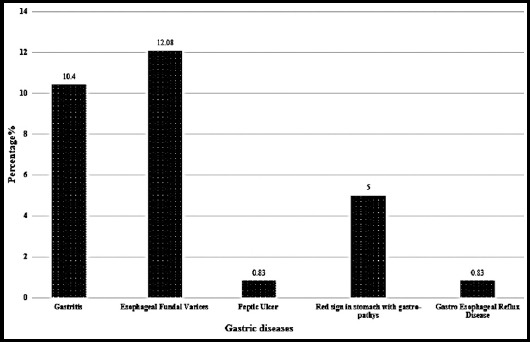
Demographic characteristics of seropositive patients showed maximum 25% gastritis in age groups of 20-40 years and 41-60 years, predominantly (41.7%) in females. While in seronegative patient's gastritis (33.3%) was found in age group of 20-40 years mainly in males (41.7%). Among studied groups, higher expression of IL-1B-511 genotype (33.3%) polymorphism was found in healthy individuals as compared to seropositive (25%) and seronegative (8.3%). While IL-1B-31 genotype showed maximum 33.3% polymorphism rate in seropositive gastric diseased group. Moreover, haplotypes frequencies IL-1B-511CC and IL-1B-31TT were predominantly (20%) found in seropositive gastric diseased group.
In seropositive patients, gastric disease was commonly found, however, gastric disease was not only associated with as seronegative patients were also carrying gastric complications. Interleukin IL-1B polymorphism was partially associated with infection in studied dyspeptic population.
本研究旨在探讨白细胞介素1β(IL-1B)基因多态性与幽门螺杆菌感染及其他胃部疾病的关联。
2017年1月至2019年1月期间,从费萨拉巴德联合医院内镜科收集消化不良患者的血液样本,并对血清中细胞毒素相关基因A(CagA)抗体进行定性检测。采用聚合酶链反应(PCR)及直接测序法检测促炎细胞因子IL-1B基因多态性。利用SnapGene viewer软件进行单倍型序列分析。
血清阳性患者的人口统计学特征显示,20 - 40岁和41 - 60岁年龄组中胃炎发生率最高,为25%,女性居多(41.7%)。而血清阴性患者中,20 - 40岁年龄组胃炎发生率为33.3%,主要为男性(41.7%)。在研究组中,与血清阳性(25%)和血清阴性(8.3%)患者相比,健康个体中IL-1B - 511基因型多态性表达较高(33.3%)。而在血清阳性胃部疾病组中,IL-1B - 31基因型多态性发生率最高,为33.3%。此外,血清阳性胃部疾病组中,单倍型频率IL-1B - 511CC和IL-1B - 31TT占主导(20%)。
血清阳性患者中常见胃部疾病,然而,胃部疾病不仅与幽门螺杆菌感染有关,血清阴性患者也存在胃部并发症。在本研究的消化不良人群中,白细胞介素IL-1B多态性与幽门螺杆菌感染部分相关。