Mao Yunwei, He Qi, Zhao Xuanhe
Department of Mechanical Engineering, Massachusetts Institute of Technology, Cambridge, MA 02139, USA.
Department of Civil and Environmental Engineering, Massachusetts Institute of Technology, Cambridge, MA 02139, USA.
Sci Adv. 2020 Apr 24;6(17):eaaz4169. doi: 10.1126/sciadv.aaz4169. eCollection 2020 Apr.
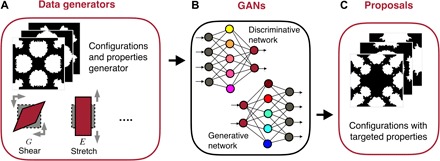
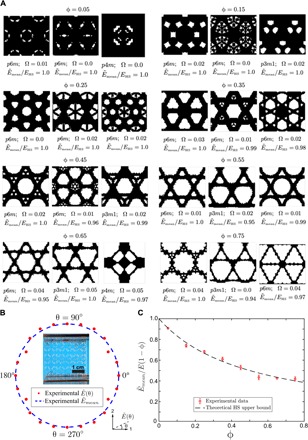
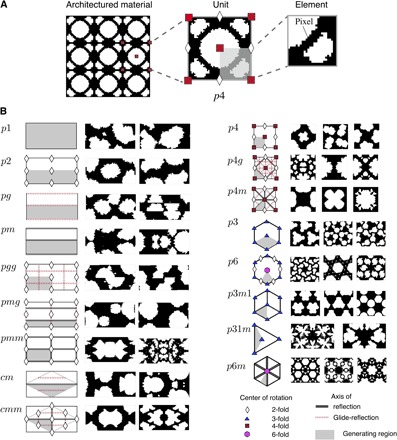
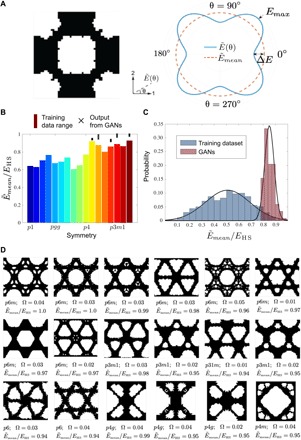
Architectured materials on length scales from nanometers to meters are desirable for diverse applications. Recent advances in additive manufacturing have made mass production of complex architectured materials technologically and economically feasible. Existing architecture design approaches such as bioinspiration, Edisonian, and optimization, however, generally rely on experienced designers' prior knowledge, limiting broad applications of architectured materials. Particularly challenging is designing architectured materials with extreme properties, such as the Hashin-Shtrikman upper bounds on isotropic elasticity in an experience-free manner without prior knowledge. Here, we present an experience-free and systematic approach for the design of complex architectured materials with generative adversarial networks. The networks are trained using simulation data from millions of randomly generated architectures categorized based on different crystallographic symmetries. We demonstrate modeling and experimental results of more than 400 two-dimensional architectures that approach the Hashin-Shtrikman upper bounds on isotropic elastic stiffness with porosities from 0.05 to 0.75.
长度尺度从纳米到米的结构化材料适用于多种应用。增材制造的最新进展已使大规模生产复杂的结构化材料在技术和经济上可行。然而,现有的结构设计方法,如仿生、爱迪生式和优化方法,通常依赖于经验丰富的设计师的先验知识,这限制了结构化材料的广泛应用。特别具有挑战性的是设计具有极端性能的结构化材料,例如在没有先验知识的情况下以无经验的方式达到各向同性弹性的Hashin-Shtrikman上限。在这里,我们提出了一种使用生成对抗网络设计复杂结构化材料的无经验且系统的方法。这些网络使用来自数百万个基于不同晶体学对称性分类的随机生成结构的模拟数据进行训练。我们展示了400多种二维结构的建模和实验结果,这些结构在孔隙率从0.05到0.75的情况下接近各向同性弹性刚度的Hashin-Shtrikman上限。