Department of Health Behavior, Division of Cancer Prevention and Population Sciences, Roswell Park Comprehensive Cancer Center, Buffalo, NY, USA.
BMC Pharmacol Toxicol. 2020 Jun 4;21(1):42. doi: 10.1186/s40360-020-00418-1.
Population-based studies suggest increasing rates of concurrent use of vaping products that contain either nicotine or cannabinoids. The aim of this pilot study was to test in vitro the acute inhalation toxicity of vaporized flavored and unflavored nicotine solutions co-administered with cannabidiol (CBD).
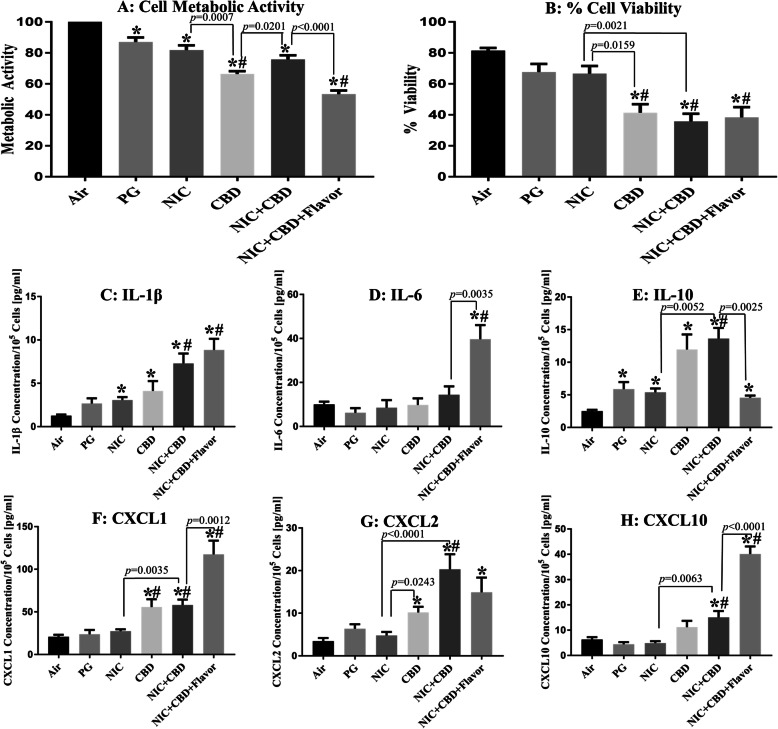
Bronchial epithelial cells (H292) were exposed directly to aerosol generated from electronic cigarettes refilled with propylene glycol only, unflavored nicotine solutions in propylene glycol with and without CBD, as well as to solutions containing only CBD. Cells were also exposed to a commercially available flavored solution containing nicotine and CBD. The in vitro toxicological effects were assessed after exposure using the following methods: 1) a trypan blue exclusion assay (cell viability), 2) neutral red uptake assay (metabolic activity) and 3) ELISA (concentrations of inflammatory mediators).
Unflavored solution containing only CBD was significantly more cytotoxic than unflavored solution containing only nicotine. Unflavored solution containing both CBD and nicotine was significantly more cytotoxic than unflavored solutions with only nicotine. Levels of released cytokines were significantly higher when cells were co-exposed to nicotine and CBD as compared to cells exposed to only nicotine or only CBD. Overall, flavored products showed increased toxicity as compared to unflavored solutions.
This pilot in vitro study suggests independent and additive toxic effects of vaporized nicotine and CBD. Observed toxic effects are accentuated by flavorings. Future studies are needed to determine the potential long-term health consequences of concurrent use of vaporized nicotine and cannabis products.
基于人群的研究表明,同时使用含有尼古丁或大麻素的蒸气产品的比例在不断上升。本初步研究旨在测试电子香烟蒸发的尼古丁香味和无味溶液与大麻二酚(CBD)共同吸入的急性吸入毒性。
支气管上皮细胞(H292)直接暴露于由丙二醇填充的电子烟产生的气溶胶中,同时还暴露于丙二醇中的无味尼古丁溶液中,包括含有和不含有 CBD 的溶液,以及仅含 CBD 的溶液。还将细胞暴露于含有尼古丁和 CBD 的市售香味溶液中。暴露后,采用以下方法评估体外毒理学效应:1)台盼蓝排除试验(细胞活力),2)中性红摄取试验(代谢活性)和 3)ELISA(炎症介质浓度)。
仅含有 CBD 的无味溶液的细胞毒性明显高于仅含有尼古丁的无味溶液。同时含有 CBD 和尼古丁的无味溶液的细胞毒性明显高于仅含有尼古丁的无味溶液。与仅暴露于尼古丁或 CBD 的细胞相比,当细胞同时暴露于尼古丁和 CBD 时,释放的细胞因子水平明显更高。总体而言,与无味溶液相比,调味产品的毒性增加。
本初步体外研究表明,蒸发的尼古丁和 CBD 具有独立和累加的毒性作用。调味剂加剧了观察到的毒性作用。需要进一步研究以确定同时使用蒸发的尼古丁和大麻产品的潜在长期健康后果。