Fu Chengwei, Wu Tong, Shu Qing, Song Aiqun, Jiao Yang
Hubei University of Traditional Chinese Medicine.
Zhuji People's Hospital of Zhejiang Province, Zhuji, China.
Medicine (Baltimore). 2020 Jun 5;99(23):e20301. doi: 10.1097/MD.0000000000020301.
Postoperative nausea and vomiting (PONV) is a common complication after surgery. However, drugs cannot prevent it completely, and acupuncture therapy shows the potential in preventing PONV, yet the best choice hasn't been demonstrated.
This network meta analysis aimed to evaluate the effectiveness of different acupuncture therapies used for preventing PONV in abdominal operation.
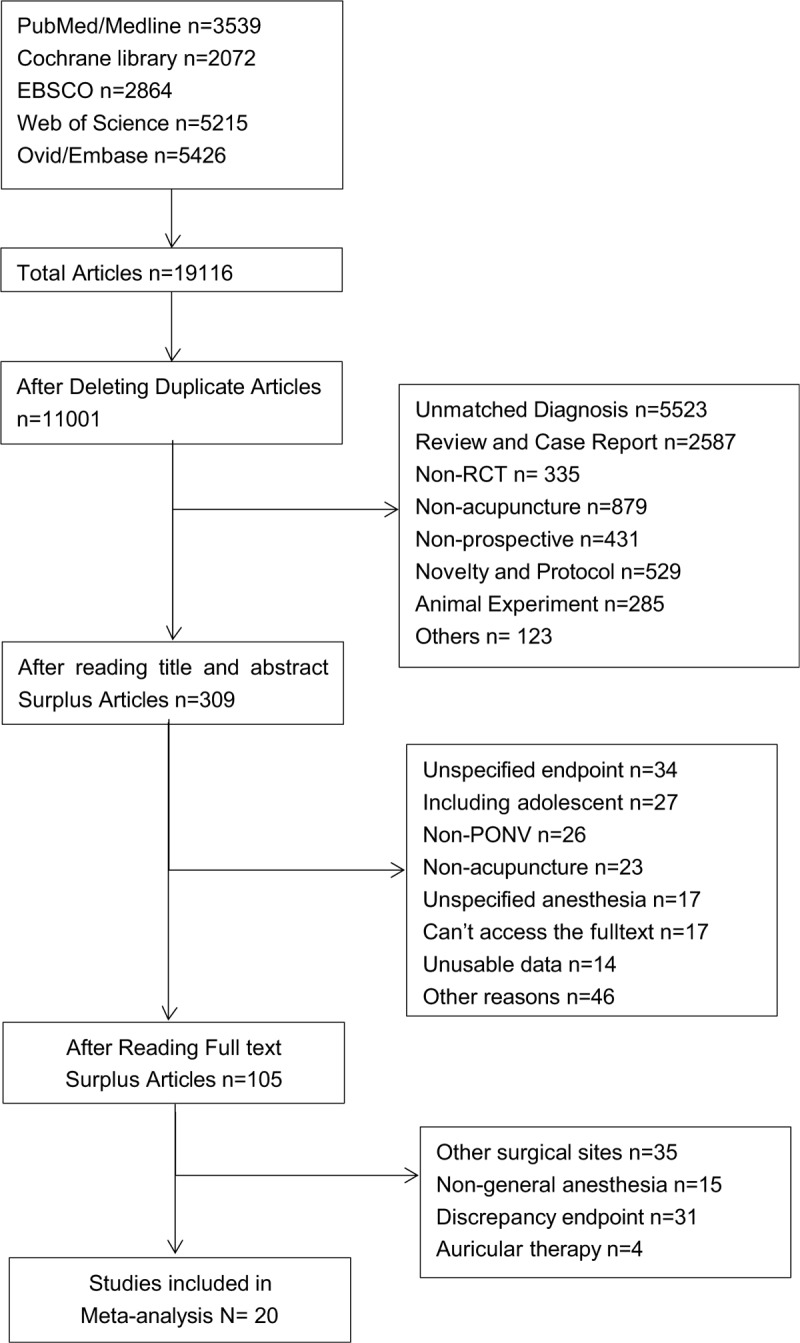
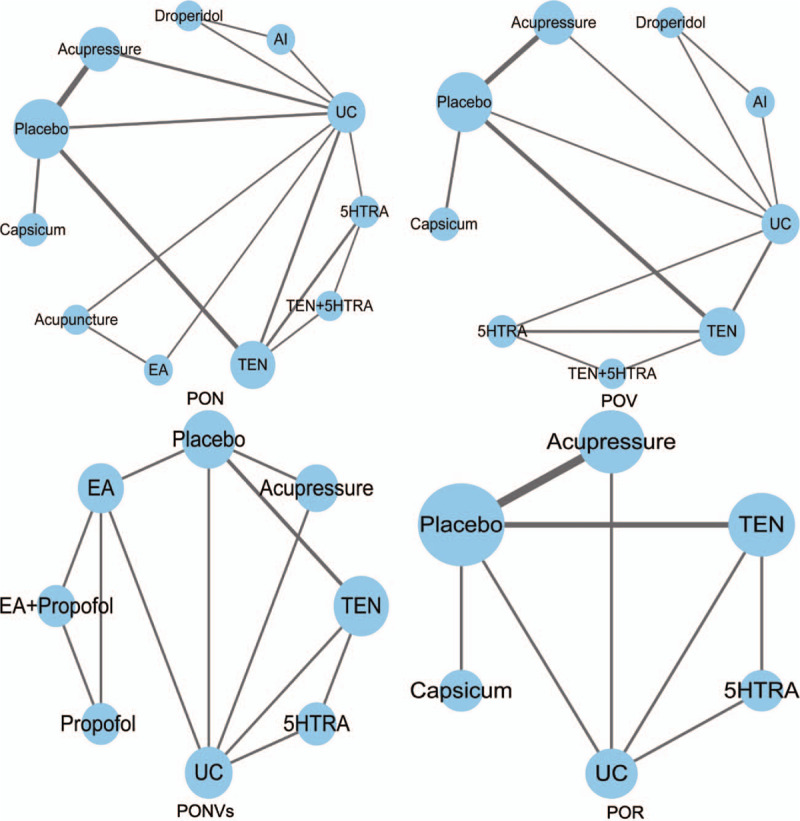
Authors searched articles from PubMed/Medline, Cochrane library, Web of Science, Ebsco and Ovid/Embase, and established database from setup time to June 2019. Quality evaluation of included studies was performed with Cochrane risk-of-bias tool (ROB 2.0). Pairwise and network meta analysis were conducted by RevMan and Addis respectively.
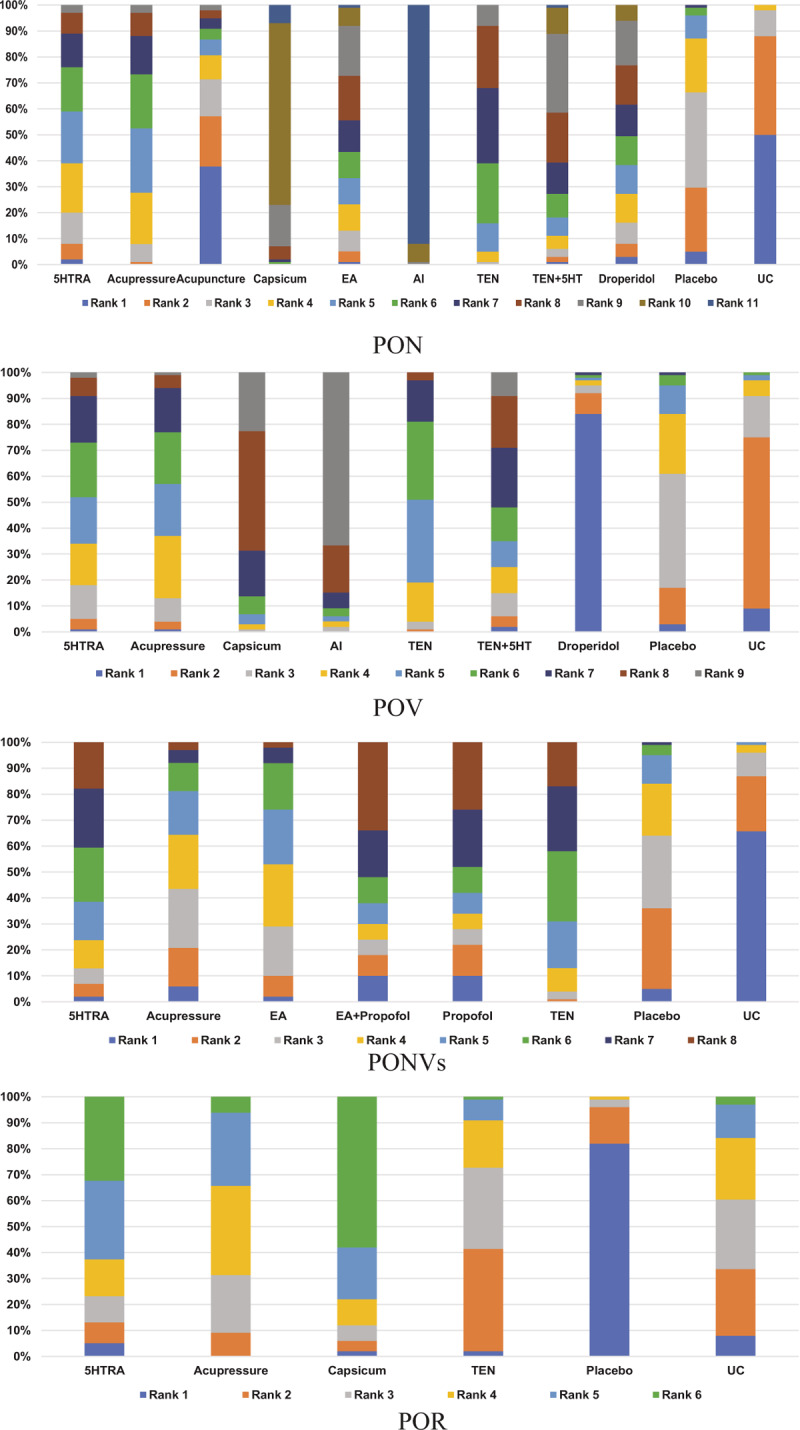
Twenty studies with 2862 patients were included in this research. Pairwise meta analysis shows that compared with placebo, transcutaneous electric nerve stimulation had lower risk of postoperative nausea (PON) (odds ratio (OR) = 0.42, 95%confidence interval (CI): 0.30-0.60), postoperative vomiting (POV) (OR = 0.53, 95%CI: 0.36-0.78), PONVs (OR = 0.46, 95%CI: 0.31-0.68), and postoperative rescue (POR) (OR = 0.61, 95%CI: 0.41-0.90), Capsicum had lower risk of PON (OR = 0.16, 95%CI: 0.09-0.28), PONVs (OR = 0.23, 95%CI: 0.12-0.45), Acupressure had lower risk of POV (OR = 0.42, 95%CI: 0.25-0.70), POR (OR = 0.42, 95%CI: 0.27-0.64). In network meta analysis, compared with usual care, the probability rank suggested that Acupoint Injection showed lowest risk of PON (OR = 0.02, 95%CI: 0.00-0.11), POV (OR = 0.06, 95%CI: 0.01-0.49), Usual care for PONVs (OR = 0.31, 95%CI: 0.13-0.75), and Capsicum for POR (OR = 0.39, 95%CI: 0.07-2.33). Further study should be carried out to verify this result.
Both pairwise and network meta analysis showed acupuncture therapy was superior to placebo and usual care. Different acupuncture therapy regimens may have advantages in different aspects. And compared with POV, PON seems easier to control. Research results may provide guidance for the prevention of PONV.Systematic review registration: PROSPERO CRD42019147556.
术后恶心呕吐(PONV)是手术后常见的并发症。然而,药物并不能完全预防它,针灸疗法在预防PONV方面显示出潜力,但最佳选择尚未得到证实。
本网络荟萃分析旨在评估不同针灸疗法预防腹部手术中PONV的有效性。
作者检索了来自PubMed/Medline、Cochrane图书馆、Web of Science、Ebsco和Ovid/Embase的文章,并建立了从建库时间到2019年6月的数据库。采用Cochrane偏倚风险工具(ROB 2.0)对纳入研究进行质量评估。分别使用RevMan和Addis进行成对和网络荟萃分析。
本研究纳入了20项研究,共2862例患者。成对荟萃分析表明,与安慰剂相比,经皮电刺激神经术后恶心(PON)风险较低(比值比(OR)=0.42,95%置信区间(CI):0.30-0.60),术后呕吐(POV)风险较低(OR = 0.53,95%CI:0.36-0.78),PONV风险较低(OR = 0.46,95%CI:0.31-0.68),以及术后补救(POR)风险较低(OR = 0.61,95%CI:0.41-0.90);辣椒素组PON风险较低(OR = 0.16,95%CI:0.09-0.28),PONV风险较低(OR = 0.23,95%CI:0.12-0.45);指压组POV风险较低(OR = 0.42,95%CI:0.25-0.70),POR风险较低(OR = 0.42,95%CI:0.27-0.64)。在网络荟萃分析中,与常规护理相比,概率排序表明穴位注射显示出最低的PON风险(OR = 0.02,95%CI:0.00-0.11),POV风险(OR = 0.06,95%CI:0.01-0.49),常规护理组的PONV风险(OR = 0.31,95%CI:0.13-0.75),以及辣椒素组的POR风险(OR = 0.39,95%CI:0.07-2.33)。需要进一步研究来验证这一结果。
成对和网络荟萃分析均表明针灸疗法优于安慰剂和常规护理。不同的针灸治疗方案可能在不同方面具有优势。与POV相比,PON似乎更容易控制。研究结果可能为预防PONV提供指导。系统评价注册:PROSPERO CRD42019147556。