Tulyaprawat Orawan, Pharkjaksu Sujiraphong, Chongtrakool Piriyaporn, Ngamskulrungroj Popchai
Department of Microbiology, Faculty of Medicine Siriraj Hospital, Mahidol University, Bangkok, Thailand.
Front Microbiol. 2020 May 19;11:934. doi: 10.3389/fmicb.2020.00934. eCollection 2020.
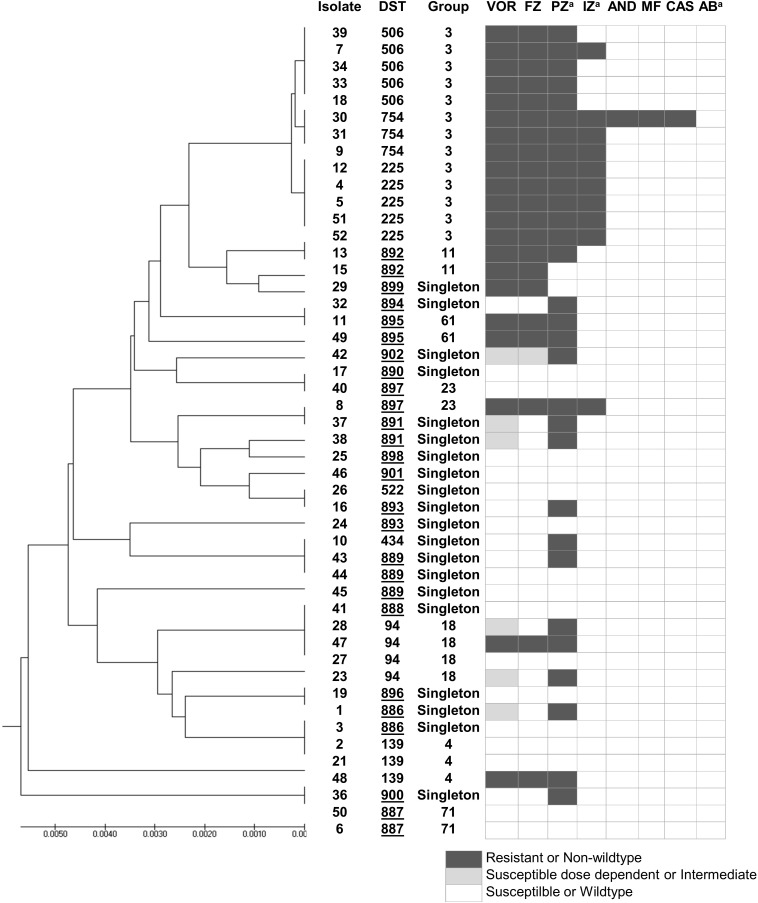
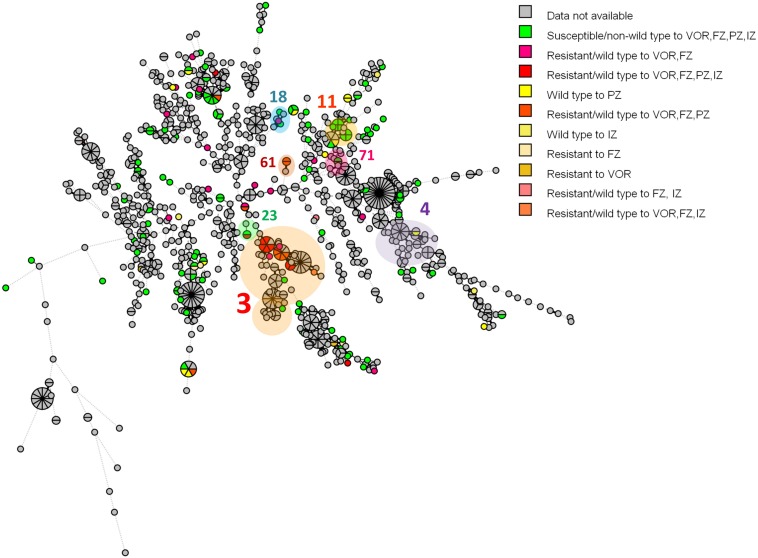
Candidemia, a bloodstream infection caused by genus , has a high mortality rate. was previously reported to be the most common causative species among candidemia patients. However, during the past 10 years in Thailand, has been recovered from blood more frequently than . The cause of this shift in the prevalence of spp. remains unexplored. We conducted virulence studies and antifungal susceptibility profiles of 48 blood isolates collected during 2015-2017. To compare to global isolates of , multilocus sequence typing (MLST), a minimum spanning tree, and an eBURST analysis were also conducted. and were the most (47-48.7%) and second-most (21.5-33.9%) common species to be isolated from candidemia patients, respectively. Of the blood isolates, 29.2, 0, 100, and 93.8% exhibited proteinase activity, phospholipase activity, hemolytic activity, and biofilm formation, respectively. Moreover, 20.8% (10/48) of the isolates were resistant to voriconazole and fluconazole, and also showed high minimum inhibitory concentrations (MICs) to posaconazole and itraconazole. In contrast, most of the isolates were susceptible to anidulafungin (97.9%), micafungin (97.9%), and caspofungin (97.9%), and showed low MICs to amphotericin B (100%) and 5-flucytosine (100%). The MLST identified 22 diploid sequence types. Based on the eBURST analysis and minimum spanning tree, 9 out of 13 members (69.2%) of an eBURST group 3 were resistant to voriconazole and fluconazole, and also showed high MICs to posaconazole and itraconazole. Association analysis revealed the eBURST group 3 was significantly associated with the four triazole resistance ( < 0.001). In conclusion, the eBURST group 3 was associated with the triazole resistance and resistance to many antifungal drugs might be collectively responsible for the prevalence shift.
念珠菌血症是由念珠菌属引起的血流感染,死亡率很高。此前有报道称,念珠菌血症患者中,[具体菌种1]是最常见的致病菌种。然而,在泰国过去10年中,从血液中分离出[具体菌种2]的频率高于[具体菌种1]。念珠菌属菌种流行率的这种变化原因尚不清楚。我们对2015 - 2017年收集的48株[具体菌种2]血液分离株进行了毒力研究和抗真菌药敏分析。为了与全球的[具体菌种2]分离株进行比较,还进行了多位点序列分型(MLST)、最小生成树分析和eBURST分析。[具体菌种1]和[具体菌种2]分别是念珠菌血症患者中最常分离出的(47 - 48.7%)和第二常分离出的(21.5 - 33.9%)菌种。在这些血液分离株中,分别有29.2%、0%、100%和93.8%表现出蛋白酶活性、磷脂酶活性、溶血活性和生物膜形成能力。此外,20.8%(10/48)的分离株对伏立康唑和氟康唑耐药,对泊沙康唑和伊曲康唑也表现出高最低抑菌浓度(MIC)。相比之下,大多数分离株对阿尼芬净(97.9%)、米卡芬净(97.9%)和卡泊芬净(97.9%)敏感,对两性霉素B(100%)和5-氟胞嘧啶(100%)表现出低MIC。MLST鉴定出22种二倍体序列类型。基于eBURST分析和最小生成树,eBURST第3组的13个成员中有9个(69.2%)对伏立康唑和氟康唑耐药,对泊沙康唑和伊曲康唑也表现出高MIC。关联分析显示,eBURST第3组与对四种三唑类药物耐药显著相关(P < 0.001)。总之,eBURST第3组与三唑类耐药相关,对多种抗真菌药物的耐药可能共同导致了流行率的变化。