Braun Dominik, Ezekiel Chibundu N, Marko Doris, Warth Benedikt
Department of Food Chemistry and Toxicology, Faculty of Chemistry, University of Vienna, Vienna, Austria.
Department of Microbiology, Babcock University, Ilishan Remo, Nigeria.
Front Chem. 2020 May 19;8:423. doi: 10.3389/fchem.2020.00423. eCollection 2020.
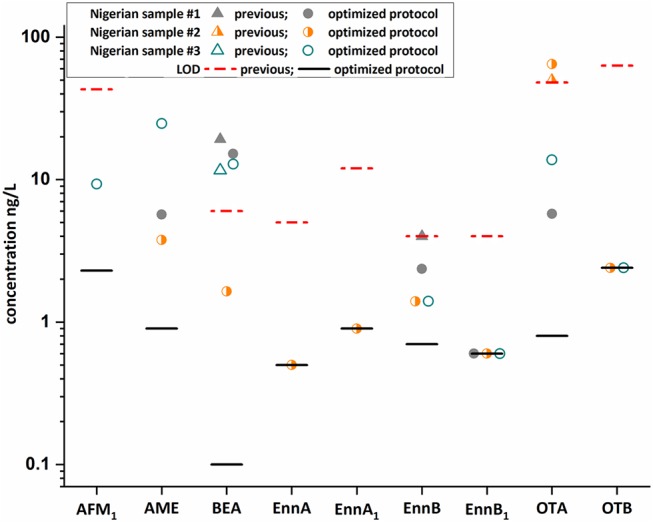
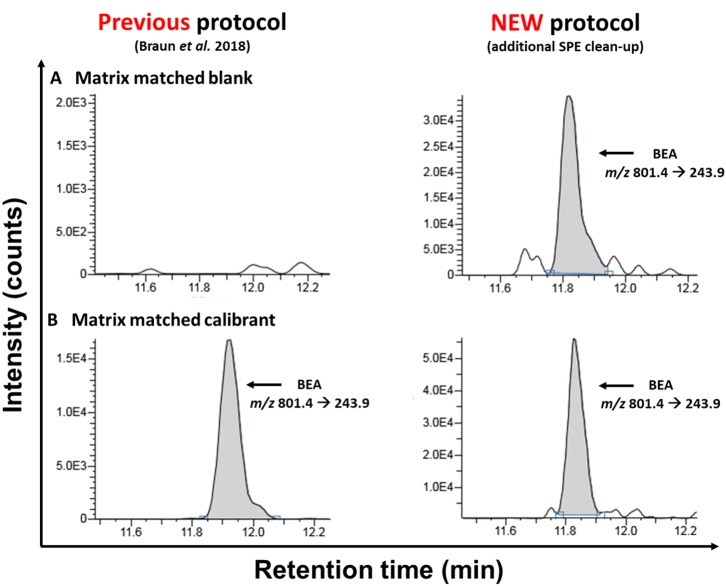
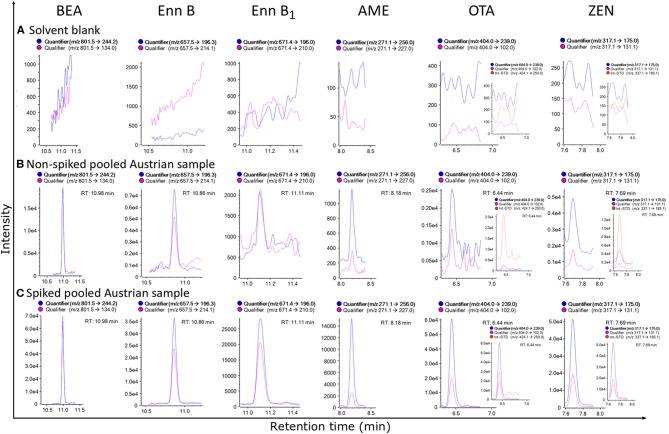
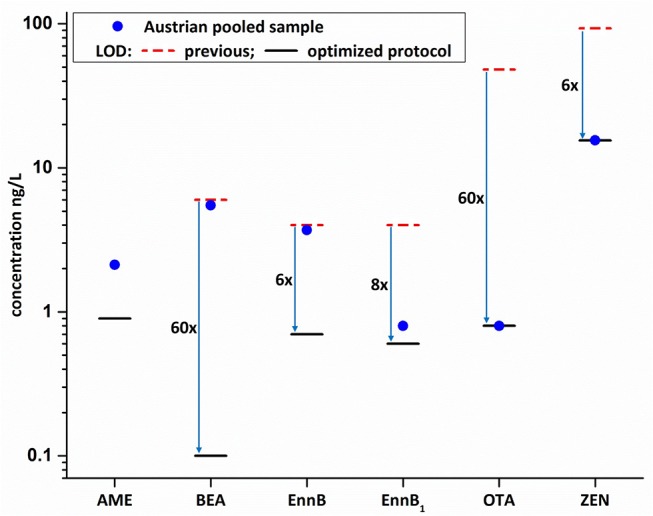
Exposure to natural food contaminants during infancy may influence health consequences later in life. Hence, breast milk may serve as a vehicle to transport these contaminants, including mycotoxins, from mothers to their infants. Analytical methods mostly focused on single exposures in the past, thus neglecting co-occurrences and mixture effects. Here, we present a highly sensitive multi-biomarker approach by a sophisticated combination of steps during sample preparation including a Quick, Easy, Cheap, Effective, Rugged and Safe (QuEChERS) extraction followed by a solid phase extraction (SPE) cleanup and utilizing stable isotopes for compensating challenging matrix effects. The assay was validated in-house, reaching limits of detection (LOD) for all 34 analytes in the range of 0.1 to 300 ng/L with satisfying extraction efficiencies (75-109%) and stable intermediate precisions (1-18%) for most analytes. Compared to a similar multi-mycotoxin assay for breast milk, LOD values were decreased by a factor of 2-60x enabling the assessment of chronic low-dose exposures. The new method was applied to a small set of Nigerian breast milk samples ( = 3) to compare results with already published data. Concentration levels of samples that were found to be contaminated before could be confirmed. In addition, other mycotoxins were determined in all three samples, for example the newly investigated alternariol monomethyl ether (AME) was found for the first time in this biological fluid at concentrations up to 25 ng/L. Moreover, in a pooled Austrian sample obtained from a milk bank, trace amounts of multiple mycotoxins including AME (1.9 ng/L), beauvericin (5.4 ng/L), enniatin B (4.7 ng/L), enniatin B (<LOQ), ochratoxin A (<LOQ) and the estrogenic zearalenone (<LOQ) confirmed co-occurrence and exposure even in a country with high food safety standards. In conclusion, the method facilitates the determination of mycotoxins at ultra-trace levels in breast milk, enabling the generation of occurrence data necessary for comprehensive co-exposure assessment.
婴儿期接触天然食品污染物可能会影响其日后的健康状况。因此,母乳可能是将包括霉菌毒素在内的这些污染物从母亲传递给婴儿的一种载体。过去的分析方法大多集中在单一暴露上,从而忽略了同时存在和混合效应。在此,我们通过在样品制备过程中精心组合多个步骤,提出了一种高灵敏度的多生物标志物方法,包括快速、简便、廉价、高效、耐用且安全(QuEChERS)萃取,随后进行固相萃取(SPE)净化,并利用稳定同位素补偿具有挑战性的基质效应。该检测方法在内部得到验证,所有34种分析物的检测限(LOD)在0.1至300 ng/L范围内,大多数分析物的萃取效率令人满意(75 - 109%),中间精密度稳定(1 - 18%)。与类似的母乳多霉菌毒素检测方法相比,LOD值降低了2至60倍,能够评估慢性低剂量暴露。该新方法应用于一小批尼日利亚母乳样品(n = 3),以将结果与已发表的数据进行比较。之前被发现受污染的样品的浓度水平得到了确认。此外,在所有三个样品中还检测到了其他霉菌毒素,例如新研究的单甲基交替霉素(AME)首次在这种生物体液中被发现,浓度高达25 ng/L。此外,在从一个奶库获得的奥地利混合样品中,检测到了痕量的多种霉菌毒素,包括AME(1.9 ng/L)、白僵菌素(5.4 ng/L)、恩镰孢菌素B(4.7 ng/L)、恩镰孢菌素B(<LOQ)、赭曲霉毒素A(<LOQ)和具有雌激素活性的玉米赤霉烯酮(<LOQ),这证实了即使在食品安全标准较高的国家也存在同时存在和暴露的情况。总之,该方法有助于测定母乳中痕量水平的霉菌毒素,能够生成全面共暴露评估所需的存在数据。