Li Jieqiong, Hao Nan, Han Juan, Zhang Mi, Li Xiaomei, Yang Nan
Department of Nurse, The First Affiliated Hospital of Xi'an Jiaotong University, Xi'an, 710061 Shaanxi China.
Department of Surgical Oncology, The First Affiliated Hospital of Xi'an Jiaotong University, Xi'an, 710061 Shaanxi China.
Cancer Cell Int. 2020 Jun 5;20:216. doi: 10.1186/s12935-020-01307-7. eCollection 2020.
ZKSCAN3, a zinc-finger transcription factor containing KRAB and SCAN domains, has been reported to be regulated in several human cancers. However, its expression and function in hepatocellular carcinoma (HCC) remains unknown.
Expression of ZKSCAN3 in HCC was analyzed by western blotting, immunohistochemistry, and real time PCR. Its correlation with the clinicopathological characteristics and prognosis of HCC patients was analyzed. The effects of ZKSCAN3 on the migration and invasion were determined by Transwell assays. The potential downstream targets of ZKSCAN3 and related molecular mechanisms were clarified by Western blot and dual luciferase reporter assay.
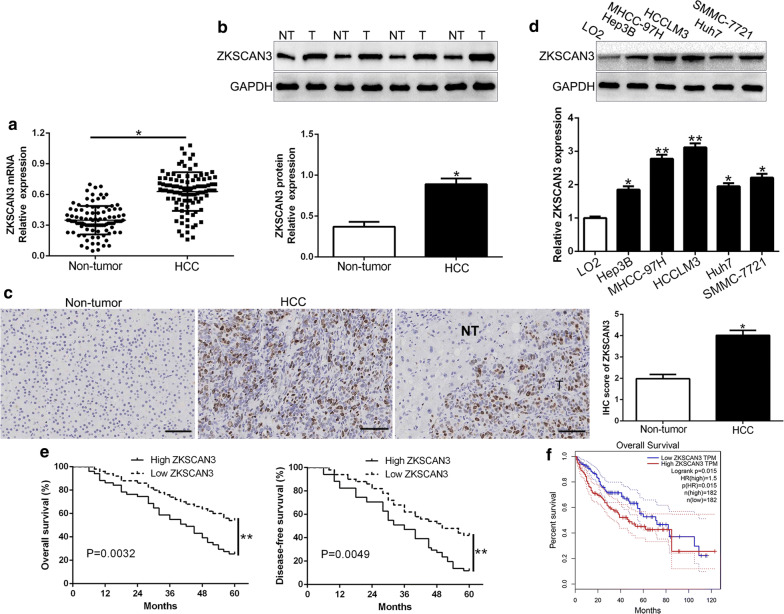
In this study, we demonstrated for the first time that ZKSCAN3 mRNA and protein was up-regulated in HCC tissues and cell lines. High ZKSCAN3 expression was significantly associated with poor prognostic features, including advanced TNM stage and vascular invasion. For 5-year survival, ZKSCAN3 served as a potential prognostic marker of HCC patients. Functionally, ZKSCAN3 promoted migration, invasion and EMT progress via directly binding to integrin β4 (ITGB4) promoter and enhanced its expression. Further investigation proved that ITGB4 triggers the focal adhesion kinase (FAK) to activate the AKT signaling pathway. Inactivation of FAK and AKT by their specific inhibitors respectively reversed the effects of ZKSCAN3 on HCC cells. In addition, we demonstrated that ZKSCAN3 expression was regulated by miR-124. In HCC tissues. MiR-124 has an inverse correlation with ZKSCAN3 expression.
We demonstrate for the first time that ZKSCAN3 is overexpressed in HCC tissues and promotes migration, invasion and EMT process through ITGB4-dependent FAK/AKT activation, which was regulated by miR-124, suggesting the potential therapeutic value for HCC.
ZKSCAN3是一种含有KRAB和SCAN结构域的锌指转录因子,据报道在几种人类癌症中受到调控。然而,其在肝细胞癌(HCC)中的表达和功能仍不清楚。
通过蛋白质免疫印迹法、免疫组织化学和实时PCR分析ZKSCAN3在HCC中的表达。分析其与HCC患者临床病理特征及预后的相关性。通过Transwell实验确定ZKSCAN3对迁移和侵袭的影响。通过蛋白质免疫印迹法和双荧光素酶报告基因检测阐明ZKSCAN3的潜在下游靶点及相关分子机制。
在本研究中,我们首次证明ZKSCAN3 mRNA和蛋白在HCC组织和细胞系中上调。ZKSCAN3高表达与不良预后特征显著相关,包括晚期TNM分期和血管侵犯。对于5年生存率而言,ZKSCAN3是HCC患者的一个潜在预后标志物。在功能上,ZKSCAN3通过直接结合整合素β4(ITGB4)启动子并增强其表达,促进迁移、侵袭和上皮-间质转化进程。进一步研究证明,ITGB4触发粘着斑激酶(FAK)以激活AKT信号通路。分别用其特异性抑制剂使FAK和AKT失活可逆转ZKSCAN3对HCC细胞的影响。此外,我们证明ZKSCAN3的表达受miR-124调控。在HCC组织中,miR-124与ZKSCAN3表达呈负相关。
我们首次证明ZKSCAN3在HCC组织中过表达,并通过ITGB4依赖的FAK/AKT激活促进迁移、侵袭和上皮-间质转化进程,这一过程受miR-124调控,提示其对HCC具有潜在治疗价值。