Department of Microbiology, Immunology, and Genetics University of North Texas Health Science Center, Fort Worth, TX, USA.
Department of Biomedical Engineering, Lerner Research Institute, Cleveland Clinic, Cleveland, OH, USA.
Int J Nanomedicine. 2020 May 22;15:3639-3647. doi: 10.2147/IJN.S250865. eCollection 2020.
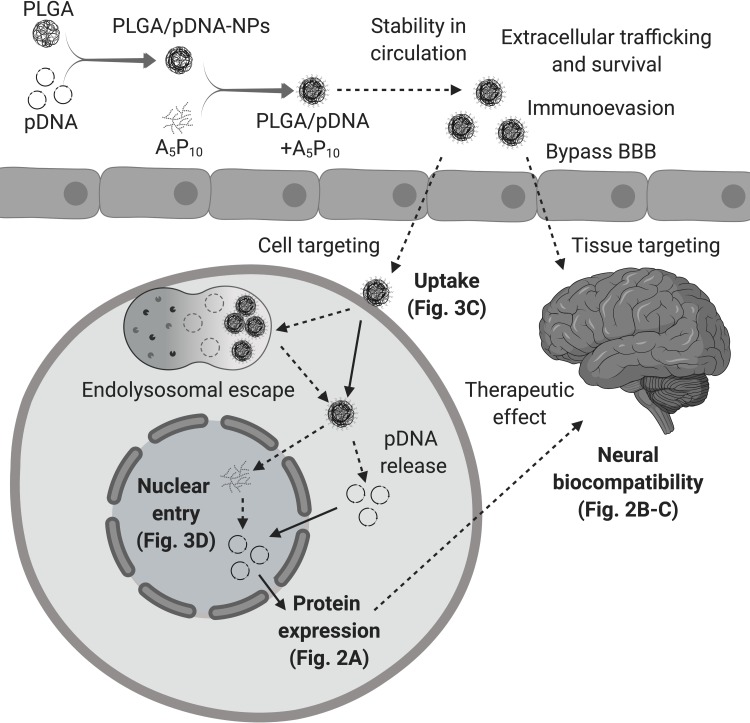
Astrocyte dysfunction is a hallmark of central nervous system injury or infection. As a primary contributor to neurodegeneration, astrocytes are an ideal therapeutic target to combat neurodegenerative conditions. Gene therapy has arisen as an innovative technique that provides excellent prospect for disease intervention. Poly (lactide-co-glycolide) (PLGA) and polyethylenimine (PEI) are polymeric nanoparticles commonly used in gene delivery, each manifesting their own set of advantages and disadvantages. As a clinically approved polymer by the Federal Drug Administration, well characterized for its biodegradability and biocompatibility, PLGA-based nanoparticles (PLGA-NPs) are appealing for translational gene delivery systems. However, our investigations revealed PLGA-NPs were ineffective at facilitating exogenous gene expression in primary human astrocytes, despite their success in other cell lines. Furthermore, PEI polymers illustrate high delivery efficiency but induce cytotoxicity. The purpose of this study is to develop viable and biocompatible NPsystem for astrocyte-targeted gene therapy.
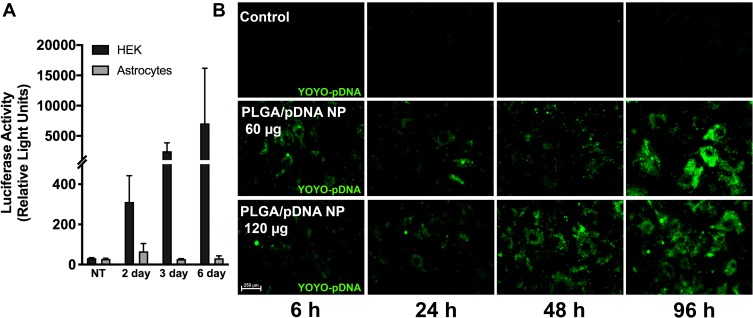
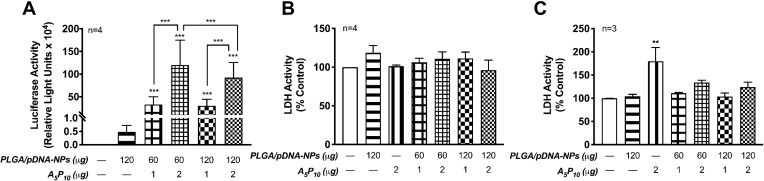
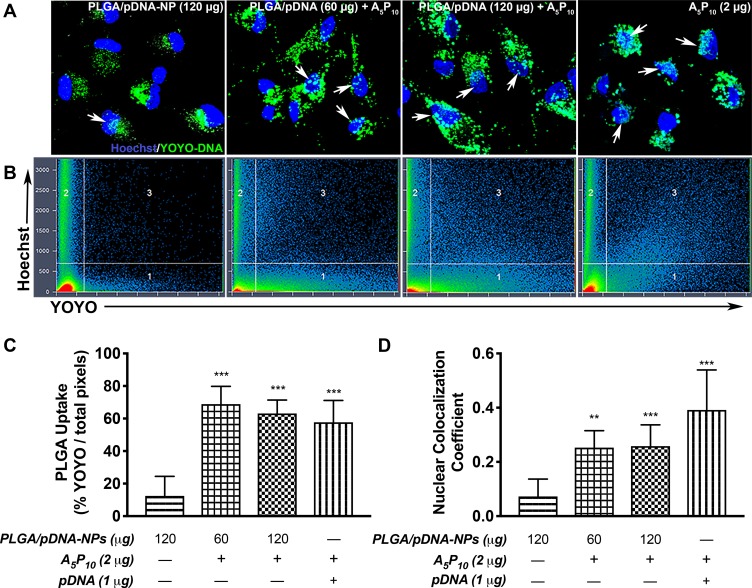
Successful gene expression by PLGA-NPs alone or in combination with arginine-modified PEI polymers (AP) was assessed by a luciferase reporter gene encapsulated in PLGA-NPs. Cytoplasmic release and nuclear localization of DNA were investigated using fluorescent confocal imaging with YOYO-labeled plasmid DNA (pDNA). NP-mediated cytotoxicity was assessed via lactate dehydrogenase in primary human astrocytes and neurons.
Confocal imaging of YOYO-labeled pDNA confirmed PLGA-NPs delivered pDNA to the cytoplasm in a dose and time-dependent manner. However, co-staining revealed pDNA delivered by PLGA-NPs did not localize to the nucleus. The addition of AP significantly improved nuclear localization of pDNA and successfully achieved gene expression in primary human astrocytes. Moreover, these formulations were biocompatible with both astrocytes and neurons.
By co-transfecting two polymeric NPs, we developed an improved system for gene delivery and expression in primary human astrocytes. These findings provide a basis for a biocompatible and clinically translatable method to regulate astrocyte function during neurodegenerative diseases and disorders.
星形胶质细胞功能障碍是中枢神经系统损伤或感染的标志。星形胶质细胞作为神经退行性变的主要贡献者,是对抗神经退行性疾病的理想治疗靶点。基因治疗作为一种创新技术,为疾病干预提供了极好的前景。聚(乳酸-共-乙醇酸)(PLGA)和聚乙烯亚胺(PEI)是常用的基因传递聚合物纳米粒,各有其优缺点。PLGA 基于纳米粒(PLGA-NPs)作为一种经美国食品和药物管理局批准的临床聚合物,以其生物降解性和生物相容性得到了很好的表征,是一种有吸引力的转染基因传递系统。然而,我们的研究表明,PLGA-NPs 不能有效地促进原代人星形胶质细胞中外源基因的表达,尽管它们在其他细胞系中取得了成功。此外,PEI 聚合物显示出高的转染效率,但诱导细胞毒性。本研究旨在开发用于星形胶质细胞靶向基因治疗的可行和生物相容的纳米系统。
通过包裹在 PLGA-NPs 中的荧光素酶报告基因评估 PLGA-NPs 单独或与精氨酸修饰的 PEI 聚合物(AP)联合使用时的基因表达情况。使用 YOYO 标记的质粒 DNA(pDNA)的荧光共焦成像研究 DNA 的细胞质释放和核定位。通过原代人星形胶质细胞和神经元中的乳酸脱氢酶评估 NP 介导的细胞毒性。
YOYO 标记的 pDNA 的共焦成像证实,PLGA-NPs 以剂量和时间依赖的方式将 pDNA 递送到细胞质中。然而,共染色显示 PLGA-NPs 递送来的 pDNA 没有定位到细胞核。AP 的添加显著改善了 pDNA 的核定位,并成功地在原代人星形胶质细胞中实现了基因表达。此外,这些配方对星形胶质细胞和神经元均具有生物相容性。
通过共转染两种聚合物纳米粒,我们开发了一种改进的原代人星形胶质细胞基因转染和表达系统。这些发现为调节神经退行性疾病和障碍期间星形胶质细胞功能提供了一种生物相容和临床可转化的方法。