Sorati Marzieh, Behne Dawn Marie
Department of Psychology, Norwegian University of Science and Technology, Trondheim, Norway.
Front Psychol. 2020 May 29;11:1094. doi: 10.3389/fpsyg.2020.01094. eCollection 2020.
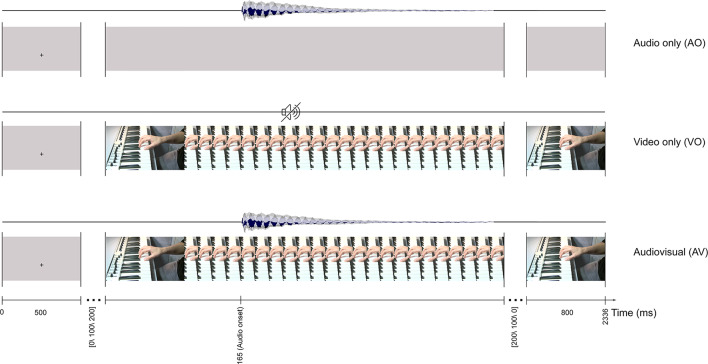
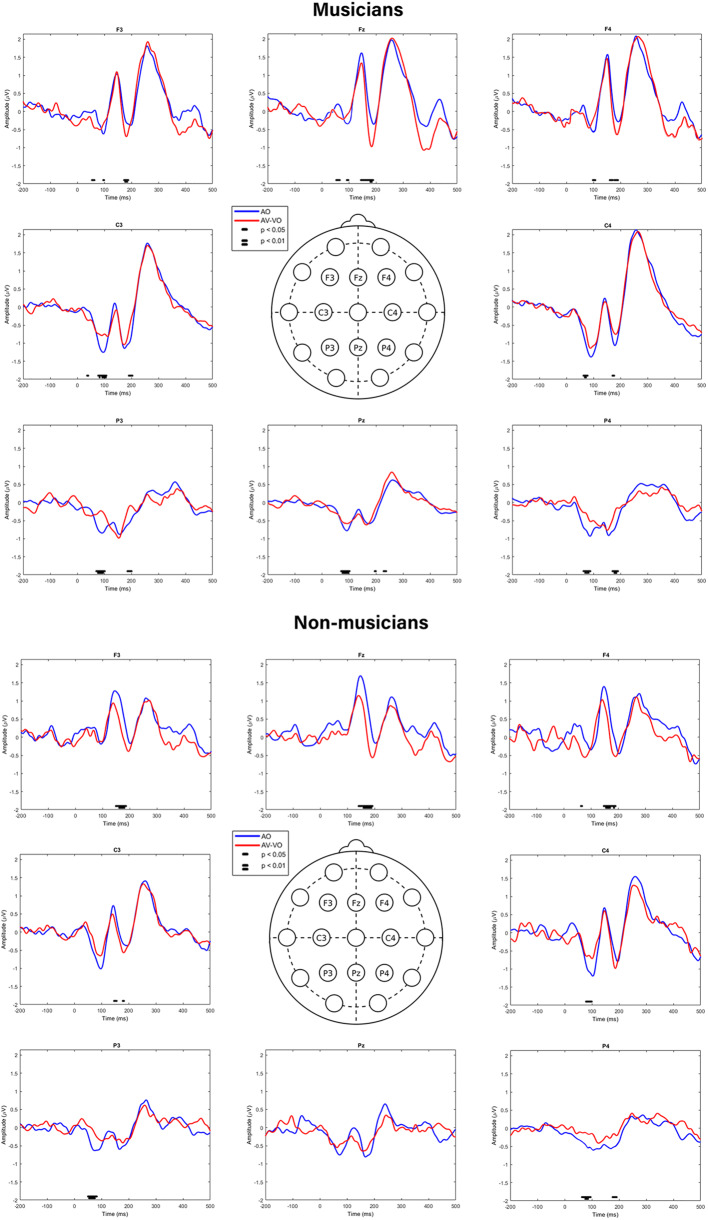
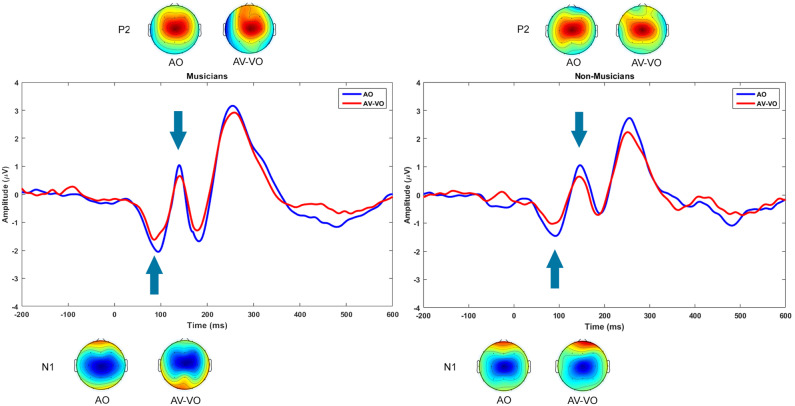
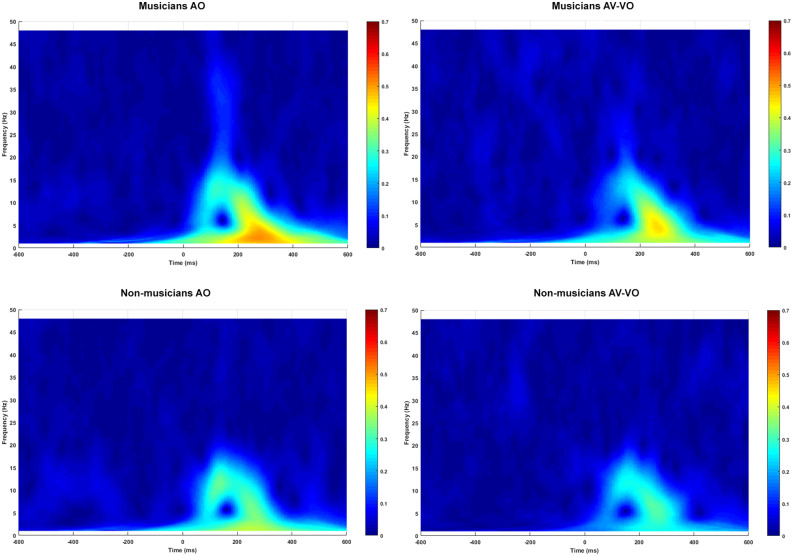
In audiovisual music perception, visual information from a musical instrument being played is available prior to the onset of the corresponding musical sound and consequently allows a perceiver to form a prediction about the upcoming audio music. This prediction in audiovisual music perception, compared to auditory music perception, leads to lower N1 and P2 amplitudes and latencies. Although previous research suggests that audiovisual experience, such as previous musical experience may enhance this prediction, a remaining question is to what extent musical experience modifies N1 and P2 amplitudes and latencies. Furthermore, corresponding event-related phase modulations quantified as inter-trial phase coherence (ITPC) have not previously been reported for audiovisual music perception. In the current study, audio video recordings of a keyboard key being played were presented to musicians and non-musicians in audio only (AO), video only (VO), and audiovisual (AV) conditions. With predictive movements from playing the keyboard isolated from AV music perception (AV-VO), the current findings demonstrated that, compared to the AO condition, both groups had a similar decrease in N1 amplitude and latency, and P2 amplitude, along with correspondingly lower ITPC values in the delta, theta, and alpha frequency bands. However, while musicians showed lower ITPC values in the beta-band in AV-VO compared to the AO, non-musicians did not show this pattern. Findings indicate that AV perception may be broadly correlated with auditory perception, and differences between musicians and non-musicians further indicate musical experience to be a specific factor influencing AV perception. Predicting an upcoming sound in AV music perception may involve visual predictory processes, as well as beta-band oscillations, which may be influenced by years of musical training. This study highlights possible interconnectivity in AV perception as well as potential modulation with experience.
在视听音乐感知中,正在演奏的乐器的视觉信息在相应音乐声音出现之前就已可得,因此使感知者能够对即将到来的音频音乐形成预测。与听觉音乐感知相比,视听音乐感知中的这种预测会导致N1和P2波幅及潜伏期降低。尽管先前的研究表明,视听体验,如先前的音乐体验,可能会增强这种预测,但一个悬而未决的问题是音乐体验在多大程度上会改变N1和P2波幅及潜伏期。此外,以前尚未报道过将作为试验间相位相干性(ITPC)量化的相应事件相关相位调制用于视听音乐感知。在本研究中,向音乐家和非音乐家分别呈现仅音频(AO)、仅视频(VO)和视听(AV)条件下的键盘按键演奏的音频视频记录。通过将与AV音乐感知(AV-VO)分离的键盘演奏的预测动作分离出来,当前研究结果表明,与AO条件相比,两组的N1波幅和潜伏期以及P2波幅均有类似程度的降低,同时在δ、θ和α频段的ITPC值相应较低。然而,与AO条件相比,音乐家在AV-VO条件下的β频段显示出较低的ITPC值,而非音乐家则未表现出这种模式。研究结果表明,AV感知可能与听觉感知广泛相关,音乐家和非音乐家之间的差异进一步表明音乐体验是影响AV感知的一个特定因素。在AV音乐感知中预测即将到来的声音可能涉及视觉预测过程以及β频段振荡,这可能会受到多年音乐训练的影响。本研究强调了AV感知中可能存在的相互联系以及经验的潜在调节作用。