Key Lab of Chinese Medicine Resources Conservation, State Administration of Traditional Chinese Medicine of the People's Republic of China, Institute of Medicinal Plant Development, Chinese Academy of Medical Sciences & Peking Union Medical College, Beijing, 100193, China.
Engineering Research Center of Chinese Medicine Resource, Ministry of Education, Beijing, 100193, China.
BMC Biol. 2020 Jun 18;18(1):63. doi: 10.1186/s12915-020-00795-3.
Plants have evolved a panoply of specialized metabolites that increase their environmental fitness. Two examples are caffeine, a purine psychotropic alkaloid, and crocins, a group of glycosylated apocarotenoid pigments. Both classes of compounds are found in a handful of distantly related plant genera (Coffea, Camellia, Paullinia, and Ilex for caffeine; Crocus, Buddleja, and Gardenia for crocins) wherein they presumably evolved through convergent evolution. The closely related Coffea and Gardenia genera belong to the Rubiaceae family and synthesize, respectively, caffeine and crocins in their fruits.
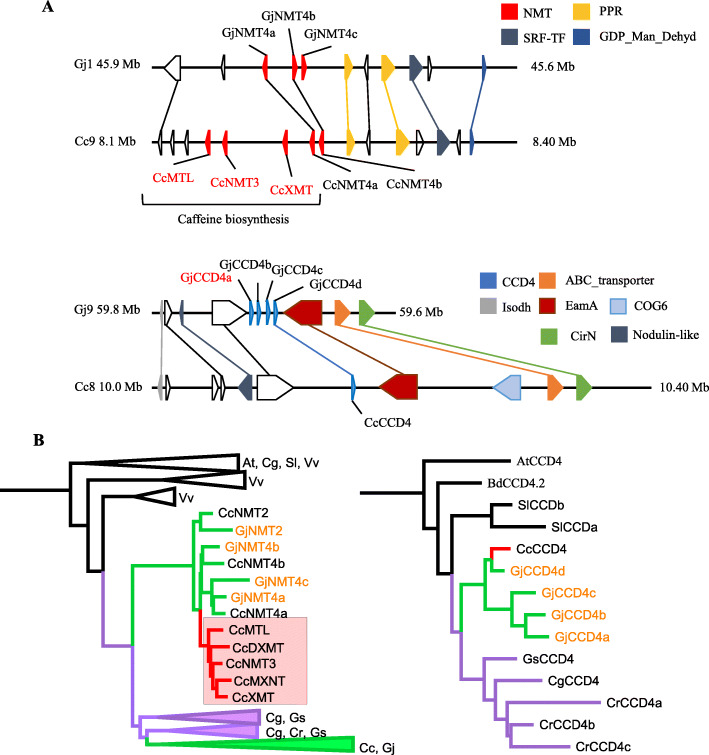
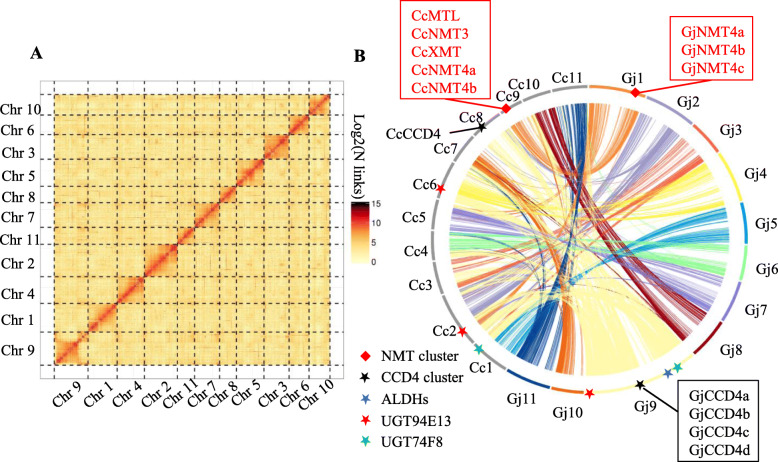
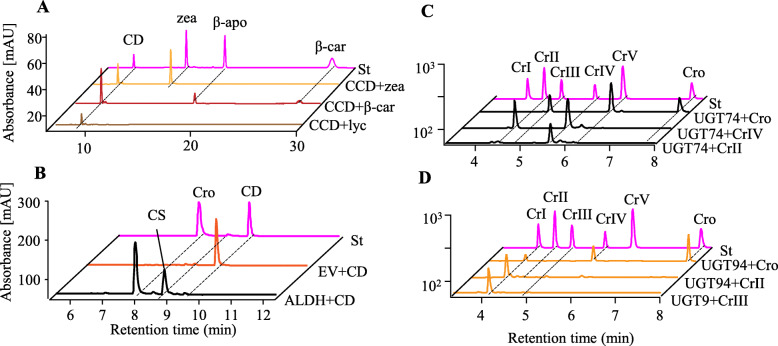
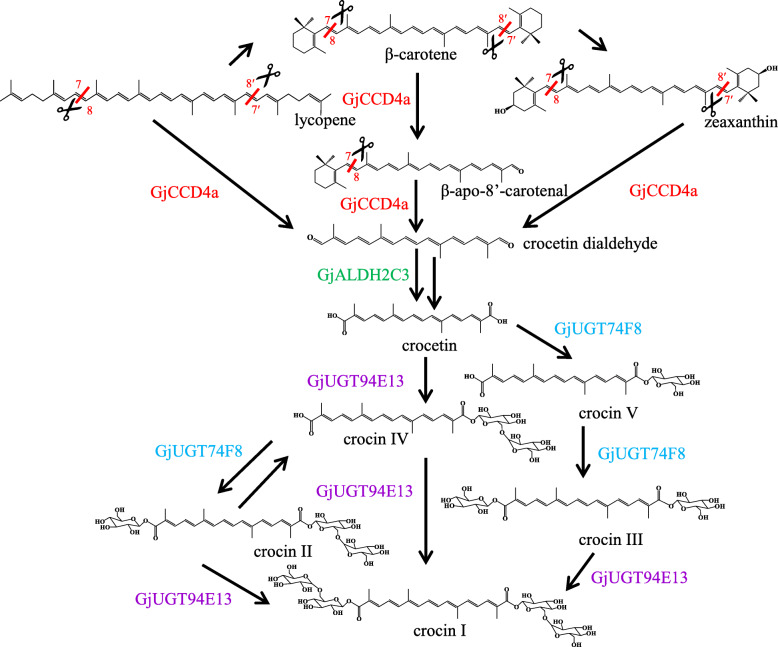
Here, we report a chromosomal-level genome assembly of Gardenia jasminoides, a crocin-producing species, obtained using Oxford Nanopore sequencing and Hi-C technology. Through genomic and functional assays, we completely deciphered for the first time in any plant the dedicated pathway of crocin biosynthesis. Through comparative analyses with Coffea canephora and other eudicot genomes, we show that Coffea caffeine synthases and the first dedicated gene in the Gardenia crocin pathway, GjCCD4a, evolved through recent tandem gene duplications in the two different genera, respectively. In contrast, genes encoding later steps of the Gardenia crocin pathway, ALDH and UGT, evolved through more ancient gene duplications and were presumably recruited into the crocin biosynthetic pathway only after the evolution of the GjCCD4a gene.
This study shows duplication-based divergent evolution within the coffee family (Rubiaceae) of two characteristic secondary metabolic pathways, caffeine and crocin biosynthesis, from a common ancestor that possessed neither complete pathway. These findings provide significant insights on the role of tandem duplications in the evolution of plant specialized metabolism.
植物进化出了多种多样的特殊代谢物,以提高其环境适应性。咖啡因和藏红花素就是两个例子,前者是一种嘌呤类精神活性生物碱,后者是一组糖基化的类胡萝卜素色素。这两类化合物都存在于少数几个远缘植物属中(咖啡属、茶属、蒴莲属和冬青属中有咖啡因;藏红花属、醉鱼草属和栀子属中有藏红花素),它们可能是通过趋同进化而产生的。亲缘关系密切的咖啡属和栀子属都属于茜草科,分别在其果实中合成咖啡因和藏红花素。
我们报道了栀子(Gardenia jasminoides)的染色体水平基因组组装,栀子是一种藏红花素产生物种,该组装是使用牛津纳米孔测序和 Hi-C 技术获得的。通过基因组和功能分析,我们首次在任何植物中完全阐明了藏红花素生物合成的专用途径。通过与咖啡属和其他真双子叶植物基因组的比较分析,我们表明咖啡属咖啡因合酶和栀子藏红花素途径中的第一个专用基因 GjCCD4a,分别在两个不同属中通过最近的串联基因重复进化而来。相比之下,编码栀子藏红花素途径中后续步骤的基因 ALDH 和 UGT,则是通过更古老的基因重复进化而来的,并且仅在 GjCCD4a 基因进化后才被招募到藏红花素生物合成途径中。
本研究表明,在咖啡科(茜草科)中,从一个既没有完整途径又拥有两个特征次生代谢途径(咖啡因和藏红花素生物合成)的共同祖先开始,基于重复的分歧进化发生了。这些发现为串联重复在植物特殊代谢物进化中的作用提供了重要的见解。