Schäfer Sarah, Wentura Dirk, Frings Christian
Cognitive Psychology, University of Trier, D-54286, Trier, Germany.
General Psychology and Statistics, Saarland University, Saarbrücken, Germany.
Atten Percept Psychophys. 2020 Oct;82(7):3750-3766. doi: 10.3758/s13414-020-02070-7.
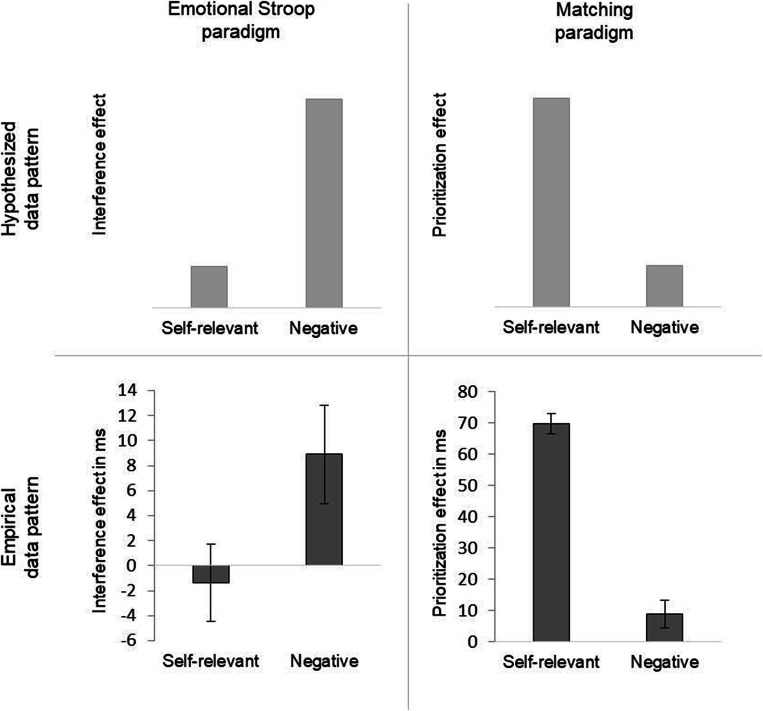
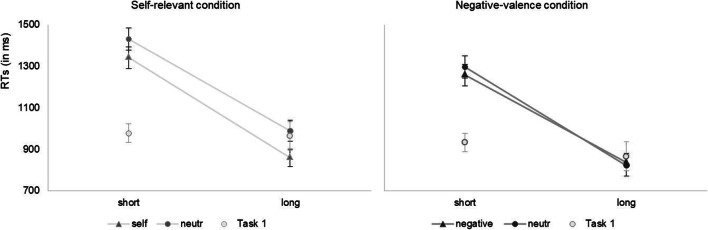
Several factors guide our attention and the way we process our surroundings. In that regard, there is an ongoing debate about the way we are influenced by stimuli that have a particular self-relevance for us. Recent findings suggest that self-relevance does not always capture our attention automatically. Instead, an interpretation of the literature might be that self-relevance serves as an associative advantage facilitating the integration of relevant stimuli into the self-concept. We compared the effect of self-relevant stimuli with the effect of negative stimuli in three tasks measuring different aspects of cognitive processing. We found a first dissociation suggesting that negative valence attracts attention while self-relevance does not, a second dissociation suggesting that self-relevance influences stimulus processing beyond attention-grabbing mechanisms and in the form of an "associative glue," while negative valence does not, and, last but not least, a third dissociation suggesting that self-relevance influences stimulus processing at a later stage than negative valence does.
有几个因素引导着我们的注意力以及我们处理周围环境的方式。在这方面,关于我们如何受到对我们具有特定自我相关性的刺激影响的问题,一直存在着争论。最近的研究结果表明,自我相关性并不总是能自动吸引我们的注意力。相反,对文献的一种解读可能是,自我相关性作为一种联想优势,有助于将相关刺激整合到自我概念中。我们在测量认知加工不同方面的三项任务中,比较了自我相关刺激与负面刺激的效果。我们发现了第一种分离,表明负性效价吸引注意力,而自我相关性则不然;第二种分离表明,自我相关性以“联想粘合剂”的形式,在吸引注意力的机制之外影响刺激加工,而负性效价则不会;最后但同样重要的是,第三种分离表明,自我相关性比负性效价在更晚的阶段影响刺激加工。