Department of Cardiology, Keio University School of Medicine, Shinjuku-ku, Tokyo, Japan.
Center for Molecular Hydrogen Medicine, Keio University, Minato-ku, Tokyo, Japan.
PLoS One. 2020 Jun 19;15(6):e0234626. doi: 10.1371/journal.pone.0234626. eCollection 2020.
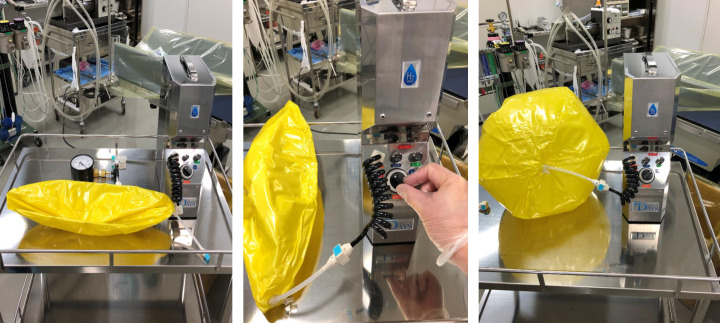
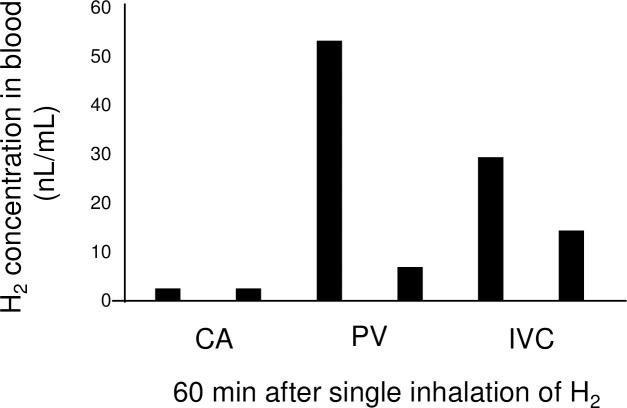
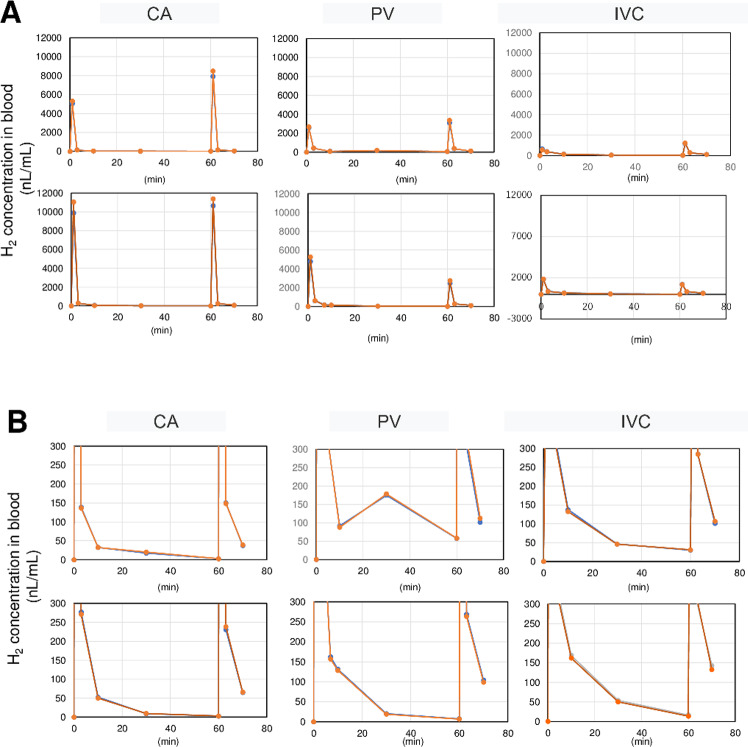
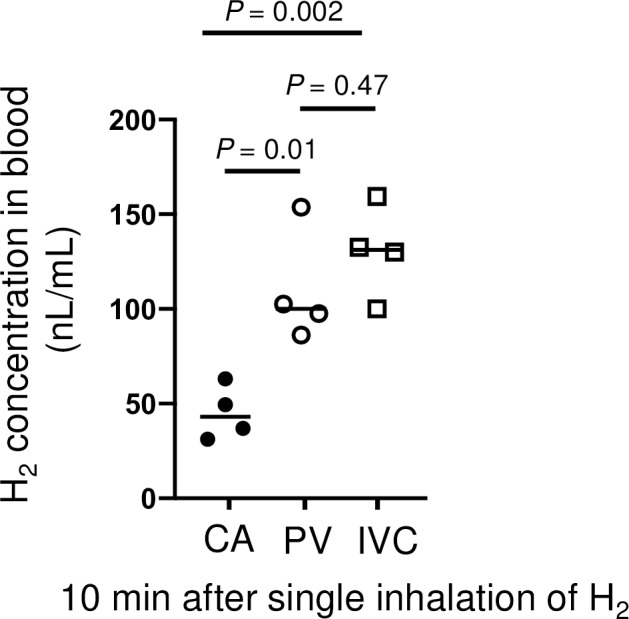
The benefits of inhaling hydrogen gas (H2) have been widely reported but its pharmacokinetics have not yet been sufficiently analyzed. We developed a new experimental system in pigs to closely evaluate the process by which H2 is absorbed in the lungs, enters the bloodstream, and is distributed, metabolized, and excreted. We inserted and secured catheters into the carotid artery (CA), portal vein (PV), and supra-hepatic inferior vena cava (IVC) to allow repeated blood sampling and performed bilateral thoracotomy to collapse the lungs. Then, using a hydrogen-absorbing alloy canister, we filled the lungs to the maximum inspiratory level with 100% H2. The pig was maintained for 30 seconds without resuming breathing, as if they were holding their breath. We collected blood from the three intravascular catheters after 0, 3, 10, 30, and 60 minutes and measured H2 concentration by gas chromatography. H2 concentration in the CA peaked immediately after breath holding; 3 min later, it dropped to 1/40 of the peak value. Peak H2 concentrations in the PV and IVC were 40% and 14% of that in the CA, respectively. However, H2 concentration decay in the PV and IVC (half-life: 310 s and 350 s, respectively) was slower than in the CA (half-life: 92 s). At 10 min, H2 concentration was significantly higher in venous blood than in arterial blood. At 60 min, H2 was detected in the portal blood at a concentration of 6.9-53 nL/mL higher than at steady state, and in the SVC 14-29 nL/mL higher than at steady state. In contrast, H2 concentration in the CA decreased to steady state levels. This is the first report showing that inhaled H2 is transported to the whole body by advection diffusion and metabolized dynamically.
氢气(H2)吸入的益处已被广泛报道,但尚未充分分析其药代动力学。我们在猪中开发了一种新的实验系统,以密切评估氢气在肺部吸收、进入血液以及分布、代谢和排泄的过程。我们将导管插入并固定在颈总动脉(CA)、门静脉(PV)和肝上腔下腔静脉(IVC)中,以便重复采血,并进行双侧开胸以使肺部塌陷。然后,我们使用氢气吸收合金罐将肺部充满 100% H2,达到最大吸气水平。猪在不恢复呼吸的情况下保持 30 秒,就像屏住呼吸一样。我们在 0、3、10、30 和 60 分钟后从三个血管内导管采集血液,并通过气相色谱法测量 H2 浓度。在屏住呼吸后,CA 中的 H2 浓度立即达到峰值;3 分钟后,其下降到峰值的 1/40。PV 和 IVC 中的 H2 峰值浓度分别为 CA 的 40%和 14%。然而,PV 和 IVC 中 H2 浓度的衰减(半衰期:分别为 310 s 和 350 s)比 CA 中慢(半衰期:92 s)。在 10 分钟时,静脉血中的 H2 浓度明显高于动脉血。在 60 分钟时,门静脉中的 H2 浓度比稳态时高 6.9-53 nL/mL,SVC 中的 H2 浓度比稳态时高 14-29 nL/mL。相比之下,CA 中的 H2 浓度降至稳态水平。这是首次报道表明吸入的 H2 通过对流扩散输送到全身,并动态代谢。