Katahira Kenji, Kawakami Ai, Tomita Akitoshi, Nagata Noriko
School of Science and Technology, Kwansei Gakuin University, Sanda, Japan.
Research Center for Kansei Value Creation, Kwansei Gakuin University, Sanda, Japan.
Front Neurosci. 2020 Jun 5;14:590. doi: 10.3389/fnins.2020.00590. eCollection 2020.
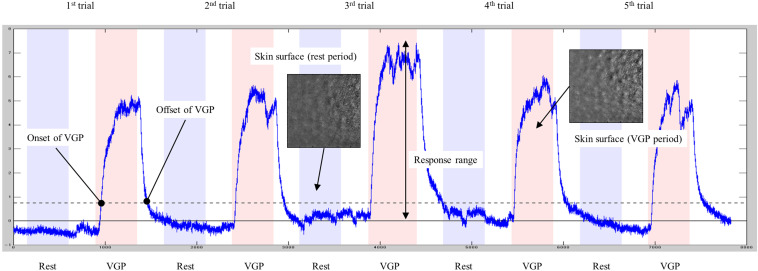
The volitional control of piloerection has been previously reported in a small subset of individuals. Although this ability may be useful to study the mechanism underlying piloerection, there is little existing research on this ability, neither objective evidence at a group-level, nor information about its stability under experimental constraints. The present study aimed to validate existing findings of voluntarily generated piloerection (VGP) and to examine its potential contribution to neuroscientific research based on objective evidence of this ability. In Study 1, to confirm the characteristics of VGP reported in previous studies and identify individuals with VGP capability, an online survey of VGP candidates was conducted. In Study 2, 18 VGP holders participated in a mail-based piloerection measurement experiment, and the nature of VGP was examined based on the objective data obtained by image-based analysis (GooseLab). Study 1 largely confirmed the characteristics of VGP reported in previous studies, and Study 2 demonstrated VGP at a group-level and provided information about the temporal characteristics of this ability, which supports the utility of VGP in neuroscientific research. For some participants, VGP appeared to be emotionally promoted, which suggests that VGP has some relationship with the emotional nature of involuntary piloerection. Although the studies did not tightly control the environment in which VGP was elicited, the findings nonetheless demonstrate the possible contribution of VGP to elucidating the mechanism of involuntary emotional piloerection and the neural basis of piloerection itself.
先前已有报道称一小部分人能够自主控制竖毛反应。尽管这种能力可能有助于研究竖毛反应的潜在机制,但目前针对该能力的研究较少,既缺乏群体层面的客观证据,也没有关于其在实验条件下稳定性的信息。本研究旨在验证自愿产生竖毛反应(VGP)的现有研究结果,并基于该能力的客观证据,探讨其对神经科学研究的潜在贡献。在研究1中,为了确认先前研究中报道的VGP特征,并识别具有VGP能力的个体,我们对VGP候选者进行了在线调查。在研究2中,18名VGP者参与了一项基于邮件的竖毛测量实验,并根据基于图像分析(GooseLab)获得的客观数据,对VGP的本质进行了研究。研究1在很大程度上证实了先前研究中报道的VGP特征,研究2在群体层面展示了VGP,并提供了关于该能力时间特征的信息,这支持了VGP在神经科学研究中的实用性。对于一些参与者来说,VGP似乎受到情绪的促进,这表明VGP与非自愿竖毛反应的情绪本质存在某种关系。尽管这些研究没有严格控制引发VGP的环境,但研究结果仍然证明了VGP在阐明非自愿情绪性竖毛反应机制和竖毛反应本身的神经基础方面的潜在贡献。