Shi Yongchuan, Yuan Tulin, Bell Robin, Wang Jiatong
College of Innovation and Entrepreneurship, Wenzhou University, Wenzhou, China.
College of Education, Wenzhou University, Wenzhou, China.
Front Psychol. 2020 Jun 9;11:1209. doi: 10.3389/fpsyg.2020.01209. eCollection 2020.
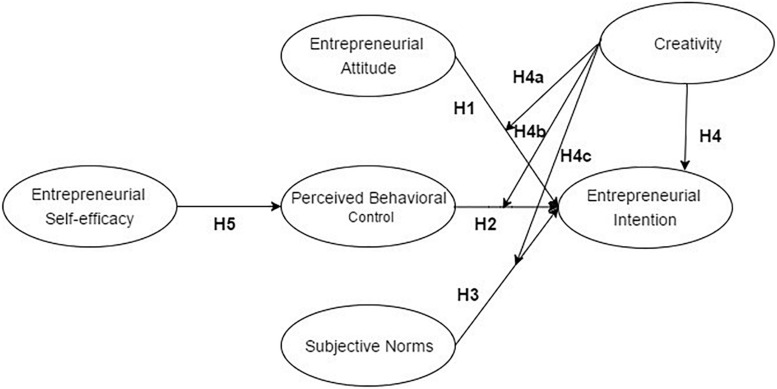
Cultivating students' creativity in entrepreneurship education at the college and university level is a key facet of entrepreneurship education in encouraging innovation in students. In this study, the influence of creativity, self-efficacy, entrepreneurial attitude, perceived control, and subjective norms, on students' entrepreneurial intention were examined through a moderated model based on Ajzen's (1985) Theory of Planned Behavior (TPB). A questionnaire survey was used to obtain the data from 523 students from different universities in China's Zhejiang province. SPSS 20.0 was used to conduct descriptive analysis and exploratory analysis of the data, and Amos 22.0 was used to conduct confirmatory factor analysis. The research concluded that creativity has a significant impact on entrepreneurial intention; entrepreneurial self-efficacy has a marked effect on perceived behavior control; and perceived behavioral control, subjective norms and entrepreneurial attitude all significantly affect entrepreneurial intention. Finally, creativity has a significant moderating effect on the roles of perceived behavioral control and subjective norms on entrepreneurial intention, but not on the attitude to entrepreneurship. These results suggest that entrepreneurship education should focus on the cultivation of students' creativity and entrepreneurial efficacy, while encouraging their entrepreneurial intention as well as developing their entrepreneurial skills and mindset.
在高校创业教育中培养学生的创造力是创业教育鼓励学生创新的一个关键方面。在本研究中,基于阿杰恩(1985)的计划行为理论(TPB),通过一个调节模型检验了创造力、自我效能感、创业态度、感知控制和主观规范对学生创业意向的影响。采用问卷调查的方式从中国浙江省不同高校的523名学生中获取数据。运用SPSS 20.0对数据进行描述性分析和探索性分析,运用Amos 22.0进行验证性因子分析。研究得出结论:创造力对创业意向有显著影响;创业自我效能感对感知行为控制有显著作用;感知行为控制、主观规范和创业态度均对创业意向有显著影响。最后,创造力对感知行为控制和主观规范在创业意向中的作用具有显著的调节效应,但对创业态度没有调节作用。这些结果表明,创业教育应注重培养学生的创造力和创业效能感,同时鼓励他们的创业意向,并培养他们的创业技能和思维方式。