Lai Yalan, Wang Mingshu, Cheng Anchun, Mao Sai, Ou Xumin, Yang Qiao, Wu Ying, Jia Renyong, Liu Mafeng, Zhu Dekang, Chen Shun, Zhang Shaqiu, Zhao Xin-Xin, Huang Juan, Gao Qun, Wang Yin, Xu Zhiwen, Chen Zhengli, Zhu Ling, Luo Qihui, Liu Yunya, Yu Yanling, Zhang Ling, Tian Bin, Pan Leichang, Rehman Mujeeb Ur, Chen Xiaoyue
Institute of Preventive Veterinary Medicine, Sichuan Agricultural University, Chengdu, China.
Key Laboratory of Animal Disease and Human Health of Sichuan Province, Sichuan Agricultural University, Chengdu, China.
Front Microbiol. 2020 Jun 3;11:1145. doi: 10.3389/fmicb.2020.01145. eCollection 2020.
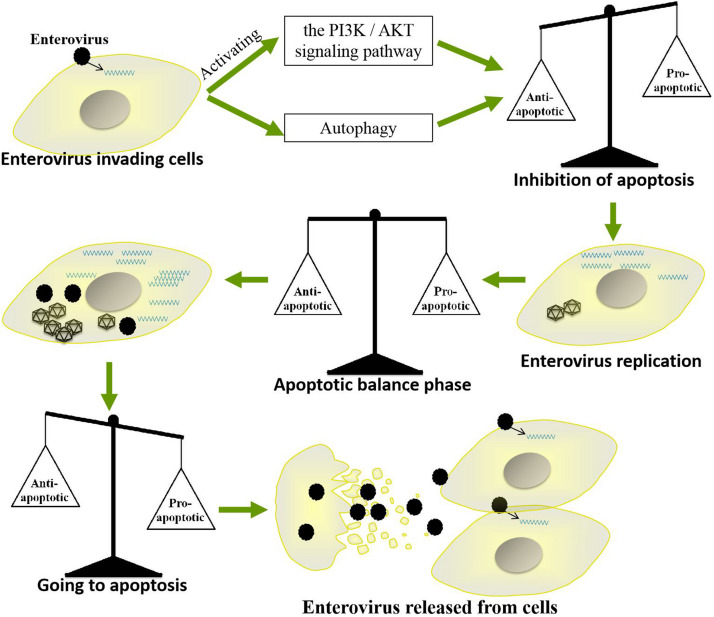
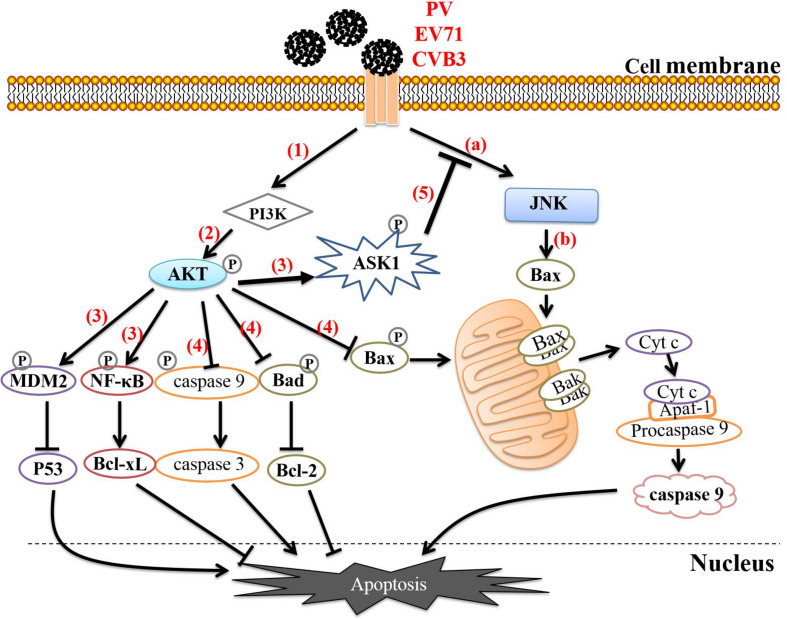
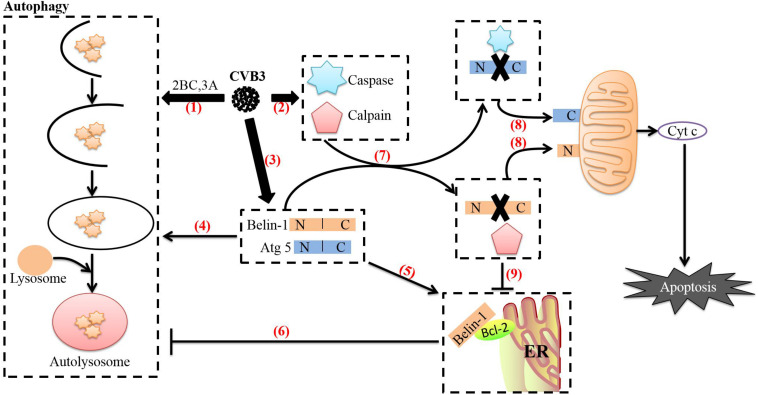
Enterovirus infection can cause a variety of diseases and severely impair the health of humans, animals, poultry, and other organisms. To resist viral infection, host organisms clear infected cells and viruses via apoptosis. However, throughout their long-term competition with host cells, enteroviruses have evolved a series of mechanisms to regulate the balance of apoptosis in order to replicate and proliferate. In the early stage of infection, enteroviruses mainly inhibit apoptosis by regulating the PI3K/Akt pathway and the autophagy pathway and by impairing cell sensors, thereby delaying viral replication. In the late stage of infection, enteroviruses mainly regulate apoptotic pathways and the host translation process via various viral proteins, ultimately inducing apoptosis. This paper discusses the means by which these two phenomena are balanced in enteroviruses to produce virus-favoring conditions - in a temporal sequence or through competition with each other. This information is important for further elucidation of the relevant mechanisms of acute infection by enteroviruses and other members of the picornavirus family.
肠道病毒感染可引发多种疾病,并严重损害人类、动物、家禽及其他生物体的健康。为抵御病毒感染,宿主生物体通过细胞凋亡清除受感染的细胞和病毒。然而,在与宿主细胞的长期竞争过程中,肠道病毒已进化出一系列调节细胞凋亡平衡的机制,以便进行复制和增殖。在感染早期,肠道病毒主要通过调节PI3K/Akt通路和自噬通路以及损害细胞传感器来抑制细胞凋亡,从而延迟病毒复制。在感染后期,肠道病毒主要通过各种病毒蛋白调节凋亡通路和宿主翻译过程,最终诱导细胞凋亡。本文讨论了肠道病毒如何平衡这两种现象以产生有利于病毒的条件——按时间顺序或通过相互竞争。这些信息对于进一步阐明肠道病毒及微小核糖核酸病毒科其他成员急性感染的相关机制具有重要意义。