Canadian Science Centre for Human and Animal Health, Winnipeg, MB, Canada.
J.C. Wilt Infectious Diseases Research Centre, Public Health Agency of Canada, Winnipeg, MB, Canada.
Front Public Health. 2020 Jun 2;8:183. doi: 10.3389/fpubh.2020.00183. eCollection 2020.
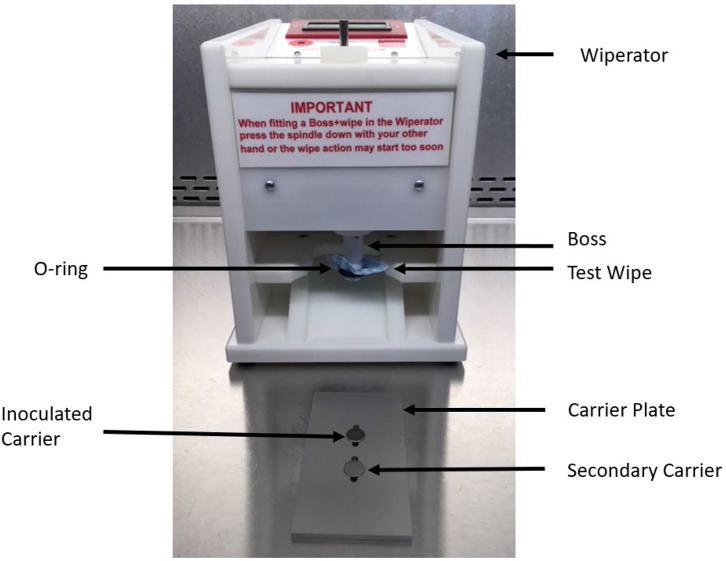
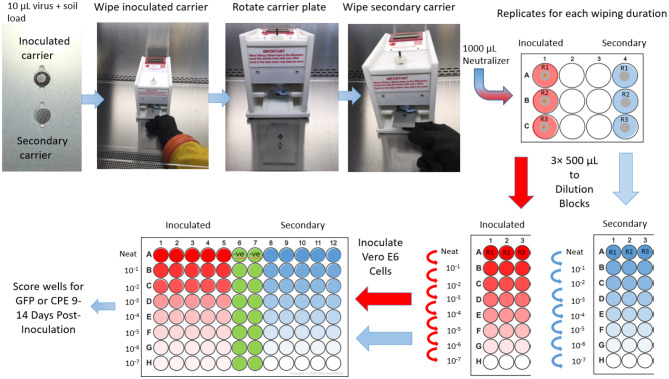
Disinfectant pre-soaked wipes (DPW) containing activated hydrogen peroxide (AHP) or quaternary ammonium compounds (QAC) were tested using ASTM E2967-15 to determine removal, transfer, and inactivation of Ebola virus Makona variant (EBOV/Mak) and vesicular stomatitis virus (VSV) from contaminated stainless steel prototypic environmental surfaces. The infectious virus-contaminated carriers were subjected to wiping in the Wiperator per the standard. Following the use of negative control (J-Cloth)-, AHP-, or QAC-based wipes, recovery of residual infectious virus was assayed. In the case of the J-Cloth wipes (negative control), although removal of virus from inoculated carriers was extensive i.e., 99% (1.9-3.5 log) transfer of virus by these wipes to a secondary surface amounted to ≤ 2% (3.8 log) of the initial virus load. In the case of each DPW, >6 log removal/inactivation of virus was observed, with limited (EBOV/Mak) or no (VSV) virus transfer observed. The efficacy of wipes for decontaminating high-touch environmental surfaces spiked with EBOV/Mak or VSV is discussed. In summary, removal of EBOV/Mak and VSV using wipes was extensive in this study. In the absence of a sufficient concentration and contact time of an appropriate microbicidal active in DPW (such as the AHP- and QAC-based DPW tested), transfer of a low, albeit significant (from an infectious unit/infectious dose perspective), quantity of infectious virus from the inoculated surface to a secondary surface was observed. In the case of Ebola virus, it is essential that a DPW with an appropriate microbicidal active, following the appropriate contact time, be used to prevent unintended transfer of infectious virus to a clean secondary surface (as observed in negative control /J-Cloth). Otherwise, there exists the possibility of dissemination of Ebola virus and the associated risk of transmission of Ebola virus disease.
含活性过氧化氢 (AHP) 或季铵化合物 (QAC) 的消毒剂预浸擦拭巾 (DPW) 按照 ASTM E2967-15 进行了测试,以确定从污染的不锈钢原型环境表面去除、转移和灭活埃博拉病毒马科纳变体 (EBOV/Mak) 和水疱性口炎病毒 (VSV)。受感染病毒污染的载体按照标准在 Wiperator 中进行擦拭。使用阴性对照 (J-Cloth)-、AHP-或 QAC 基擦拭巾后,检测残留传染性病毒的回收情况。在 J-Cloth 擦拭巾(阴性对照)的情况下,尽管从接种载体上清除病毒的效果很显著,即99%(1.9-3.5 对数),但这些擦拭巾将病毒转移到二次表面的病毒量仅占初始病毒负荷的≤2%(3.8 对数)。在每种 DPW 的情况下,观察到 >6 对数的病毒去除/失活,观察到有限的(EBOV/Mak)或没有(VSV)病毒转移。讨论了用于消毒高接触环境表面的擦拭巾对埃博拉病毒/马科纳或水疱性口炎病毒的去污效果。总之,在本研究中,使用擦拭巾清除 EBOV/Mak 和 VSV 的效果非常显著。在 DPW 中没有足够浓度和适当接触时间的适当杀菌活性物质(如测试的 AHP 和 QAC 基 DPW)的情况下,从接种表面到二次表面观察到低但显著(从传染性单位/传染性剂量的角度来看)数量的传染性病毒的转移。在埃博拉病毒的情况下,至关重要的是,在适当的接触时间后,使用含有适当杀菌活性物质的 DPW 来防止传染性病毒意外转移到清洁的二次表面(如在阴性对照/J-Cloth 中观察到的那样)。否则,存在埃博拉病毒传播和埃博拉病毒病传播的相关风险。