Lin Yulan, Hu Zhijian, Alias Haridah, Wong Li Ping
Department of Epidemiology and Health Statistics, Fujian Provincial Key Laboratory of Environment Factors and Cancer, School of Public Health, Fujian Medical University, Fuzhou, China.
Centre for Epidemiology and Evidence-Based Practice, Department of Social and Preventive Medicine, Faculty of Medicine, University of Malaya, Kuala Lumpur, Malaysia.
J Med Internet Res. 2020 Jul 20;22(7):e19982. doi: 10.2196/19982.
An extensive amount of information related to the novel coronavirus (COVID-19) pandemic was disseminated by mass and social media in China. To date, there is limited evidence on how this infodemic may influence psychobehavioral responses to the crisis.
The aim of this study is to assess the psychobehavioral responses to the COVID-19 outbreak and examine their associations with mass and social media exposure.
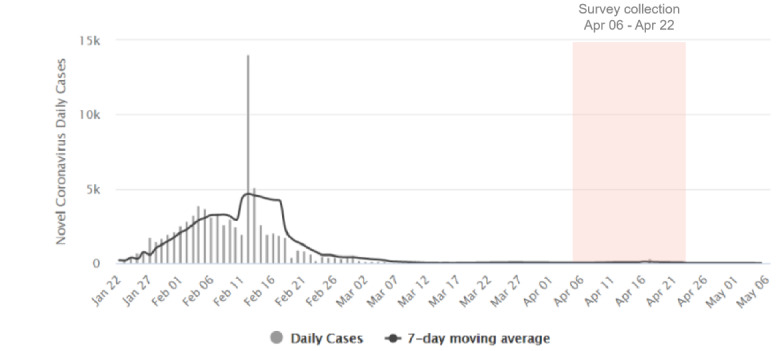
A cross-sectional study among medical and health sciences students from the Fujian Medical University in Fuzhou, China, was conducted between April 6-22, 2020.
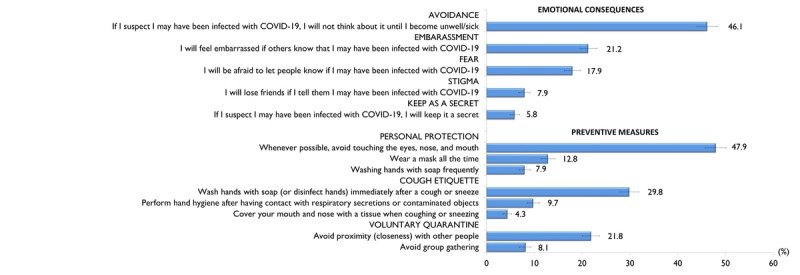
A total of 2086 completed responses were received. Multivariable analyses demonstrated that four constructs of the Health Belief Model (HBM)-higher perception of susceptibility (odds ratio [OR] 1.44; 95% CI 1.07-1.94), severity (OR 1.32; 95% CI 1.10-1.59), self-efficacy (OR 1.61; 95% CI 1.21-2.15), and perceived control or intention to carry out prevention measures (OR 1.32; 95% CI 1.09-1.59)-were significantly associated with a higher mass media exposure score, whereas only three constructs-higher perception of severity (OR 1.43; 95% CI 1.19-1.72), self-efficacy (OR 1.85; 95% CI 1.38-2.48), and perceived control or intention to carry out prevention measures (OR 1.32; 95% CI 1.08-1.58)-were significantly associated with a higher social media exposure score. Lower emotional consequences and barriers to carry out prevention measures were also significantly associated with greater mass and social media exposure. Our findings on anxiety levels revealed that 38.1% (n=795; 95% CI 36.0-40.2) of respondents reported moderate-to-severe anxiety. A lower anxiety level was significantly associated with higher mass and social media exposure in the univariable analyses; however, the associations were not significant in the multivariable analyses.
In essence, both mass and social media are useful means of disseminating health messages and contribute to the betterment of psychobehavioral responses to COVID-19. Our findings stress the importance of the credibility of information shared through mass and social media outlets and viable strategies to counter misinformation during a pandemic.
中国的大众媒体和社交媒体传播了大量与新型冠状病毒(COVID-19)大流行相关的信息。迄今为止,关于这种信息疫情如何影响对危机的心理行为反应的证据有限。
本研究旨在评估对COVID-19疫情的心理行为反应,并检验它们与大众媒体和社交媒体接触之间的关联。
2020年4月6日至22日,在中国福州的福建医科大学对医学和健康科学专业的学生进行了一项横断面研究。
共收到2086份完整回复。多变量分析表明,健康信念模型(HBM)的四个构成要素——更高的易感性认知(比值比[OR]1.44;95%置信区间1.07-1.94)、严重性(OR 1.32;95%置信区间1.10-1.59)、自我效能感(OR 1.61;95%置信区间1.21-2.15)以及对采取预防措施的感知控制或意图(OR 1.32;95%置信区间1.09-1.59)——与更高的大众媒体接触得分显著相关,而只有三个构成要素——更高的严重性认知(OR 1.43;95%置信区间1.19-1.72)、自我效能感(OR 1.85;95%置信区间1.38-2.48)以及对采取预防措施的感知控制或意图(OR 1.32;95%置信区间1.08-1.58)——与更高的社交媒体接触得分显著相关。较低的情绪后果和采取预防措施的障碍也与更多的大众媒体和社交媒体接触显著相关。我们关于焦虑水平的研究结果显示,38.1%(n=795;95%置信区间36.0-40.2)的受访者报告有中度至重度焦虑。在单变量分析中,较低的焦虑水平与更多的大众媒体和社交媒体接触显著相关;然而,在多变量分析中,这些关联并不显著。
从本质上讲,大众媒体和社交媒体都是传播健康信息的有用手段,并有助于改善对COVID-19的心理行为反应。我们的研究结果强调了通过大众媒体和社交媒体渠道分享的信息的可信度以及在大流行期间应对错误信息的可行策略的重要性。