Public Health Ontario, Toronto, Ontario, Canada.
Dalla Lana School of Public Health, University of Toronto, Toronto, Ontario, Canada.
BMC Public Health. 2020 Jun 26;20(1):1017. doi: 10.1186/s12889-020-08771-w.
Quantifying the potential cancer cases associated with environmental carcinogen exposure can help inform efforts to improve population health. This study developed an approach to estimate the environmental burden of cancer and applied it to Ontario, Canada. The purpose was to identify environmental carcinogens with the greatest impact on cancer burden to support evidence-based decision making.
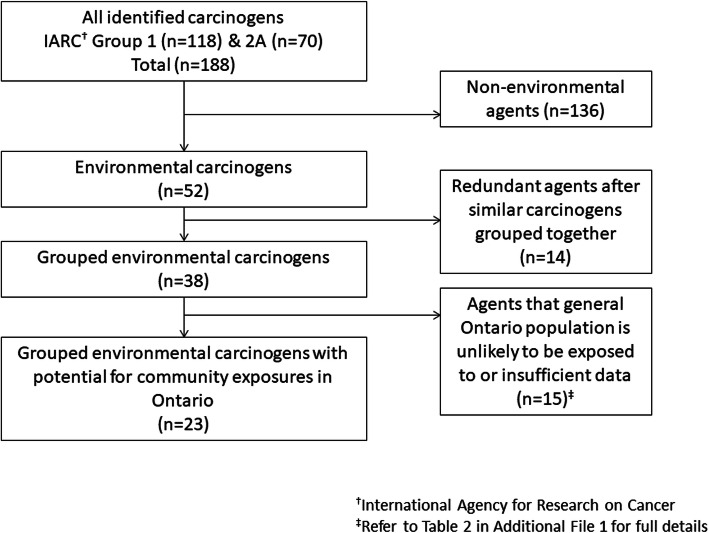
We conducted a probabilistic assessment of the environmental burden of cancer in Ontario. We selected 23 carcinogens that we defined as "environmental" (e.g., pollutants) and were relevant to the province, based on select classifications provided by the International Agency for Research on Cancer. We evaluated population exposure to the carcinogens through inhalation of indoor/outdoor air; ingestion of food, water, and dust; and exposure to radiation. We obtained or calculated concentration-response functions relating carcinogen exposure and the risk of developing cancer. Using both human health risk assessment and population attributable fraction models in a Monte Carlo simulation, we estimated the annual cancer cases associated with each environmental carcinogen, reporting the simulation summary (e.g., mean and percentiles).
We estimated between 3540 and 6510 annual cancer cases attributable to exposure to 23 environmental carcinogens in Ontario. Three carcinogens were responsible for over 90% of the environmental burden of cancer: solar ultraviolet (UV) radiation, radon in homes, and fine particulate matter (PM) in outdoor air. Eight other carcinogens had an estimated mean burden of at least 10 annual cancer cases: acrylamide, arsenic, asbestos, chromium, diesel engine exhaust particulate matter, dioxins, formaldehyde, and second-hand smoke. The remaining 12 carcinogens had an estimated mean burden of less than 10 annual cancer cases in Ontario.
We found the environmental burden of cancer in Ontario to fall between previously estimated burdens of alcohol and tobacco use. These results allow for a comparative assessment across carcinogens and offer insights into strategies to reduce the environmental burden of cancer. Our analysis could be adopted by other jurisdictions and repeated in the future for Ontario to track progress in reducing cancer burden, assess newly classified environmental carcinogens, and identify top burden contributors.
量化与环境致癌物暴露相关的潜在癌症病例有助于为改善人口健康的努力提供信息。本研究开发了一种评估安大略省癌症环境负担的方法。目的是确定对癌症负担影响最大的环境致癌物,以支持基于证据的决策。
我们对安大略省的癌症环境负担进行了概率评估。我们选择了 23 种我们定义为“环境”(例如污染物)的致癌物,并根据国际癌症研究机构提供的特定分类,选择了与该省相关的致癌物。我们通过吸入室内/室外空气、摄入食物、水和灰尘以及暴露于辐射来评估人群对致癌物的暴露情况。我们获得或计算了与致癌物暴露和癌症发病风险相关的浓度-反应函数。我们使用蒙特卡罗模拟中的人类健康风险评估和人群归因分数模型,估计与 23 种环境致癌物暴露相关的每年癌症病例,并报告模拟总结(例如平均值和百分位数)。
我们估计,在安大略省,有 3540 至 6510 例与接触 23 种环境致癌物有关的年度癌症病例。三种致癌物导致了超过 90%的癌症环境负担:太阳紫外线 (UV) 辐射、家庭中的氡和室外空气中的细颗粒物 (PM)。另外八种致癌物的估计平均负担至少有 10 例年度癌症病例:丙烯酰胺、砷、石棉、铬、柴油发动机排气颗粒物、二恶英、甲醛和二手烟。其余 12 种致癌物在安大略省的估计平均负担低于 10 例年度癌症病例。
我们发现安大略省的癌症环境负担介于之前估计的酒精和烟草使用负担之间。这些结果允许对致癌物进行比较评估,并提供了减少癌症环境负担的策略的见解。我们的分析可以被其他司法管辖区采用,并在未来对安大略省进行重复,以跟踪减少癌症负担的进展情况、评估新分类的环境致癌物和确定主要负担来源。