Shi Xuefeng, Zhu Dawei, Nicholas Stephen, Hong Baolin, Man Xiaowei, He Ping
School of Management, Beijing University of Chinese Medicine, Beijing 100029, China.
National Institute of Chinese Medicine Development and Strategy, University of Chinese Medicine, Beijing 100029, China.
Evid Based Complement Alternat Med. 2020 May 31;2020:9313491. doi: 10.1155/2020/9313491. eCollection 2020.
Traditional, complementary, and alternative medicine (TCAM) has attracted increasing attention in developed countries, but its mainstream status in China, the home of TCAM, is unclear. Over the period of 2004-2016, we analyze the health resources and health resource utilization of traditional medicine in traditional Chinese medicine (TCM) hospitals in China.
Over 2004-2016, we obtained data from all TCM hospitals in all Chinese provinces to create a hospital-based, longitudinal dataset. TCM health resources and their utilization were measured by two outcome variables: (1) primary outcome variables comprising the proportion of TCM physicians, TCM pharmacists, revenue from TCM drugs, and TCM prescriptions and (2) the secondary outcome variables, as proxies of westernization for TCM hospitals, comprising the number of medical equipment above RMB 10,000 and the proportion of surgery in inpatient visits. We used linear regression models with hospital-fixed effects to analyze time trends for the outcome variables.
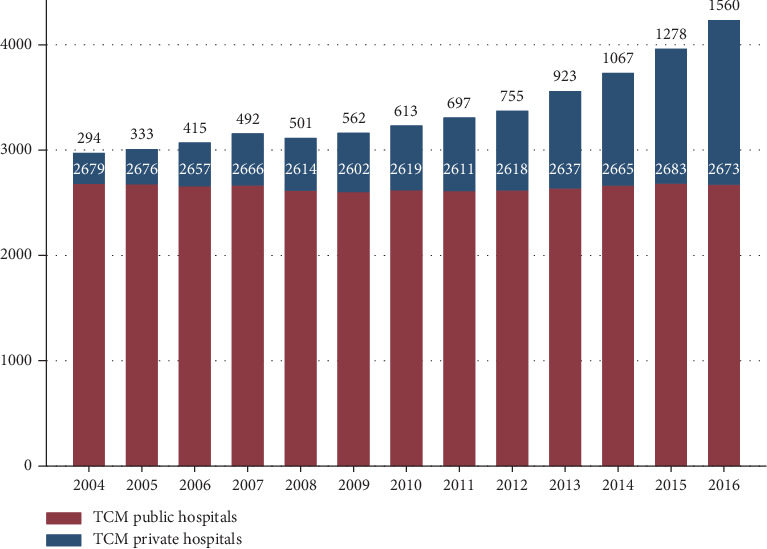
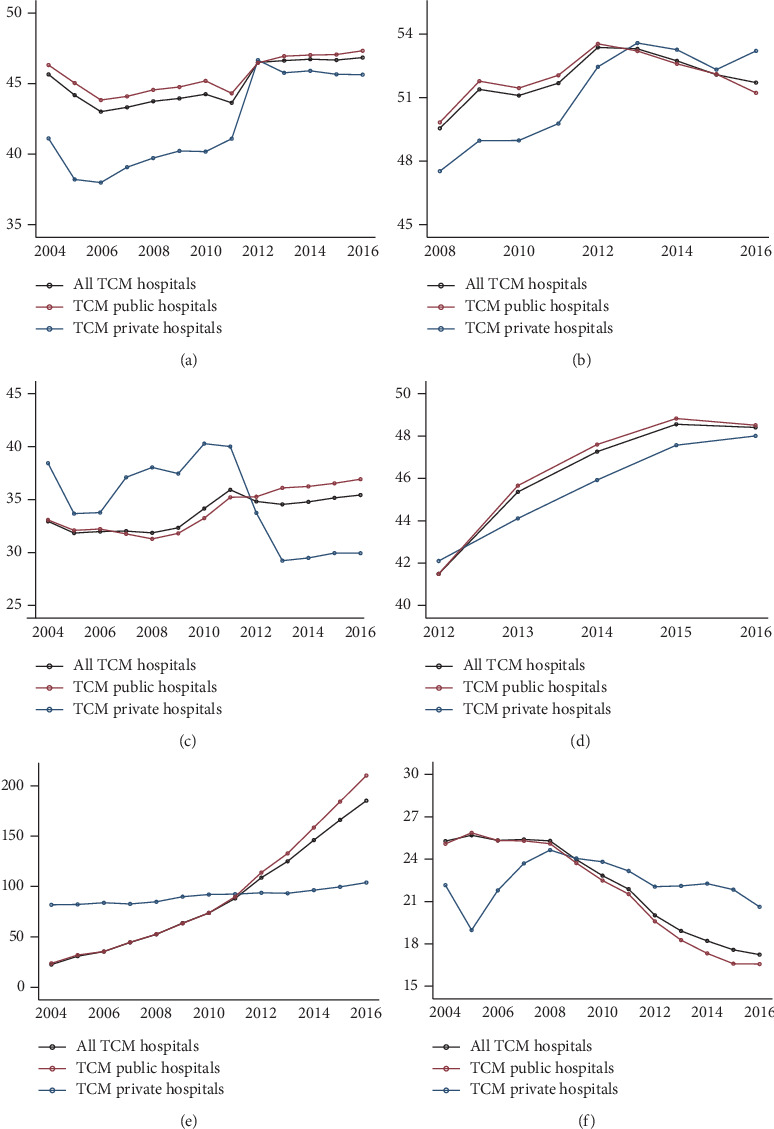
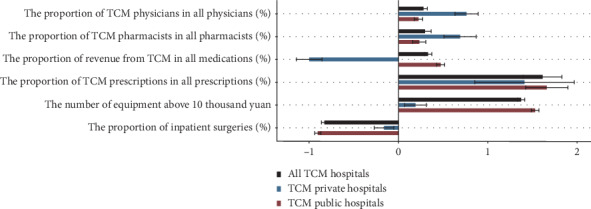
The number of public TCM hospitals remained stable from 2004 to 2016, while the number of private TCM hospitals increased from 294 in 2004 to 1560 in 2016. There was a small percentage increase in the proportion of TCM physicians (0.280%), TCM pharmacists (0.298%), and revenue from Chinese medicines (0.331%) and TCM prescriptions (1.613%) per hospital per year. Chinese drugs accounted for less than a half of the total drug prescriptions, and accordingly, just one-third of the drug revenue was from Chinese medicines at TCM hospitals. The proportions of physicians, pharmacists, revenue from Chinese drug sales, and traditional medicine prescriptions never reach the 60% benchmark target for mainstream in TCM hospitals. As proxies for Western medicine practices in TCM hospitals, the number of medical equipment above RMB 10,000 rapidly rose by over 13 percent per hospital per year, but the proportion of inpatient surgeries declined by 0.830 percentage points per hospital per year, reflecting a mixed trend in the use of Western medicine practices.
For the 2004-2016 period, traditional medicine, although making progress towards the mainstream benchmark of 60% TCM services, was still not mainstream at TCM hospitals.
传统、补充和替代医学(TCAM)在发达国家已引起越来越多的关注,但其在TCAM发源地中国的主流地位尚不明晰。在2004年至2016年期间,我们分析了中国中医医院的传统医学卫生资源及其利用情况。
在2004年至2016年期间,我们获取了中国所有省份的所有中医医院的数据,以创建一个基于医院的纵向数据集。中医卫生资源及其利用情况通过两个结果变量来衡量:(1)主要结果变量,包括中医医师比例、中药师比例、中药收入以及中医处方;(2)次要结果变量,作为中医医院西化的代理指标,包括价值超过1万元的医疗设备数量以及住院就诊中手术的比例。我们使用具有医院固定效应的线性回归模型来分析结果变量的时间趋势。
2004年至2016年期间,公立中医医院数量保持稳定,而私立中医医院数量从2004年的294家增加到2016年的1560家。每家医院每年中医医师比例(0.280%)、中药师比例(0.298%)、中药收入(0.331%)和中医处方(1.613%)均有小幅增长。中药处方占总处方不到一半,因此,中医医院的药品收入中只有三分之一来自中药。中医医院中医师、中药师、中药销售收入和传统医学处方的比例从未达到60%的主流基准目标。作为中医医院西医实践的代理指标,价值超过1万元的医疗设备数量每家医院每年迅速增长超过13%,但住院手术比例每家医院每年下降0.830个百分点,反映出西医实践使用的混合趋势。
在2004年至2016年期间,传统医学尽管朝着中医服务60%的主流基准取得了进展,但在中医医院仍未成为主流。