Hernandez-Quintanar Luis, Rodriguez-Salvador Marisela
Tecnologico de Monterrey, Escuela de Ingenieria y Ciencias, Monterrey, N.L., Mexico.
Int J Bioprint. 2018 Dec 31;5(1):178. doi: 10.18063/IJB.v5i1.178. eCollection 2019.
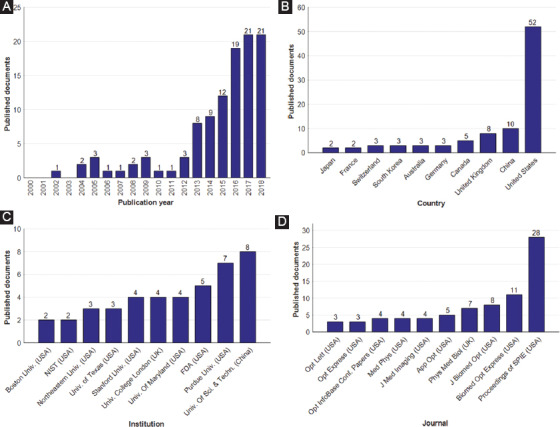
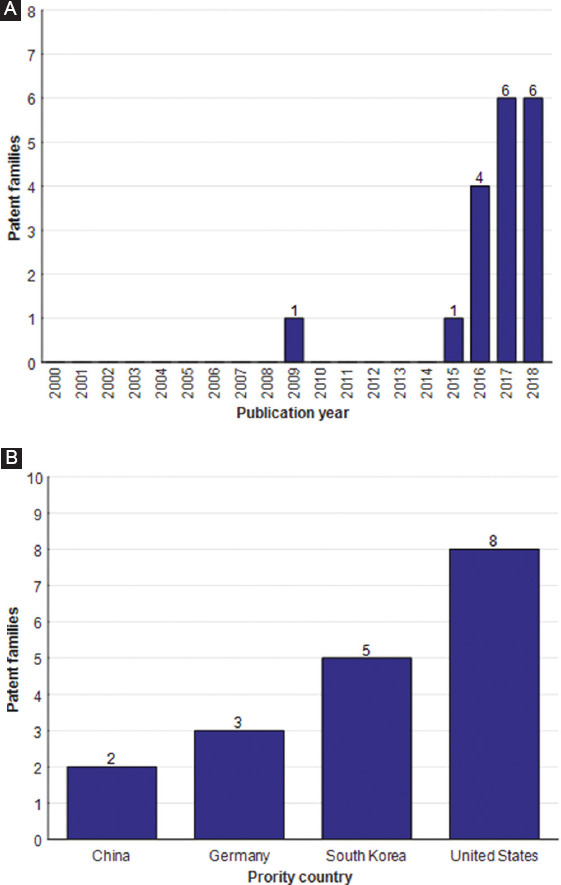
Optical tissue phantoms enable to mimic the optical properties of biological tissues for biomedical device calibration, new equipment validation, and clinical training for the detection, and treatment of diseases. Unfortunately, current methods for their development present some problems, such as a lack of repeatability in their optical properties. Where the use of three-dimensional (3D) printing or 3D bioprinting could address these issues. This paper aims to evaluate the use of this technology in the development of optical tissue phantoms. A competitive technology intelligence methodology was applied by analyzing Scopus, Web of Science, and patents from January 1, 2000, to July 31, 2018. The main trends regarding methods, materials, and uses, as well as predominant countries, institutions, and journals, were determined. The results revealed that, while 3D printing is already employed (in total, 108 scientific papers and 18 patent families were identified), 3D bioprinting is not yet applied for optical tissue phantoms. Nevertheless, it is expected to have significant growth. This research gives biomedical scientists a new window of opportunity for exploring the use of 3D bioprinting in a new area that may support testing of new equipment and development of techniques for the diagnosis and treatment of diseases.
光学组织模拟体能够模拟生物组织的光学特性,用于生物医学设备校准、新设备验证以及疾病检测和治疗的临床培训。不幸的是,目前其开发方法存在一些问题,比如光学特性缺乏可重复性。而三维(3D)打印或3D生物打印的应用可能会解决这些问题。本文旨在评估该技术在光学组织模拟体开发中的应用。通过分析2000年1月1日至2018年7月31日期间的Scopus数据库、科学引文索引数据库及专利,采用了一种具有竞争力的技术情报方法。确定了有关方法、材料和用途的主要趋势,以及主要国家、机构和期刊。结果显示,虽然3D打印已被应用(共识别出108篇科学论文和18个专利族),但3D生物打印尚未应用于光学组织模拟体。不过,预计其将有显著增长。这项研究为生物医学科学家提供了一个新的机会窗口,以探索3D生物打印在一个可能支持新设备测试以及疾病诊断和治疗技术开发的新领域中的应用。