Minden-Birkenmaier Benjamin A, Smith Richard A, Radic Marko Z, van der Merwe Marie, Bowlin Gary L
Department of Biomedical Engineering, University of Memphis, 330 Engineering Technology Building, Memphis, TN 38152, USA.
Department of Orthopaedic Surgery & Biomedical Engineering, University of Tennessee Health Science Center, E228A Coleman Building, 956 Court Avenue, Memphi, TN 38163, USA.
Polymers (Basel). 2020 Jun 26;12(6):1430. doi: 10.3390/polym12061430.
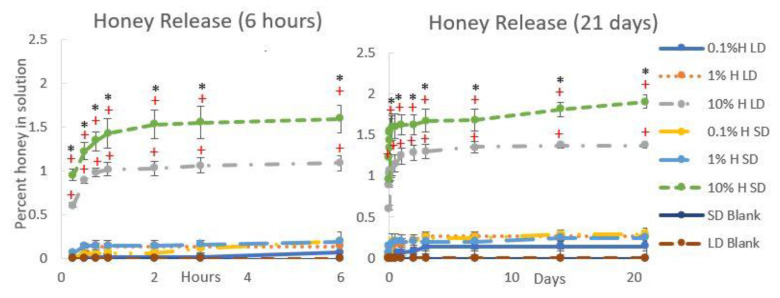
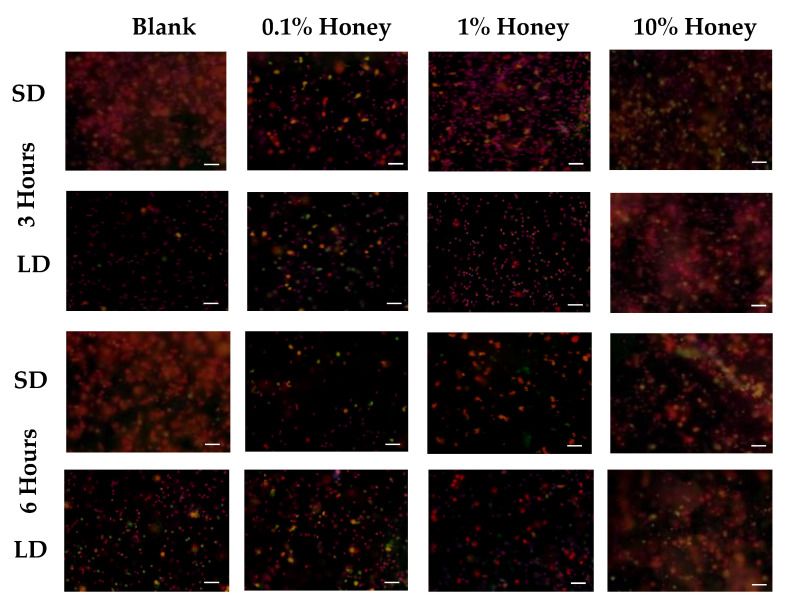
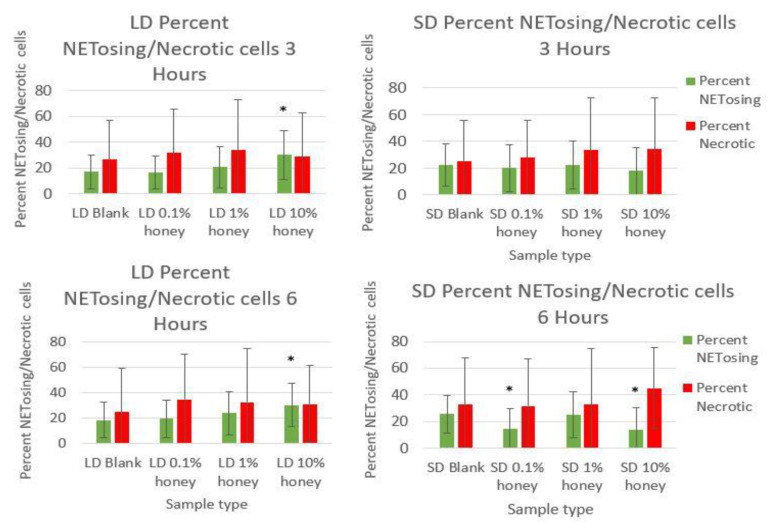
Manuka honey, a topical wound treatment used to eradicate bacteria, resolve inflammation, and promote wound healing, is a focus in the tissue engineering community as a tissue template additive. However, its effect on neutrophil extracellular trap formation (NETosis) on a tissue engineering template has yet to be examined. As NETosis has been implicated in chronic inflammation and fibrosis, the reduction in this response within the wound environment is of interest. In this study, Manuka honey was incorporated into electrospun templates with large (1.7-2.2 µm) and small (0.25-0.5 µm) diameter fibers at concentrations of 0.1%, 1%, and 10%. Template pore sizes and honey release profiles were quantified, and the effect on the NETosis response of seeded human neutrophils was examined through fluorescence imaging and myeloperoxidase (MPO) analysis. The incorporation of 0.1% and 1% Manuka honey decreased NETosis on the template surface at both 3 and 6 h, while 10% honey exacerbated the NETosis response. Additionally, 0.1% and 1% Manuka honey reduced the MMP-9 release of the neutrophils at both timepoints. These data indicate a therapeutic window for Manuka honey incorporation into tissue engineering templates for the reduction in NETosis. Future in vivo experimentation should be conducted to translate these results to a physiological wound environment.
麦卢卡蜂蜜作为一种用于根除细菌、消除炎症和促进伤口愈合的局部伤口治疗方法,作为一种组织模板添加剂,是组织工程领域的一个研究重点。然而,其对组织工程模板上中性粒细胞胞外诱捕网形成(NETosis)的影响尚未得到研究。由于NETosis与慢性炎症和纤维化有关,因此在伤口环境中减少这种反应具有重要意义。在本研究中,将麦卢卡蜂蜜以0.1%、1%和10%的浓度掺入具有大直径(1.7-2.2微米)和小直径(0.25-0.5微米)纤维的电纺模板中。对模板孔径和蜂蜜释放曲线进行了量化,并通过荧光成像和髓过氧化物酶(MPO)分析研究了其对接种的人中性粒细胞NETosis反应的影响。掺入0.1%和1%的麦卢卡蜂蜜在3小时和6小时时均降低了模板表面的NETosis,而10%的蜂蜜则加剧了NETosis反应。此外,0.1%和1%的麦卢卡蜂蜜在两个时间点均降低了中性粒细胞的MMP-9释放。这些数据表明,将麦卢卡蜂蜜掺入组织工程模板以减少NETosis存在一个治疗窗口。未来应进行体内实验,将这些结果转化到生理伤口环境中。