Wang Gang, Yang Yan, Wang Chunfeng, Huang Jianzhong, Wang Xiao, Liu Ying, Wang Hao
Department of Anesthesiology, Tianjin First Central Hospital, Tianjin, China.
Department of Anesthesiology, First People's Hospital, Wuhan, Hubei, China.
Korean J Pain. 2020 Jul 1;33(3):216-225. doi: 10.3344/kjp.2020.33.3.216.
Garlic oil is a rich source of organosulfur compounds including diallyl disulfide and diallyl trisulfide. There have been studies showing the neuroprotective actions of these organosulfur compounds. However, the potential of these organosulfur compounds in neuropathic pain has not been explored. The present study was aimed at investigating the pain attenuating potential of diallyl disulfide and diallyl trisulfide in chronic constriction injury (CCI)-induced neuropathic pain in rats. The study also explored their pain-attenuating mechanisms through modulation of HS, brain-derived neurotrophin factor (BDNF) and nuclear factor erythroid 2-related factor 2 (Nrf2).
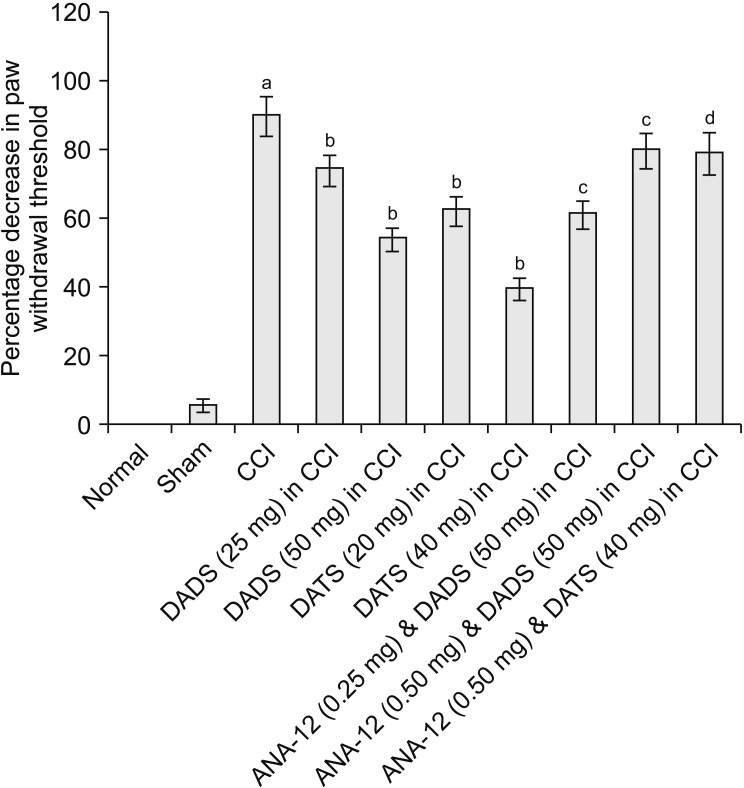
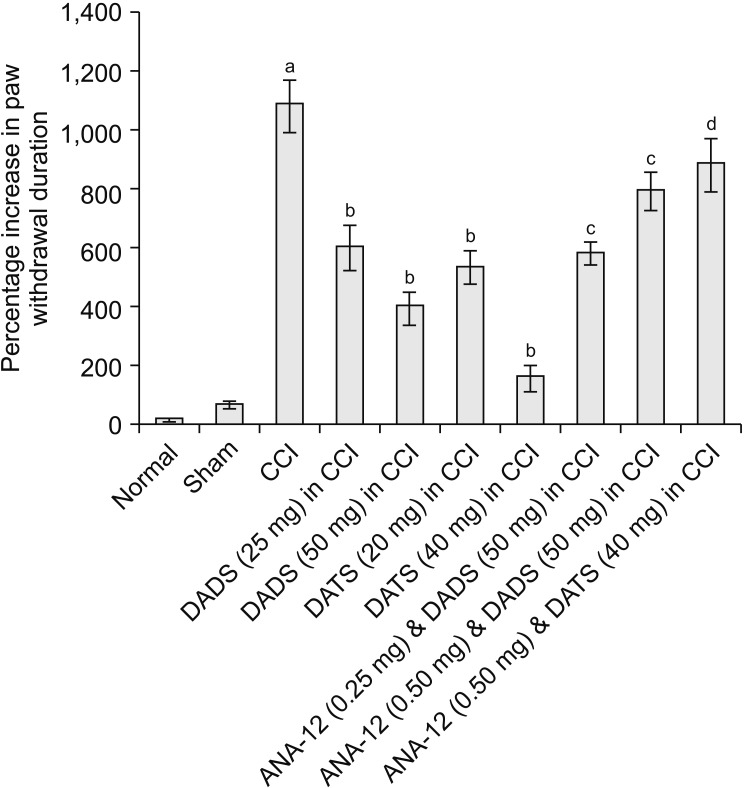
The rats were subjected to CCI injury by ligating the sciatic nerve in four places. The development of neuropathic pain was measured by assessing mechanical hyperalgesia (Randall-Selittotest), mechanical allodynia (Von Frey test), and cold allodynia (acetone drop test) on 14th day after surgery.
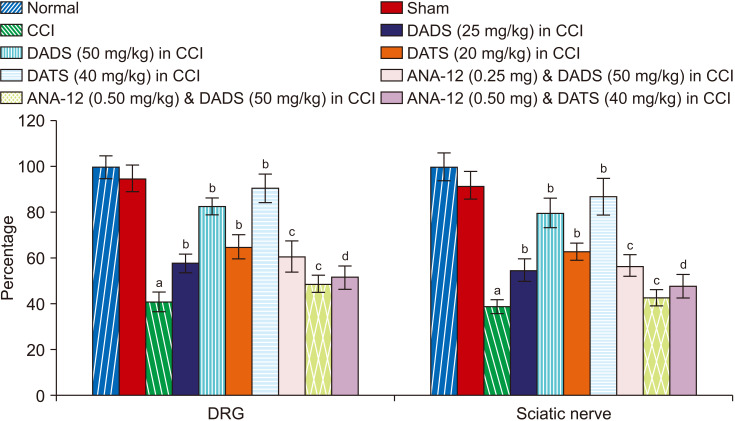
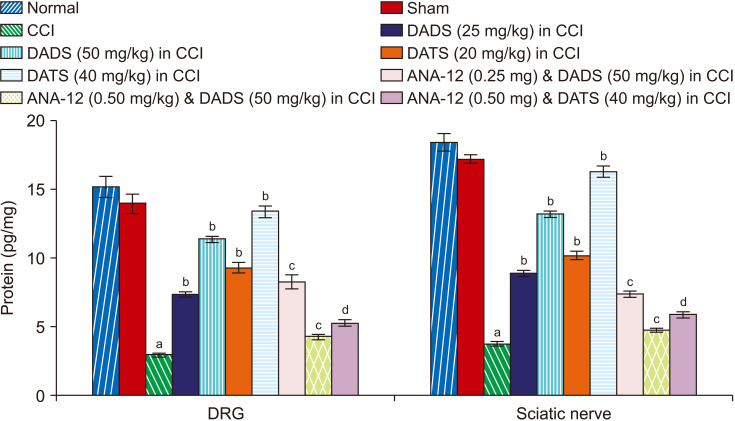
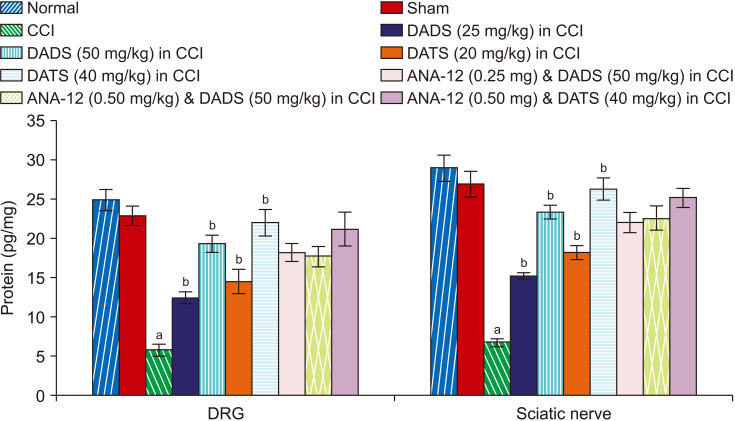
Administration of diallyl disulfide (25 and 50 mg/kg) and diallyl trisulfide (20 and 40 mg/kg) for 14 days led to a significant reduction in pain in CCI-subjected rats. Moreover, treatment with these organosulfur compounds led to the restoration of HS, BDNF and Nrf2 levels in the sciatic nerve and dorsal root ganglia. Coadministration of ANA-12 (BDNF blocker) abolished pain attenuating actions as well as BDNF and the Nrf2 restorative actions of diallyl disulfide and diallyl trisulfide, without modulating HS levels.
Diallyl disulfide and diallyl trisulfide have the potential to attenuate neuropathic pain in CCI-subjected rats possibly through activation of HS-BDNF-Nrf2 signaling pathway.
大蒜油富含有机硫化合物,包括二烯丙基二硫化物和二烯丙基三硫化物。已有研究表明这些有机硫化合物具有神经保护作用。然而,这些有机硫化合物在神经性疼痛方面的潜力尚未得到探索。本研究旨在调查二烯丙基二硫化物和二烯丙基三硫化物对大鼠慢性压迫性损伤(CCI)诱导的神经性疼痛的镇痛潜力。该研究还通过调节热休克蛋白(HS)、脑源性神经营养因子(BDNF)和核因子红细胞2相关因子2(Nrf2)来探索它们的镇痛机制。
通过在四个部位结扎坐骨神经使大鼠遭受CCI损伤。在手术后第14天,通过评估机械性痛觉过敏(兰德尔-塞利托试验)、机械性异常性疼痛(von Frey试验)和冷异常性疼痛(丙酮滴注试验)来测量神经性疼痛的发展。
给予二烯丙基二硫化物(25和50毫克/千克)和二烯丙基三硫化物(20和40毫克/千克)14天可导致CCI大鼠的疼痛显著减轻。此外,用这些有机硫化合物治疗可使坐骨神经和背根神经节中的HS、BDNF和Nrf2水平恢复。联合给予ANA-12(BDNF阻断剂)消除了二烯丙基二硫化物和二烯丙基三硫化物的镇痛作用以及BDNF和Nrf2的恢复作用,而未调节HS水平。
二烯丙基二硫化物和二烯丙基三硫化物有可能通过激活HS-BDNF-Nrf2信号通路减轻CCI大鼠的神经性疼痛。