Moskal P, Kisielewska D, Y Shopa R, Bura Z, Chhokar J, Curceanu C, Czerwiński E, Dadgar M, Dulski K, Gajewski J, Gajos A, Gorgol M, Del Grande R, C Hiesmayr B, Jasińska B, Kacprzak K, Kamińska A, Kapłon Ł, Karimi H, Korcyl G, Kowalski P, Krawczyk N, Krzemień W, Kozik T, Kubicz E, Małczak P, Mohammed M, Niedźwiecki Sz, Pałka M, Pawlik-Niedźwiecka M, Pędziwiatr M, Raczyński L, Raj J, Ruciński A, Sharma S, Shivani S, Silarski M, Skurzok M, Stępień E Ł, Vandenberghe S, Wiślicki W, Zgardzińska B
Faculty of Physics, Astronomy and Applied Computer Science, Jagiellonian University, prof. Stanisława Łojasiewicza 11, Cracow, 30-348, Poland.
Department of Complex Systems, National Centre for Nuclear Research, Otwock-Świerk, 05-400, Poland.
EJNMMI Phys. 2020 Jun 30;7(1):44. doi: 10.1186/s40658-020-00307-w.
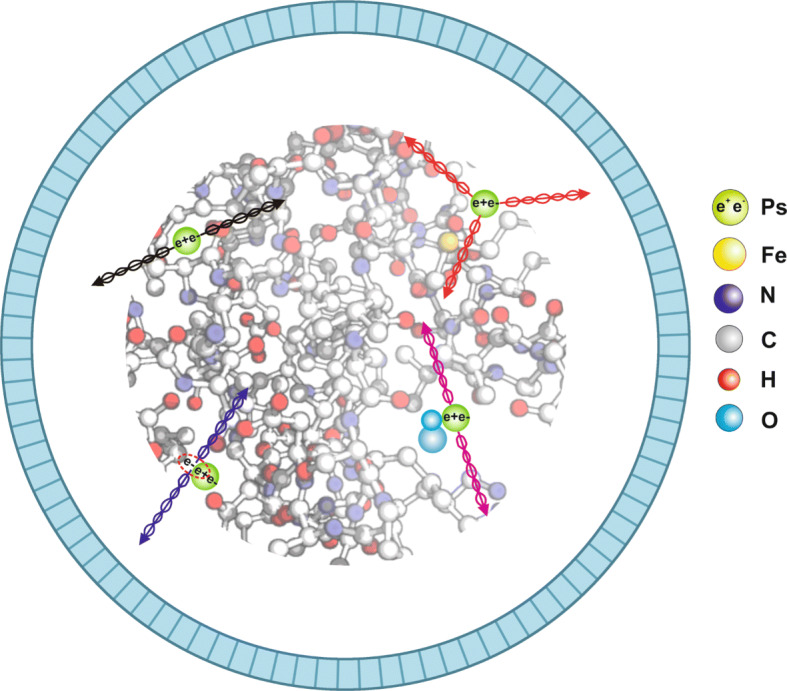
In living organisms, the positron-electron annihilation (occurring during the PET imaging) proceeds in about 30% via creation of a metastable ortho-positronium atom. In the tissue, due to the pick-off and conversion processes, over 98% of ortho-positronia annihilate into two 511 keV photons. In this article, we assess the feasibility for reconstruction of the mean ortho-positronium lifetime image based on annihilations into two photons. The main objectives of this work include the (i) estimation of the sensitivity of the total-body PET scanners for the ortho-positronium mean lifetime imaging using 2γ annihilations and (ii) estimation of the spatial and time resolution of the ortho-positronium image as a function of the coincidence resolving time (CRT) of the scanner.
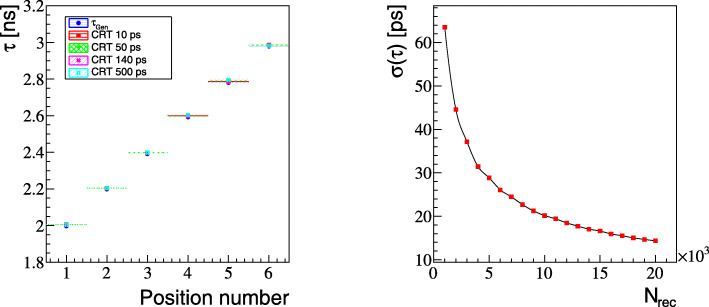
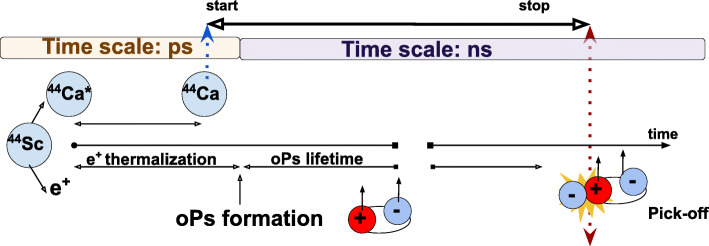
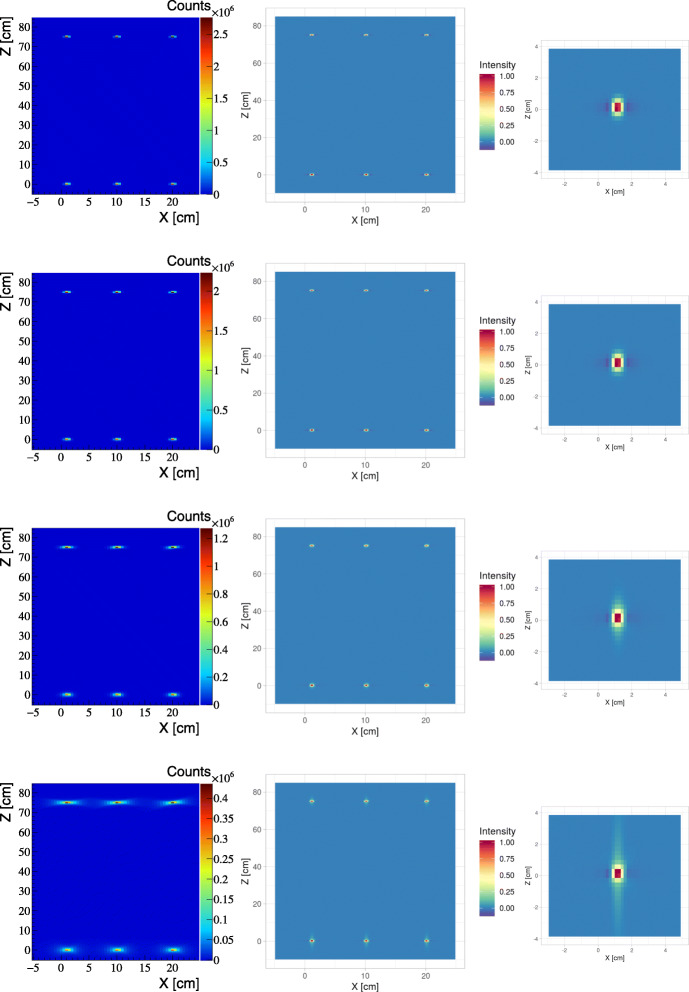
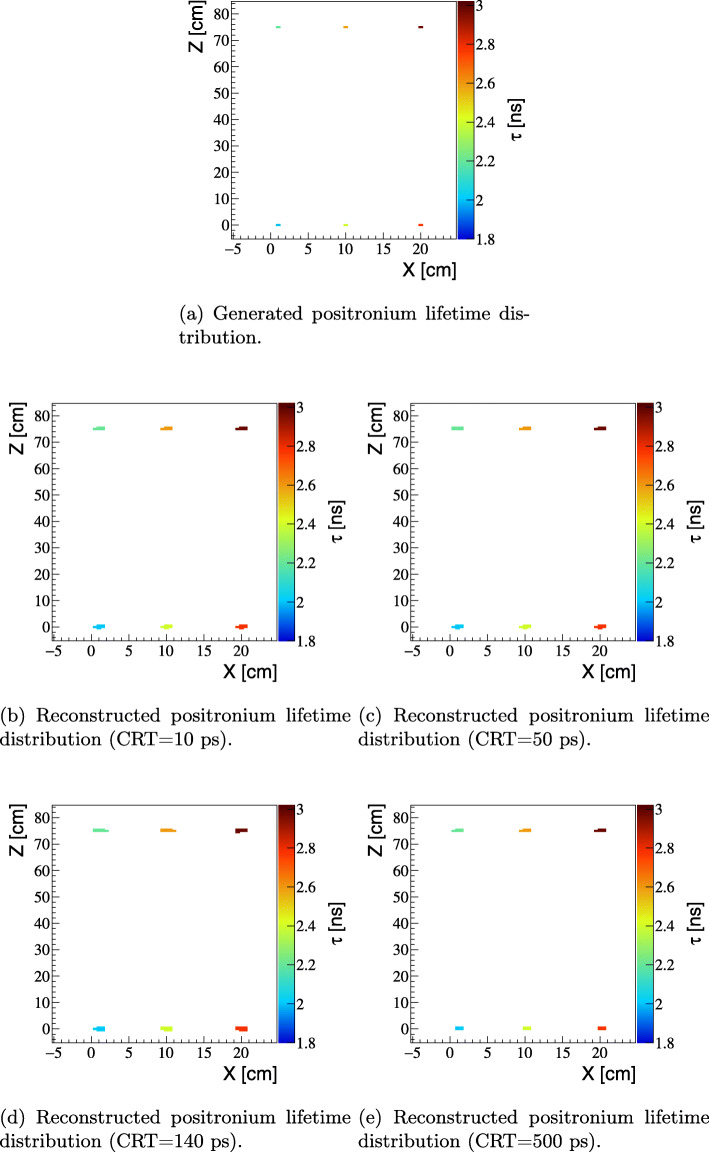
Simulations are conducted assuming that radiopharmaceutical is labeled with Sc isotope emitting one positron and one prompt gamma. The image is reconstructed on the basis of triple coincidence events. The ortho-positronium lifetime spectrum is determined for each voxel of the image. Calculations were performed for cases of total-body detectors build of (i) LYSO scintillators as used in the EXPLORER PET and (ii) plastic scintillators as anticipated for the cost-effective total-body J-PET scanner. To assess the spatial and time resolution, the four cases were considered assuming that CRT is equal to 500 ps, 140 ps, 50 ps, and 10 ps.
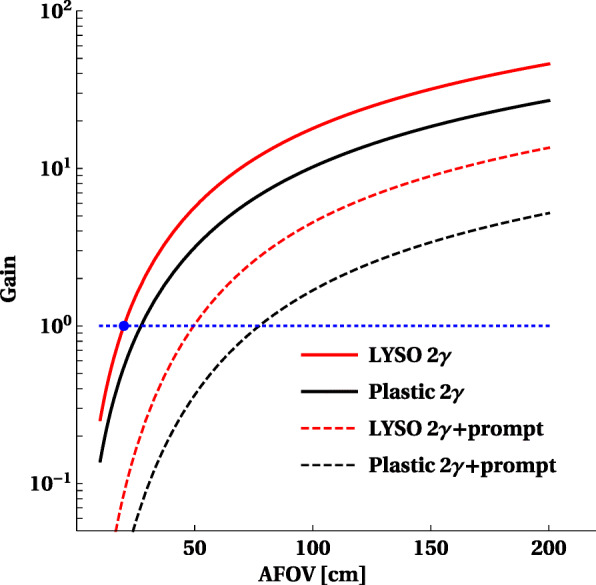
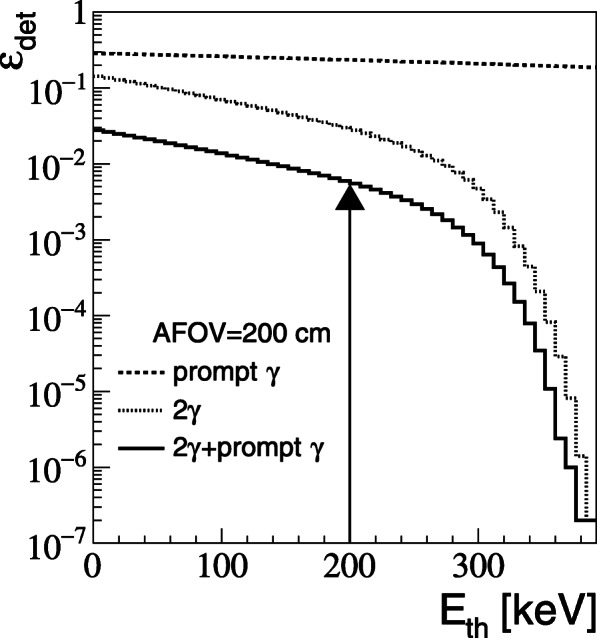
The estimated total-body PET sensitivity for the registration and selection of image forming triple coincidences (2γ+γ) is larger by a factor of 13.5 (for LYSO PET) and by factor of 5.2 (for plastic PET) with respect to the sensitivity for the standard 2γ imaging by LYSO PET scanners with AFOV = 20 cm. The spatial resolution of the ortho-positronium image is comparable with the resolution achievable when using TOF-FBP algorithms already for CRT = 50 ps. For the 20-min scan, the resolution better than 20 ps is expected for the mean ortho-positronium lifetime image determination.
Ortho-positronium mean lifetime imaging based on the annihilations into two photons and prompt gamma is shown to be feasible with the advent of the high sensitivity total-body PET systems and time resolution of the order of tens of picoseconds.
在生物体内,正电子 - 电子湮灭(发生在PET成像过程中)约30%是通过形成亚稳态的正电子素原子进行的。在组织中,由于拾取和转换过程,超过98%的正电子素湮灭为两个511 keV光子。在本文中,我们评估了基于双光子湮灭重建平均正电子素寿命图像的可行性。这项工作的主要目标包括:(i)使用2γ湮灭估计全身PET扫描仪对正电子素平均寿命成像的灵敏度,以及(ii)估计正电子素图像的空间和时间分辨率作为扫描仪符合分辨时间(CRT)的函数。
假设放射性药物用发射一个正电子和一个瞬发γ射线的Sc同位素标记,进行模拟。基于三重符合事件重建图像。为图像的每个体素确定正电子素寿命谱。针对以下两种全身探测器情况进行计算:(i)如EXPLORER PET中使用的LYSO闪烁体,以及(ii)预期用于经济高效的全身J - PET扫描仪的塑料闪烁体。为了评估空间和时间分辨率,考虑了CRT等于500 ps、140 ps、50 ps和10 ps的四种情况。
对于AFOV = 20 cm的LYSO PET扫描仪,估计的全身PET对成像三重符合(2γ + γ)的记录和选择灵敏度相对于标准2γ成像灵敏度,使用LYSO闪烁体时高13.5倍,使用塑料闪烁体时高5.2倍。对于CRT = 50 ps,正电子素图像的空间分辨率与使用TOF - FBP算法时可实现的分辨率相当。对于20分钟的扫描,预计平均正电子素寿命图像测定的分辨率优于20 ps。
随着高灵敏度全身PET系统的出现以及几十皮秒量级的时间分辨率,基于双光子和瞬发γ射线湮灭的正电子素平均寿命成像被证明是可行的。