Krysinski E P, Heimsch R C
Appl Environ Microbiol. 1977 Apr;33(4):947-54. doi: 10.1128/aem.33.4.947-954.1977.
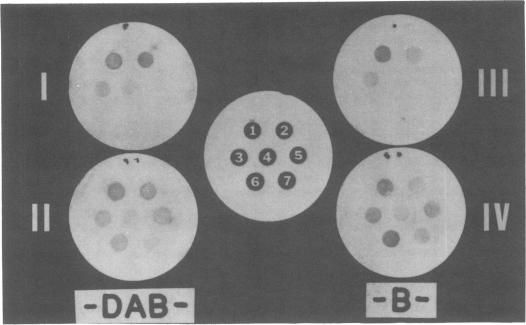
An indirect enzyme-labeled antibody technique (ELAT), in which Salmonella typhimurium was used as a model, was developed as a method to detect Salmonella in food samples. A cellulose-acetate membrane filter, the matrix for detection, was placed on a membrane-filter base and overlaid with a multiwelled lucite template. Mixed broth enrichment cultures were dispensed in the template wells, and cells were spotted onto the membrane via suction. After fixation, the membranes were immersed in rabbit anti-S. typhimurium flagella antibody, washed, immersed in goat anti-rabbit antibody conjugated to peroxidase, and washed. Exposure of membranes to the substrates 3,3'-diaminobenzidine or benzidine resulted in development of brown or blue macroscopic reaction products, respectively, on spots containing S. typhimurium. ELAT results agreed with those of enrichment serology and cultural procedures on three food products containing known levels of S. typhimurium. Because of the magnification effect of the enzyme-substrate reaction, fewer cells were needed for detection than with enrichment serology, thereby reducing the total analysis time. The ability to test 14 or more samples simultaneously on a 47-mm membrane filter would facilitate screening large number of samples. Pending the development of a pure H antisera pool for the common Salmonella serotypes free from O antibodies, the ELAT demonstrated potential as a Salmonella detection methodology.
以鼠伤寒沙门氏菌为模型,开发了一种间接酶标记抗体技术(ELAT),作为检测食品样本中沙门氏菌的方法。将作为检测基质的醋酸纤维素膜过滤器放置在膜过滤器基座上,并覆盖有多孔有机玻璃模板。将混合肉汤富集培养物分配到模板孔中,通过抽吸将细胞点样到膜上。固定后,将膜浸入兔抗鼠伤寒沙门氏菌鞭毛抗体中,洗涤,再浸入与过氧化物酶偶联的山羊抗兔抗体中,然后洗涤。将膜暴露于底物3, ,3'-二氨基联苯胺或联苯胺后,在含有鼠伤寒沙门氏菌的斑点上分别产生棕色或蓝色的宏观反应产物。ELAT的结果与对三种已知鼠伤寒沙门氏菌含量的食品进行富集血清学和培养程序检测的结果一致。由于酶-底物反应的放大作用,与富集血清学相比,检测所需的细胞数量更少,从而缩短了总分析时间。在47毫米的膜过滤器上同时检测14个或更多样本的能力将有助于对大量样本进行筛查。在开发出不含O抗体的常见沙门氏菌血清型的纯H抗血清库之前,ELAT显示出作为一种沙门氏菌检测方法的潜力。