Digestive Disease Center, Fondazione Policlinico Universitario A. Gemelli IRCCS, Università Cattolica del Sacro Cuore, Rome, Italy.
Division of Digestive Diseases, Department of Metabolism, Digestion and Reproduction, Faculty of Medicine, Imperial College London, London, UK.
Gut. 2020 Sep;69(9):1555-1563. doi: 10.1136/gutjnl-2020-321829. Epub 2020 Jul 3.
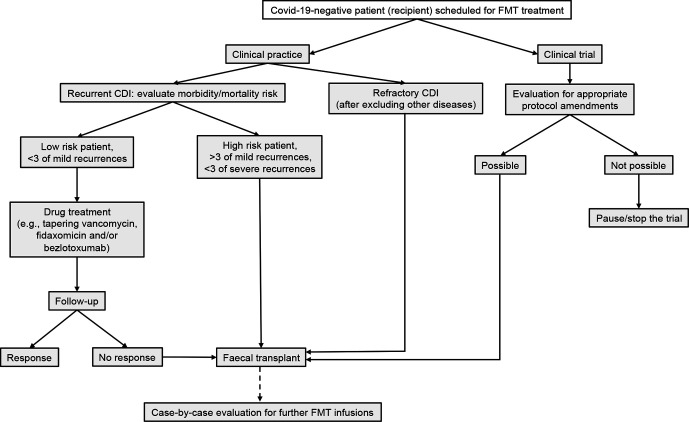
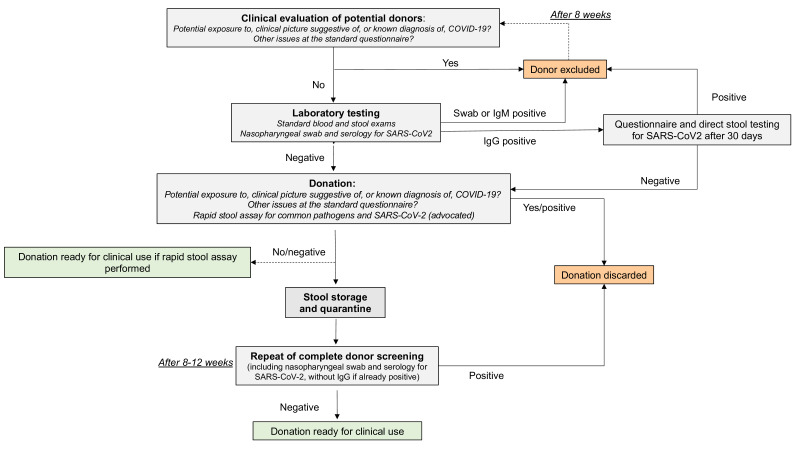
The COVID-19 pandemic has led to an exponential increase in SARS-CoV-2 infections and associated deaths, and represents a significant challenge to healthcare professionals and facilities. Individual countries have taken several prevention and containment actions to control the spread of infection, including measures to guarantee safety of both healthcare professionals and patients who are at increased risk of infection from COVID-19. Faecal microbiota transplantation (FMT) has a well-established role in the treatment of infection. In the time of the pandemic, FMT centres and stool banks are required to adopt a workflow that continues to ensure reliable patient access to FMT while maintaining safety and quality of procedures. In this position paper, based on the best available evidence, worldwide FMT experts provide guidance on issues relating to the impact of COVID-19 on FMT, including patient selection, donor recruitment and selection, stool manufacturing, FMT procedures, patient follow-up and research activities.
COVID-19 大流行导致 SARS-CoV-2 感染和相关死亡人数呈指数级增长,这对医疗保健专业人员和医疗机构构成了重大挑战。个别国家已采取多项预防和控制措施来控制感染的传播,包括采取措施保障医护人员和感染 COVID-19 风险增加的患者的安全。粪便微生物群移植(FMT)在治疗感染方面具有成熟的作用。在大流行期间,FMT 中心和粪便库需要采用一种工作流程,在确保患者可靠地获得 FMT 的同时,继续保持程序的安全性和质量。在这份立场文件中,基于现有的最佳证据,全球 FMT 专家就与 COVID-19 对 FMT 的影响相关的问题提供了指导,包括患者选择、供体招募和选择、粪便生产、FMT 程序、患者随访和研究活动。