Rychen Guido, Aquilina Gabriele, Azimonti Giovanna, Bampidis Vasileios, Bastos Maria de Lourdes, Bories Georges, Cocconcelli Pier Sandro, Flachowsky Gerhard, Gropp Jürgen, Kolar Boris, Kouba Maryline, López-Alonso Marta, López Puente Secundino, Mantovani Alberto, Mayo Baltasar, Ramos Fernando, Saarela Maria, Villa Roberto Edoardo, Wallace Robert John, Wester Pieter, Brantom Paul, Dusemund Birgit, Van Beelen Patrick, Westendorf Johannes, Gregoretti Lucilla, Manini Paola, Chesson Andrew
EFSA J. 2018 Mar 22;16(3):e05208. doi: 10.2903/j.efsa.2018.5208. eCollection 2018 Mar.
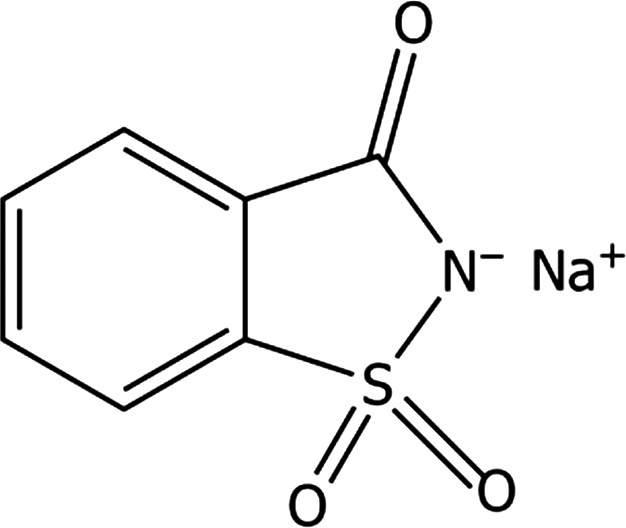
Sodium saccharin is intended to be used as a sweetener in feed and water for drinking for piglets, pigs for fattening and veal calves. The Panel on Additives and Products or Substances used in Animal Feed (FEEDAP) considers the proposed maximum use level of 150 mg sodium saccharin/kg feed as safe for calves and pigs for fattening. For piglets (sucking and weaned piglets), a lower level of 100 mg sodium saccharin/kg complete feed is considered safe. The corresponding maximum safe concentrations in water for drinking are 30 mg/L for piglets and 50 mg/L for pigs for fattening, respectively. The maximum safe concentrations of sodium saccharin in feed and water for drinking are derived under the premise that only one source, feed or water for drinking, contains the additive. The FEEDAP Panel concludes that no concern for the consumer would result from the use of sodium saccharin in feed and water for drinking at the dose considered safe for the target species. The precautions for handling the product proposed by the applicant are considered to be sufficient to ensure user safety. The FEEDAP Panel concludes that the use of sodium saccharin at the dose considered safe for target species is unlikely to have detrimental effects on the terrestrial and freshwater compartments. The high mobility and relative persistence of saccharin and the high persistency of its degradation product 4-hydroxysaccharin indicate that groundwater contamination above 0.1 μg/L is likely to occur. Since the function of sodium saccharin in feed for the target species is essentially the same as that in food, the FEEDAP Panel concludes that no demonstration of efficacy is necessary.
糖精钠拟用作仔猪、育肥猪和犊牛饲料及饮用水中的甜味剂。动物饲料添加剂及产品或物质专家委员会(FEEDAP)认为,对于犊牛和育肥猪,建议的糖精钠最大使用量为每千克饲料150毫克是安全的。对于仔猪(吮乳仔猪和断奶仔猪),每千克全价饲料100毫克的较低水平被认为是安全的。饮用水中相应的最大安全浓度,仔猪为30毫克/升,育肥猪为50毫克/升。饲料和饮用水中糖精钠的最大安全浓度是在仅一种来源(饲料或饮用水)含有该添加剂的前提下得出的。FEEDAP专家委员会得出结论,在对目标物种安全的剂量下,在饲料和饮用水中使用糖精钠不会对消费者造成担忧。申请人提出的产品处理预防措施被认为足以确保使用者安全。FEEDAP专家委员会得出结论,在对目标物种安全的剂量下使用糖精钠不太可能对陆地和淡水生态环境产生有害影响。糖精的高迁移性和相对持久性以及其降解产物4-羟基糖精的高持久性表明,可能会出现地下水污染超过0.1微克/升的情况。由于糖精钠在目标物种饲料中的功能与在食品中的基本相同,FEEDAP专家委员会得出结论,无需证明其功效。