Buhl Kristian Birk, Agergaard Asger Holm, Lillethorup Mie, Nikolajsen Jakob Pagh, Pedersen Steen Uttrup, Daasbjerg Kim
Interdisciplinary Nanoscience Center (iNANO), Aarhus University, Gustav Wieds Vej 14, DK 8000 Aarhus C, Denmark.
Radisurf ApS, Arresoevej 5B, DK-8240 Risskov, Denmark.
Polymers (Basel). 2020 Jun 30;12(7):1475. doi: 10.3390/polym12071475.
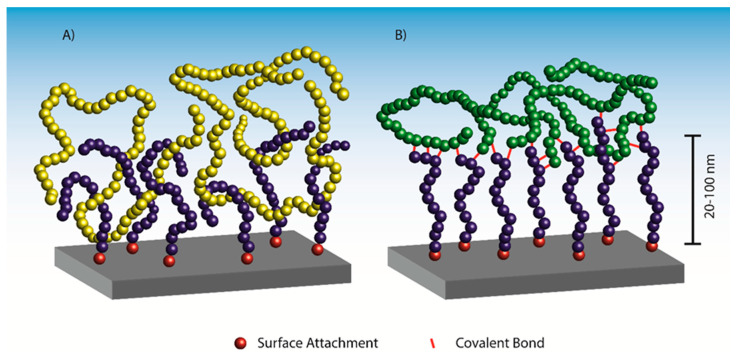
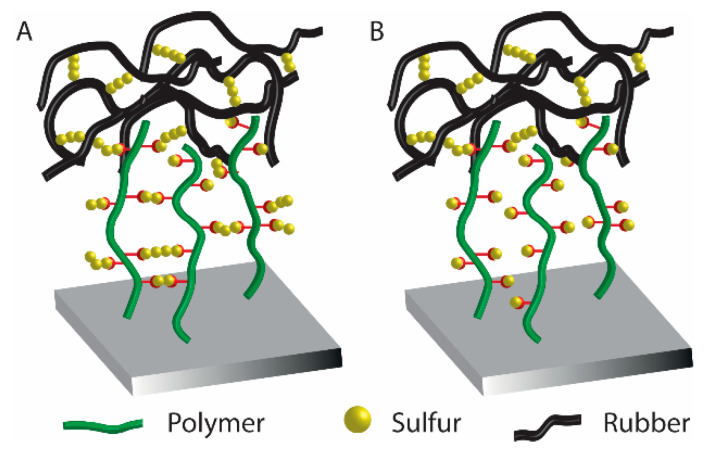
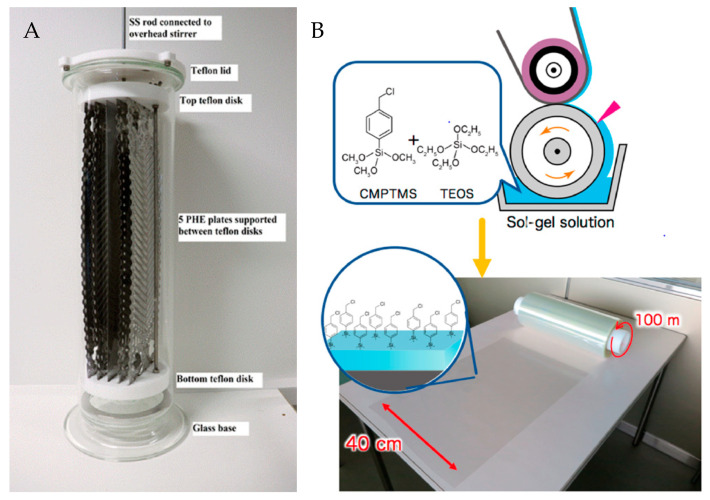
Creating strong joints between dissimilar materials for high-performance hybrid products places high demands on modern adhesives. Traditionally, adhesion relies on the compatibility between surfaces, often requiring the use of primers and thick bonding layers to achieve stable joints. The coatings of polymer brushes enable the compatibilization of material surfaces through precise control over surface chemistry, facilitating strong adhesion through a nanometer-thin layer. Here, we give a detailed account of our research on adhesion promoted by polymer brushes along with examples from industrial applications. We discuss two fundamentally different adhesive mechanisms of polymer brushes, namely (1) physical bonding via entanglement and (2) chemical bonding. The former mechanism is demonstrated by e.g., the strong bonding between poly(methyl methacrylate) (PMMA) brush coated stainless steel and bulk PMMA, while the latter is shown by e.g., the improved adhesion between silicone and titanium substrates, functionalized by a hydrosilane-modified poly(hydroxyethyl methacrylate) (PHEMA) brush. This review establishes that the clever design of polymer brushes can facilitate strong bonding between metals and various polymer materials or compatibilize fillers or nanoparticles with otherwise incompatible polymeric matrices. To realize the full potential of polymer brush functionalized materials, we discuss the progress in the synthesis of polymer brushes under ambient and scalable industrial conditions, and present recent developments in atom transfer radical polymerization for the large-scale production of brush-modified materials.
为高性能混合产品在不同材料之间创建牢固的连接,对现代粘合剂提出了很高的要求。传统上,粘合依赖于表面之间的相容性,通常需要使用底漆和厚粘结层来实现稳定的连接。聚合物刷涂层能够通过对表面化学的精确控制实现材料表面的相容化,借助纳米薄层促进强粘附。在此,我们详细介绍我们关于聚合物刷促进粘附的研究,并列举工业应用实例。我们讨论聚合物刷两种根本不同的粘附机制,即(1)通过缠结的物理键合和(2)化学键合。前一种机制例如通过聚甲基丙烯酸甲酯(PMMA)刷涂不锈钢与本体PMMA之间的强键合得到证明,而后一种机制例如通过硅氧烷与经硅氢烷改性的聚甲基丙烯酸羟乙酯(PHEMA)刷功能化的钛基材之间改善的粘附得到体现。这篇综述表明,聚合物刷的巧妙设计能够促进金属与各种聚合物材料之间的强键合,或者使填料或纳米颗粒与原本不相容的聚合物基体相容。为了充分发挥聚合物刷功能化材料的潜力,我们讨论在环境条件和可扩展工业条件下聚合物刷合成方面的进展,并介绍用于大规模生产刷改性材料的原子转移自由基聚合的最新进展。