Clinical Psychology and Behavioral Neuroscience, Technische Universität Dresden, Dresden, Germany.
Department of Psychology, University of Graz, Graz, Austria.
J Pers Assess. 2021 May-Jun;103(3):365-379. doi: 10.1080/00223891.2020.1775089. Epub 2020 Jul 6.
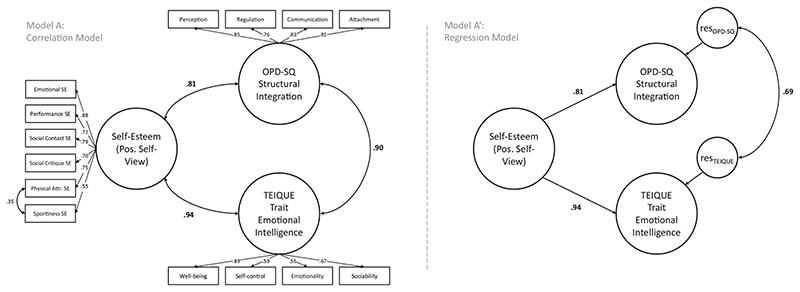
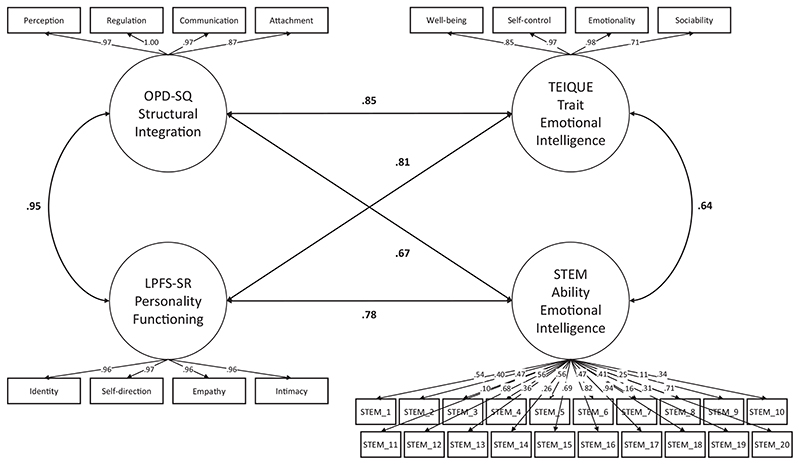
We tested the hypothesis that structural integration, as assessed in the Operationalized Psychodynamic Diagnosis (OPD) system, and emotional intelligence (EI), as studied in personality psychology, might be closely related constructs at a general level, as both might assess general personality functioning. In three studies ( = 166, = 204, = 349), we used a self-report measure of OPD structural integration and measures of Trait and Ability EI. Structural integration and Trait EI display very high correlation at general factor level ( = .77 - .82) and almost perfect latent correlation ( = .85 - .90). This correlation cannot be explained away by the general positivity of self-views or socially desirable responding. There is also substantial latent correlation between structural integration and Ability EI ( = .20 - .65). Results replicate over different samples from different countries and extend to the DSM-5 self-report personality functioning scale.
我们检验了这样一个假设,即在操作性心理诊断(OPD)系统中评估的结构整合,以及在人格心理学中研究的情绪智力(EI),可能在一般水平上是密切相关的结构,因为两者都可能评估一般人格功能。在三项研究中(n=166,n=204,n=349),我们使用了 OPD 结构整合的自我报告测量和特质和能力 EI 的测量。结构整合和特质 EI 在一般因素水平上显示出非常高的相关性(r=0.77-0.82),几乎完美的潜在相关性(r=0.85-0.90)。这种相关性不能用自我看法的一般积极性或社会期望的反应来解释。结构整合和能力 EI 之间也存在实质性的潜在相关性(r=0.20-0.65)。结果在来自不同国家的不同样本中复制,并扩展到 DSM-5 自我报告的人格功能量表。