Master of Social Sciences, Social Policy, Faculty of Social Sciences, Tampere University, Tampere, Finland.
Prasanna School of Public Health, Manipal Academy of Higher Education, Manipal, India.
BMC Health Serv Res. 2020 Jul 6;20(1):619. doi: 10.1186/s12913-020-05482-1.
This study examined access to health care in an occupational context in an urban city of India. Many people migrate from rural areas to cities, often across Indian states, for employment prospects. The purpose of the study is to explore the barriers to accessing health care among a vulnerable group - internal migrants working in the construction sector in Manipal, Karnataka. Understanding the lay workers' accounts of access to health services can help to comprehend the diversity of factors that hinder access to health care.
Individual semi-structured interviews involving 15 migrant construction workers were conducted. The study applied theory-guided content analysis to investigate access to health services among the construction workers. The adductive analysis combined deductive and inductive approaches with the aim of verifying the existing barrier theory in a vulnerable context and further developing the health care access barrier theory.
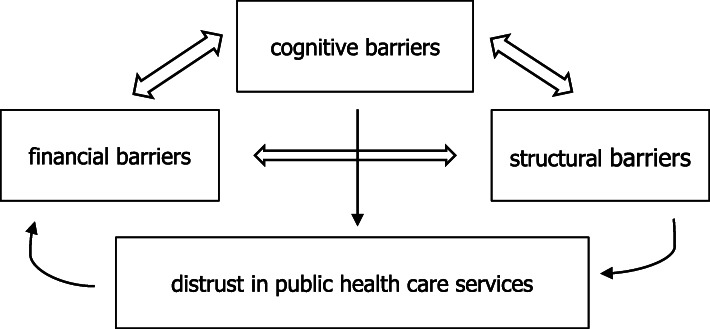
This study's result is a revised version of the health care access barriers model, including the dimension of trust. Three known health care access barriers - financial, cognitive and structural, as well as the new barrier (distrust in public health care services), were identified among migrant construction workers in a city context in Karnataka, India.
Further qualitative research on vulnerable groups would produce a more comprehensive account of access to health care. The socioeconomic status behind access to health care, as well as distrust in public health services, forms focal challenges for any policymaker hoping to improve health services to match people's needs.
本研究考察了印度一个城市中职业背景下的医疗保健可及性。许多人从农村地区迁移到城市,通常是跨越印度各州,寻找就业机会。本研究的目的是探讨在班加罗尔市马内帕尔,建筑行业中脆弱群体——内部移民获得医疗保健的障碍。了解体力劳动者获得卫生服务的情况,有助于理解阻碍获得医疗保健的多样性因素。
对 15 名移民建筑工人进行了个体半结构化访谈。该研究采用理论指导的内容分析法,调查建筑工人获得卫生服务的情况。附加分析结合了演绎和归纳方法,旨在验证脆弱背景下现有的障碍理论,并进一步发展医疗保健可及性障碍理论。
本研究的结果是医疗保健可及性障碍模型的修订版,包括信任维度。在印度卡纳塔克邦的城市背景下,我们在移民建筑工人中发现了三个已知的医疗保健可及性障碍——经济、认知和结构性障碍,以及新的障碍(对公共医疗保健服务的不信任)。
对弱势群体进行进一步的定性研究,将更全面地了解获得医疗保健的情况。获得医疗保健的社会经济地位,以及对公共卫生服务的不信任,是任何希望改善卫生服务以满足人们需求的政策制定者的核心挑战。