USC Roski Eye Institute, Department of Ophthalmology, Keck School of Medicine at the University of Southern California, Los Angeles, California.
Hamilton Glaucoma Center, Shiley Eye Institute, Department of Ophthalmology, University of California, San Diego, La Jolla, California.
Ophthalmol Glaucoma. 2020 Mar-Apr;3(2):130-138. doi: 10.1016/j.ogla.2019.12.005. Epub 2019 Dec 27.
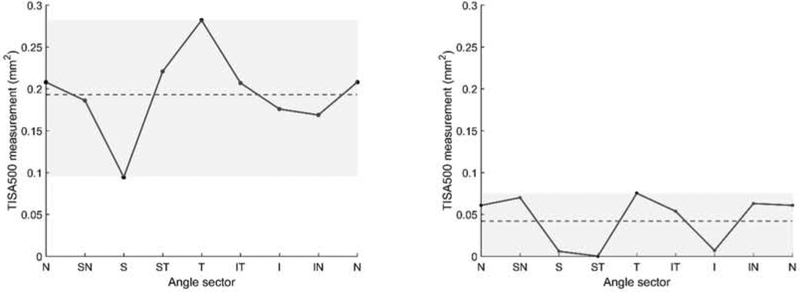
To characterize the relationship between mean and sectoral variation of anterior chamber angle (ACA) width using anterior segment optical coherence tomography (AS-OCT).
Subjects aged 50 years or older were identified from the Chinese American Eye Study (CHES), a population-based epidemiological study in Los Angeles, CA. Each subject underwent a complete ocular examination including gonioscopy and AS-OCT imaging. Primary angle closure disease (PACD) was defined as inability to visualize pigmented trabecular meshwork in 3 or more quadrants. Four AS-OCT images from one eye per subject were analyzed and parameters describing ACA width were measured at 500 and 750 μm from the scleral spur: angle opening distance (AOD), trabecular iris space area (TISA), and scleral spur angle (SSA). The relationship between mean and sectoral variation of ACA width was assessed using locally-weighted scatterplot smoothing (LOWESS) regression and change-point analyses and Spearman correlation coefficients.
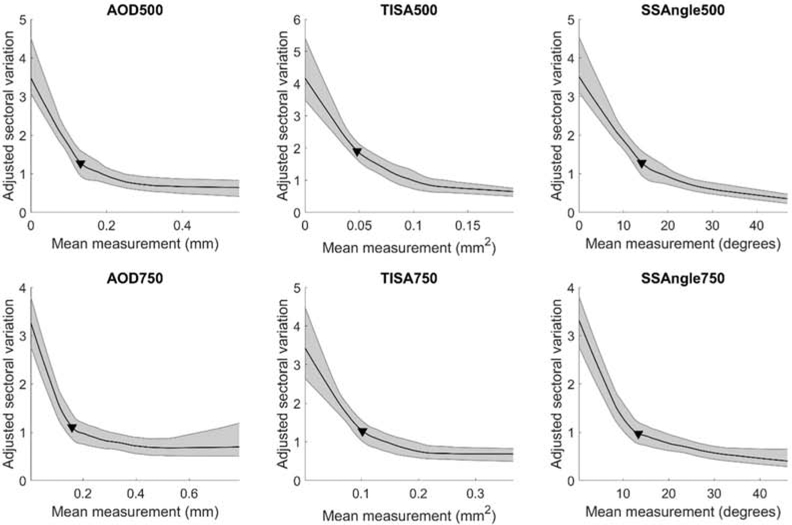
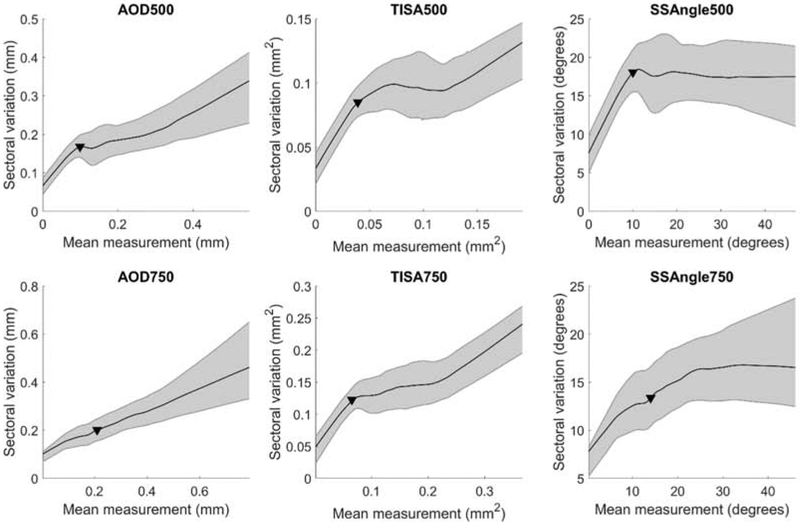
674 eyes (337 with PACD, 337 without PACD) from 674 subjects were analyzed. Overall, sectoral variation of ACA width decreased as mean ACA width decreased. This relationship was divided into two phases based on the change-point analysis. Sectoral variation of ACA width was strongly and significantly correlated (P < 0.001) with mean ACA width with below parameter-specific change points for most parameters: AOD500 (r = 0.599), AOD750 (r = 0.246), TISA500 (r = 0.734), TISA750 (r = 0.664), SSA500 (r = 0.661), SSA750 (r = 0.394). Correlations were weaker but still significant (P < 0.004) above these change points for most parameters: AOD500 (r = 0.321), AOD750 (r = 0.550), TISA500 (r = 0.122), TISA750 (r = 0.275), SSA500 (r = -0.036), SSA750 (r = 0.313). Correlations to the left and right of the change points strengthened when sectoral variation of ACA width was adjusted for mean ACA width.
Correlations between mean and sectoral variation of ACA width strengthen as the severity of angle narrowing worsens. This relationship likely reflects anatomical changes related to chronic angle closure and may be relevant for refining current definitions and management of PACD.
使用眼前节光学相干断层扫描(AS-OCT)来描述前房角(ACA)宽度的平均和扇区变化之间的关系。
从加利福尼亚州洛杉矶的基于人群的流行病学研究——中美眼研究(CHES)中确定了 50 岁或以上的受试者。每位受试者均接受了全面的眼部检查,包括房角镜检查和 AS-OCT 成像。原发性房角关闭病(PACD)定义为在 3 个或更多象限中无法观察到色素性小梁网。对每只眼的 4 个 AS-OCT 图像进行分析,并在距巩膜突 500 和 750 μm 处测量描述 ACA 宽度的参数:房角开口距离(AOD)、小梁虹膜空间面积(TISA)和巩膜突角度(SSA)。使用局部加权散点平滑(LOWESS)回归和变化点分析以及 Spearman 相关系数评估 ACA 宽度的平均和扇区变化之间的关系。
对 674 只眼(337 只患有 PACD,337 只无 PACD)的 674 名受试者进行了分析。总体而言,ACA 宽度的扇区变化随着平均 ACA 宽度的降低而降低。根据变化点分析,该关系分为两个阶段。ACA 宽度的扇区变化与平均 ACA 宽度具有很强的相关性(P <0.001),大多数参数的参数特定变化点以下具有显著相关性:AOD500(r = 0.599),AOD750(r = 0.246),TISA500(r = 0.734),TISA750(r = 0.664),SSA500(r = 0.661),SSA750(r = 0.394)。在这些变化点以上,大多数参数的相关性仍然较弱,但仍然具有统计学意义(P <0.004):AOD500(r = 0.321),AOD750(r = 0.550),TISA500(r = 0.122),TISA750(r = 0.275),SSA500(r = -0.036),SSA750(r = 0.313)。当调整平均 ACA 宽度时,变化点左右两侧的相关性增强。
随着角度变窄的严重程度恶化,ACA 宽度的平均和扇区变化之间的相关性增强。这种关系可能反映了与慢性房角关闭相关的解剖学变化,并且可能与当前 PACD 的定义和管理有关。