Programme National de Lutte Contre la Trypanosomiase Humaine Africaine, Ministère de la Santé, Conakry, Guinea.
Service de Dermatologie, Hôpital de Donka,Conakry, Guinea.
Clin Infect Dis. 2021 Jul 1;73(1):12-20. doi: 10.1093/cid/ciaa897.
The diagnosis of gambiense human African trypanosomiasis (gHAT) typically involves 2 steps: a serological screen, followed by the detection of living trypanosome parasites in the blood or lymph node aspirate. Live parasites can, however, remain undetected in some seropositive individuals, who, we hypothesize, are infected with Trypanosoma brucei gambiense parasites in their extravascular dermis.
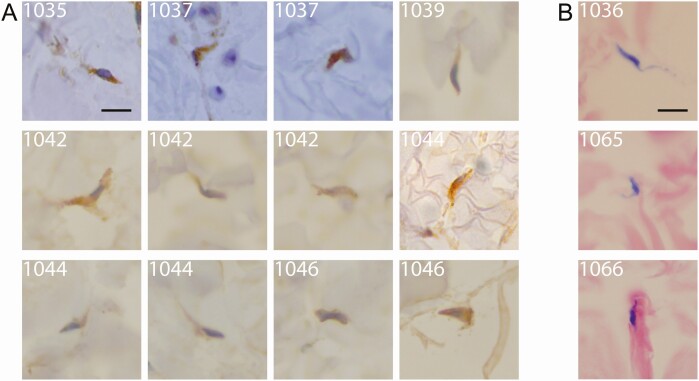
To test this hypothesis, we conducted a prospective observational cohort study in the gHAT focus of Forecariah, Republic of Guinea. Of the 5417 subjects serologically screened for gHAT, 66 were enrolled into our study and underwent a dermatological examination. At enrollment, 11 seronegative, 8 unconfirmed seropositive, and 18 confirmed seropositive individuals had blood samples and skin biopsies taken and examined for trypanosomes by molecular and immunohistological methods.
In seropositive individuals, dermatological symptoms were significantly more frequent, relative to seronegative controls. T.b. gambiense parasites were present in the blood of all confirmed cases (n = 18) but not in unconfirmed seropositive individuals (n = 8). However, T. brucei parasites were detected in the extravascular dermis of all unconfirmed seropositive individuals and all confirmed cases. Skin biopsies of all treated cases and most seropositive untreated individuals progressively became negative for trypanosomes 6 and 20 months later.
Our results highlight the skin as a potential reservoir for African trypanosomes, with implications for our understanding of this disease's epidemiology in the context of its planned elimination and underlining the skin as a novel target for gHAT diagnostics.
冈比亚人体锥虫病(gHAT)的诊断通常包括两个步骤:血清学筛查,然后检测血液或淋巴结抽吸物中的活锥虫寄生虫。然而,一些血清阳性个体中可能无法检测到活寄生虫,我们假设这些个体感染了在其血管外真皮中的冈比亚锥虫。
为了验证这一假设,我们在几内亚共和国的 gHAT 焦点地区进行了一项前瞻性观察队列研究。在对 5417 名进行 gHAT 血清学筛查的受试者中,有 66 名入组我们的研究并接受了皮肤科检查。在入组时,11 名血清阴性、8 名未确诊的血清阳性和 18 名确诊的血清阳性个体采集了血液样本和皮肤活检,并通过分子和免疫组织化学方法检查锥虫。
在血清阳性个体中,与血清阴性对照组相比,皮肤症状明显更频繁。所有确诊病例(n=18)的血液中均存在 T.b. 冈比亚锥虫,但未在未确诊的血清阳性个体(n=8)中发现。然而,所有未确诊的血清阳性个体和所有确诊病例的血管外真皮中均检测到 T. brucei 寄生虫。所有治疗病例和大多数血清阳性未治疗个体的皮肤活检在 6 和 20 个月后逐渐对锥虫呈阴性。
我们的结果强调了皮肤作为非洲锥虫的潜在储库,这对我们在计划消除该病的背景下理解该病的流行病学具有影响,并强调了皮肤作为 gHAT 诊断的新靶标。