Roth Daniel, Larsson Erik, Sundlöv Anna, Sjögreen Gleisner Katarina
Department of Medical Radiation Physics, Clinical Sciences Lund, Lund University, Lund, Sweden.
Department of Radiation Physics, Skåne University Hospital, Lund, Sweden.
EJNMMI Phys. 2020 Jul 8;7(1):46. doi: 10.1186/s40658-020-00313-y.
Currently, hand-held gamma cameras are being developed for Tc imaging, mainly for sentinel lymph node detection. These cameras offer advantages, such as mobility and ease of access, and may be useful also for other applications such as biokinetic studies in animals or for imaging of small, superficial structures in patients. In this work, the suitability of a CZT-based hand-held camera for Lu imaging is investigated. The energy response of CZT-based detectors combined with the multiple photon emissions of Lu poses new challenges compared to Tc imaging, and a thorough camera characterisation is thus warranted.
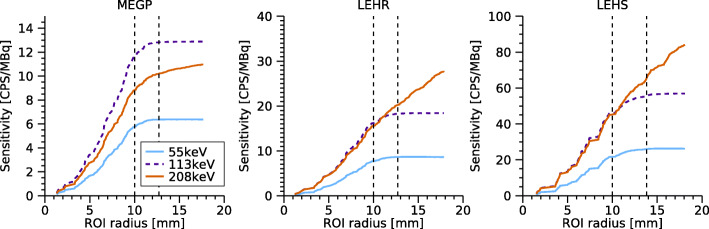
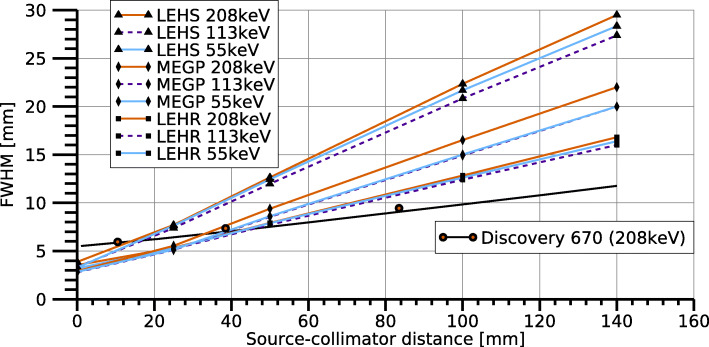
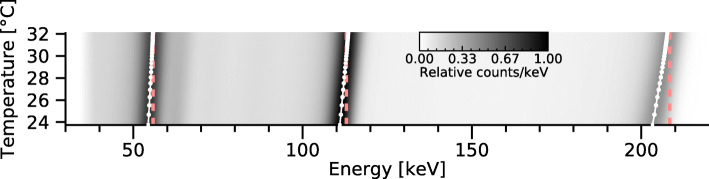
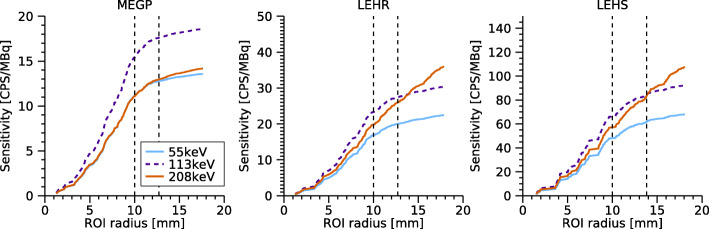
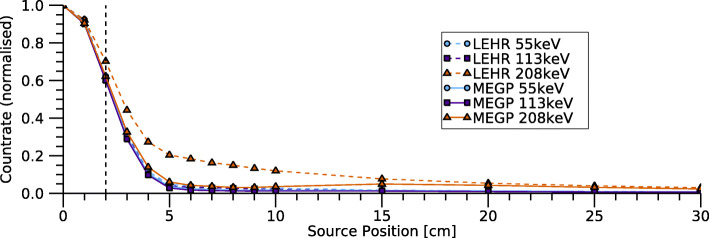
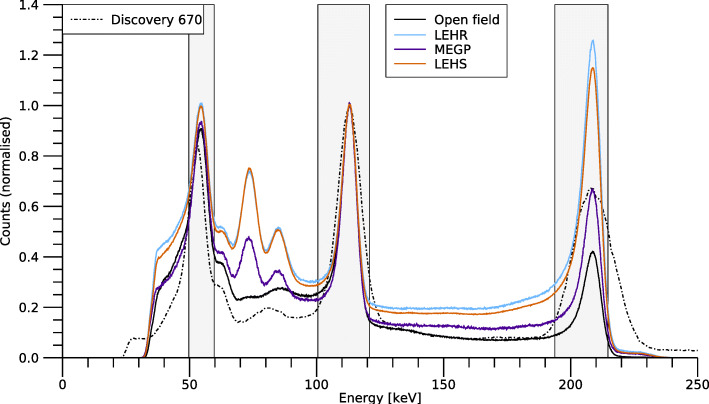
Three collimators (LEHR, LEHS, and MEGP) and three energy windows (55 keV, 113 keV, and 208 keV) are investigated. Characterised camera properties include the system spatial resolution, energy resolution, sensitivity, image uniformity, septal penetration, and temperature dependence. Characterisations are made starting from NEMA guidelines when applicable, with adjustments made when required. The applicability of the camera is demonstrated by imaging of a superficially located tumour in a patient undergoing [ Lu]Lu-DOTA-TATE therapy.
Overall, the results are encouraging. Compared to a conventional gamma camera, the hand-held camera generally has a higher sensitivity for a given collimator. For source-collimator distances below 3 cm, the spatial resolution FWHM is within 6 mm for the LEHR and MEGP collimators. Before uniformity correction, the central field-of-view integral uniformity shows best results for the 113-keV window, with values obtained between 11 and 14%. The corresponding values after uniformity correction are within 3%. Effects of septal penetration are observed but are manageable with a proper combination of collimator and energy window setting. Septal penetration and collimator scatter not only affect the 208-keV window but also contribute with counts in lower windows due to energy-tailing effects. The patient study revealed non-uniform uptake patterns in a region that appeared uniform in a conventional gamma camera image.
The results show that the hand-held camera can be used for Lu imaging. A 113-keV energy window combined with LEHR or MEGP collimators provides the best image system characteristics.
目前,正开发用于锝成像的手持式伽马相机,主要用于前哨淋巴结检测。这些相机具有诸如可移动性和便于使用等优点,也可能对其他应用有用,如动物的生物动力学研究或患者体内小的浅表结构成像。在本研究中,研究了基于碲锌镉(CZT)的手持式相机用于镥成像的适用性。与锝成像相比,基于CZT的探测器的能量响应与镥的多光子发射带来了新的挑战,因此需要对相机进行全面表征。
研究了三种准直器(低能高分辨率准直器、低能高灵敏度准直器和中能通用准直器)和三个能量窗(55千电子伏、113千电子伏和208千电子伏)。表征的相机特性包括系统空间分辨率、能量分辨率、灵敏度、图像均匀性、隔板穿透率和温度依赖性。适用时从美国电气和电子工程师协会(NEMA)指南开始进行表征,并在需要时进行调整。通过对接受[镥]镥-多胺基多乙酸-酪胺酸(Lu-DOTA-TATE)治疗的患者体内浅表肿瘤成像来证明相机的适用性。
总体而言,结果令人鼓舞。与传统伽马相机相比,手持式相机对于给定准直器通常具有更高的灵敏度。对于源-准直器距离低于3厘米的情况,低能高分辨率准直器和中能通用准直器的空间分辨率半高宽(FWHM)在6毫米以内。在均匀性校正之前,113千电子伏能量窗的中心视野积分均匀性显示出最佳结果,所得值在11%至14%之间。均匀性校正后的相应值在±3%以内。观察到隔板穿透的影响,但通过准直器和能量窗设置的适当组合是可控的。隔板穿透和准直器散射不仅影响208千电子伏能量窗,还由于能量拖尾效应在较低能量窗中产生计数。患者研究显示,在传统伽马相机图像中看似均匀的区域存在摄取模式不均匀的情况。
结果表明,手持式相机可用于镥成像。113千电子伏能量窗与低能高分辨率准直器或中能通用准直器相结合可提供最佳的图像系统特性。