Center for Alzheimer's and Neurodegenerative Diseases, Peter O'Donnell Jr. Brain Institute, University of Texas Southwestern Medical Center, Dallas, TX, USA.
FEBS Open Bio. 2020 Sep;10(9):1912-1920. doi: 10.1002/2211-5463.12928.
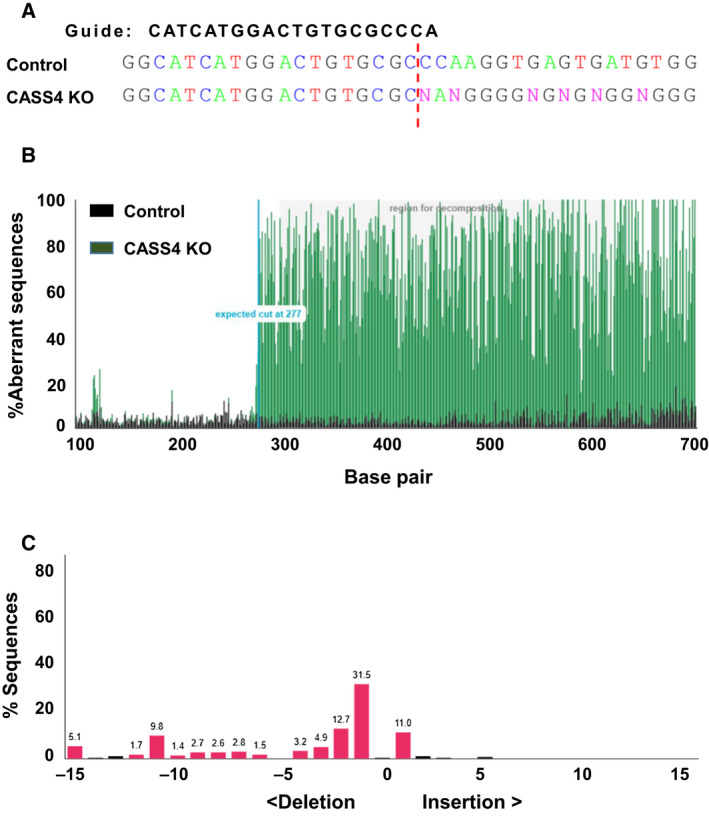
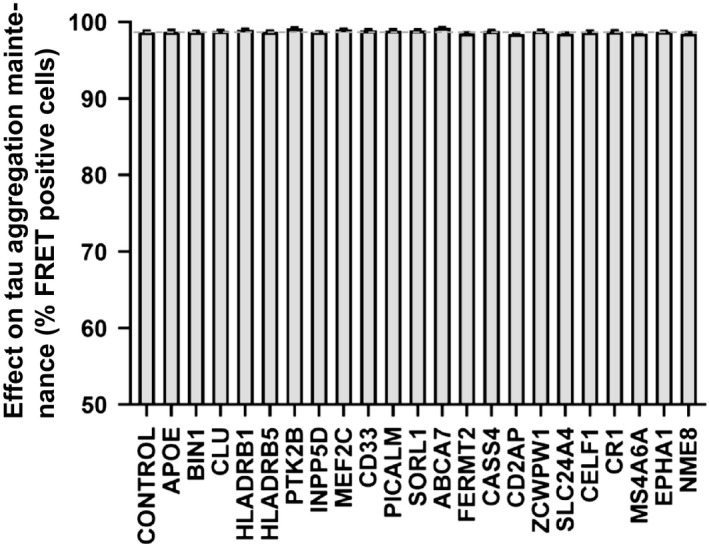
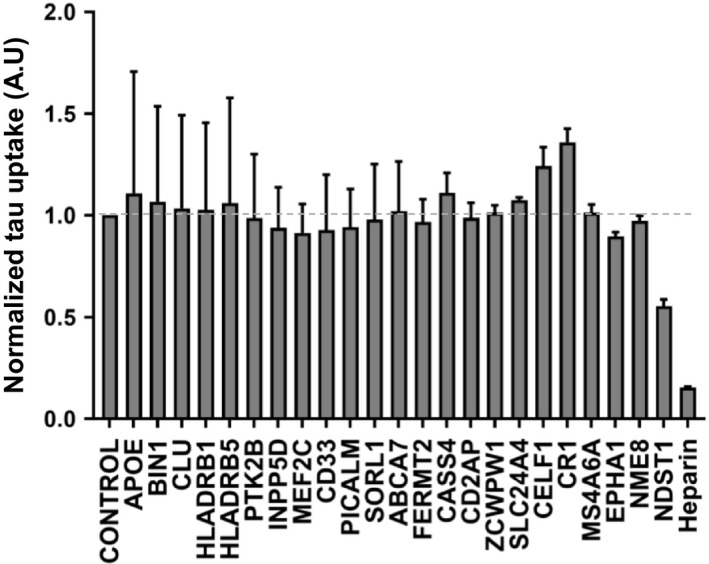
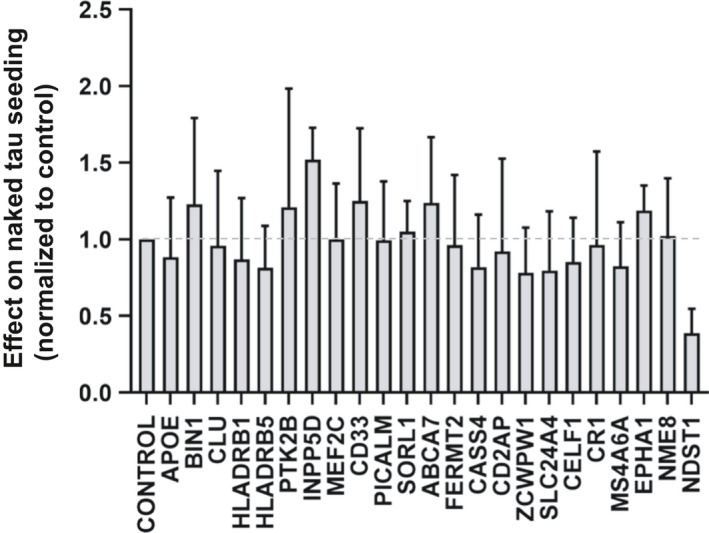
Alzheimer's disease (AD) afflicts millions of people worldwide and is caused by accumulated amyloid beta and tau pathology. Progression of tau pathology in AD may utilize prion mechanisms of propagation in which pathological tau aggregates released from one cell are taken up by neighboring or connected cells and act as templates for their own replication, a process termed 'seeding'. We have used HEK293T cells to model various aspects of pathological tau propagation, including uptake of tau aggregates, induced seeding by exogenous aggregates, seeding caused by Lipofectamine-mediated delivery to the cell interior, and stable maintenance of aggregates in dividing cells. The factors that regulate these processes are not well understood, and we hypothesized that AD risk modifier genes might play a role. We identified 22 genes strongly linked to AD via meta-analysis of genome-wide association study (GWAS). We used CRISPR/Cas9 to individually knock out each gene in HEK293T cells and verified disruption using genomic sequencing. We then tested the effect of gene knockout in tau aggregate uptake, naked and Lipofectamine-mediated seeding, and aggregate maintenance in these cultured cell lines. GWAS gene knockouts had no effect in these models of tau pathology. With obvious caveats due to the model systems used, these results imply that the 22 AD risk modifier genes are unlikely to directly modulate tau uptake, seeding, or aggregate maintenance in a cell-autonomous fashion.
阿尔茨海默病(AD)影响着全球数百万人,其病因是淀粉样β和 tau 病理学的积累。AD 中 tau 病理学的进展可能利用了朊病毒传播的机制,即从一个细胞释放的病理性 tau 聚集体被邻近或连接的细胞摄取,并作为自身复制的模板,这一过程称为“播种”。我们已经使用 HEK293T 细胞来模拟病理性 tau 传播的各个方面,包括 tau 聚集体的摄取、外源性聚集体诱导的播种、通过脂质体介导的细胞内传递引起的播种,以及在分裂细胞中稳定维持聚集体。调节这些过程的因素尚不清楚,我们假设 AD 风险修饰基因可能起作用。我们通过全基因组关联研究(GWAS)的荟萃分析确定了与 AD 密切相关的 22 个基因。我们使用 CRISPR/Cas9 逐个敲除 HEK293T 细胞中的每个基因,并使用基因组测序验证了基因的破坏。然后,我们在这些培养细胞系中测试了基因敲除对 tau 聚集体摄取、裸和脂质体介导播种以及聚集体维持的影响。GWAS 基因敲除对这些 tau 病理学模型没有影响。由于使用的模型系统存在明显的局限性,这些结果表明 22 个 AD 风险修饰基因不太可能以细胞自主的方式直接调节 tau 的摄取、播种或聚集体的维持。