Department of Clinical Nutrition, Xinhua Hospital Affiliated to Shanghai Jiao Tong University, School of Medicine, Shanghai, 200092, China.
Department of Nutrition, School of Public Health, Shanghai Jiao Tong University, Shanghai, 200025, China.
BMC Nephrol. 2020 Jul 11;21(1):268. doi: 10.1186/s12882-020-01918-2.
An appropriate diet is an important determinant of kidney health. However, the association between vegetarian diets and renal function is unclear. We aimed to study the association between vegetarian diets and renal function in healthy adults.
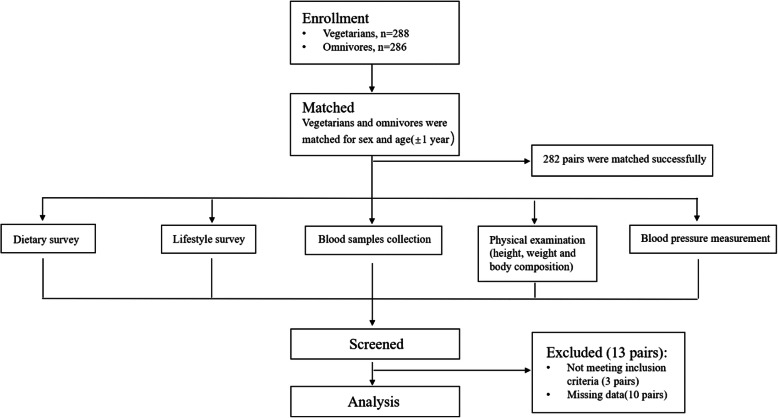
A total of 269 vegetarians and 269 sex- and age-matched nonvegetarian omnivores were enrolled in this cross-sectional study. Basic characteristics and daily dietary intakes were assessed by face-to-face interviews. Blood samples were collected, and renal function was assessed by measuring blood urea nitrogen (BUN), serum creatinine (SCr), uric acid (UA) and the estimated glomerular filtration rate (eGFR). Blood pressure, fasting blood glucose and blood lipid profiles were also assessed.
The average age of the vegetarians was 35.4 ± 8.6 years, 82.2% of whom were female. We evaluated the association between vegetarian diets and renal function using multivariate analysis. Compared with omnivores, vegetarians had lower BUN [β = - 0.63, 95% confidence interval (CI): (- 0.88, - 0.38)], SCr [β = - 2.04, 95% CI:(- 4.10, 0.02)], and UA levels [β = - 15.15, 95% CI: (- 27.81, - 2.50)] and higher eGFRs [β = 4.04, 95% CI: (0.30, 7.78)] after adjusting for sex, age, body mass index (BMI), physical activity, alcohol consumption, smoking status, low-density lipoprotein cholesterol (LDL), high-density lipoprotein cholesterol (HDL), systolic pressure and fasting blood glucose. Further analysis of food composition and renal function showed that dietary fiber intake was significantly negatively associated with BUN [β = - 0.02, 95% CI: (- 0.03, 0.00)], SCr [β = - 0.14, 95% CI: (- 0.25, 0.04)], and UA levels [β = - 0.72, 95% CI: (- 1.36, 0.07)] and positively associated with the eGFR [β = 0.20, 95% CI: (0.00, 0.40)].
Healthy adult vegetarians have better renal function than omnivores, and the higher dietary fiber intake associated with vegetarian diets may contribute to the protective effect on renal function.
适当的饮食是肾脏健康的重要决定因素。然而,素食与肾功能之间的关系尚不清楚。我们旨在研究健康成年人中素食与肾功能之间的关系。
这项横断面研究共纳入 269 名素食者和 269 名性别和年龄匹配的杂食性非素食者。通过面对面访谈评估基本特征和日常饮食摄入量。采集血样,通过测量血尿素氮(BUN)、血清肌酐(SCr)、尿酸(UA)和估算肾小球滤过率(eGFR)来评估肾功能。还评估了血压、空腹血糖和血脂谱。
素食者的平均年龄为 35.4±8.6 岁,其中 82.2%为女性。我们使用多变量分析评估了素食与肾功能之间的关系。与杂食者相比,素食者的 BUN[β=-0.63,95%置信区间(CI):(-0.88,-0.38)]、SCr[β=-2.04,95%CI:(-4.10,0.02)]和 UA 水平[β=-15.15,95%CI:(-27.81,-2.50)]较低,eGFR[β=4.04,95%CI:(0.30,7.78)]较高,调整性别、年龄、体重指数(BMI)、体力活动、饮酒、吸烟状况、低密度脂蛋白胆固醇(LDL)、高密度脂蛋白胆固醇(HDL)、收缩压和空腹血糖后。对饮食成分与肾功能的进一步分析表明,膳食纤维摄入量与 BUN[β=-0.02,95%CI:(-0.03,0.00)]、SCr[β=-0.14,95%CI:(-0.25,0.04)]和 UA 水平[β=-0.72,95%CI:(-1.36,0.07)]呈显著负相关,与 eGFR[β=0.20,95%CI:(0.00,0.40)]呈显著正相关。
健康的成年素食者的肾功能优于杂食者,与素食相关的较高膳食纤维摄入量可能有助于保护肾功能。