Laboratory for Particles-Biology Interactions, Empa, Swiss Federal Laboratories for Materials Science and Technology, Empa, Lerchenfeldstrasse 5, 9014, St.Gallen, Switzerland.
National Research Centre for the Working Environment, Copenhagen, Denmark.
Part Fibre Toxicol. 2020 Jul 11;17(1):31. doi: 10.1186/s12989-020-00359-x.
Epidemiological and animal studies provide compelling indications that environmental and engineered nanomaterials (NMs) pose a risk for pregnancy, fetal development and offspring health later in life. Understanding the origin and mechanisms underlying NM-induced developmental toxicity will be a cornerstone in the protection of sensitive populations and the design of safe and sustainable nanotechnology applications.
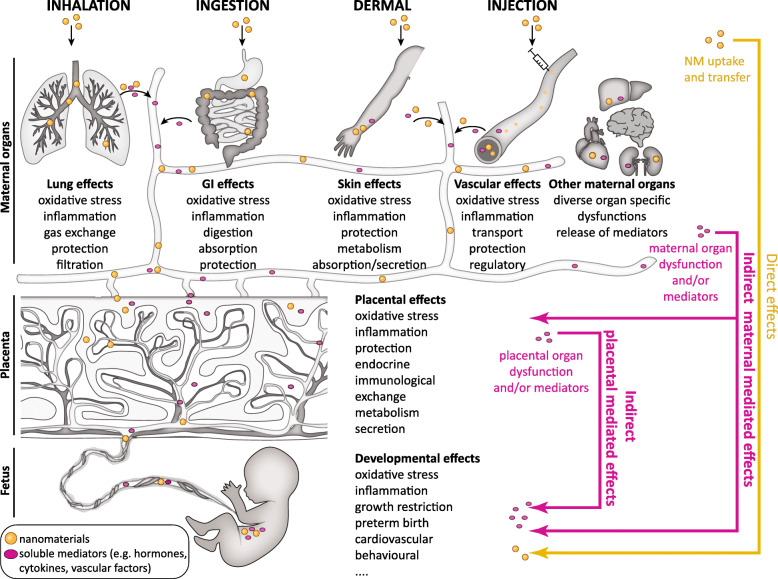
Direct toxicity originating from NMs crossing the placental barrier is frequently assumed to be the key pathway in developmental toxicity. However, placental transfer of particles is often highly limited, and evidence is growing that NMs can also indirectly interfere with fetal development. Here, we outline current knowledge on potential indirect mechanisms in developmental toxicity of NMs.
Until now, research on developmental toxicity has mainly focused on the biodistribution and placental translocation of NMs to the fetus to delineate underlying processes. Systematic research addressing NM impact on maternal and placental tissues as potential contributors to mechanistic pathways in developmental toxicity is only slowly gathering momentum. So far, maternal and placental oxidative stress and inflammation, activation of placental toll-like receptors (TLRs), impairment of placental growth and secretion of placental hormones, and vascular factors have been suggested to mediate indirect developmental toxicity of NMs. Therefore, NM effects on maternal and placental tissue function ought to be comprehensively evaluated in addition to placental transfer in the design of future studies of developmental toxicity and risk assessment of NM exposure during pregnancy.
流行病学和动物研究有力地表明,环境和工程纳米材料(NMs)对妊娠、胎儿发育和后代生命后期的健康构成风险。了解 NM 诱导的发育毒性的起源和机制将是保护敏感人群和设计安全可持续纳米技术应用的基石。
人们通常认为,NM 穿过胎盘屏障的直接毒性是发育毒性的关键途径。然而,颗粒向胎儿的胎盘转移通常受到高度限制,并且越来越多的证据表明 NM 也可以间接干扰胎儿发育。在这里,我们概述了 NM 在发育毒性中潜在间接机制的现有知识。
到目前为止,关于发育毒性的研究主要集中在 NM 向胎儿的生物分布和胎盘转移,以阐明潜在的过程。系统研究 NM 对母体和胎盘组织的影响作为发育毒性机制途径的潜在贡献者的研究才刚刚开始缓慢积累动力。到目前为止,已经提出了母体和胎盘的氧化应激和炎症、胎盘 toll 样受体(TLRs)的激活、胎盘生长和胎盘激素分泌的损害以及血管因素,以介导 NM 的间接发育毒性。因此,在设计未来的发育毒性研究和评估怀孕期间 NM 暴露的风险时,除了胎盘转移之外,还应该全面评估 NM 对母体和胎盘组织功能的影响。