Bruno Antonio, Dolcetti Ettore, Rizzo Francesca Romana, Fresegna Diego, Musella Alessandra, Gentile Antonietta, De Vito Francesca, Caioli Silvia, Guadalupi Livia, Bullitta Silvia, Vanni Valentina, Balletta Sara, Sanna Krizia, Buttari Fabio, Stampanoni Bassi Mario, Centonze Diego, Mandolesi Georgia
Synaptic Immunopathology Lab, Department of Systems Medicine, Tor Vergata University of Rome, Rome, Italy.
Synaptic Immunopathology Lab, IRCCS San Raffaele Pisana, Rome, Italy.
Front Cell Neurosci. 2020 Jun 23;14:169. doi: 10.3389/fncel.2020.00169. eCollection 2020.
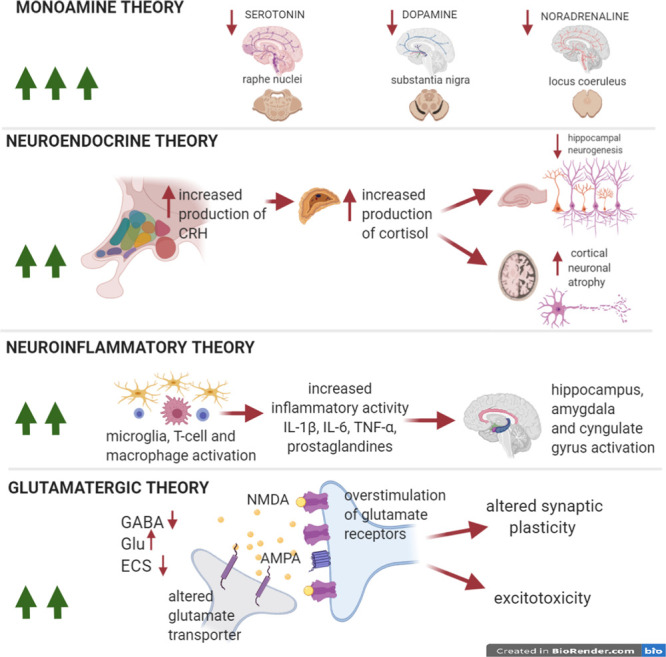
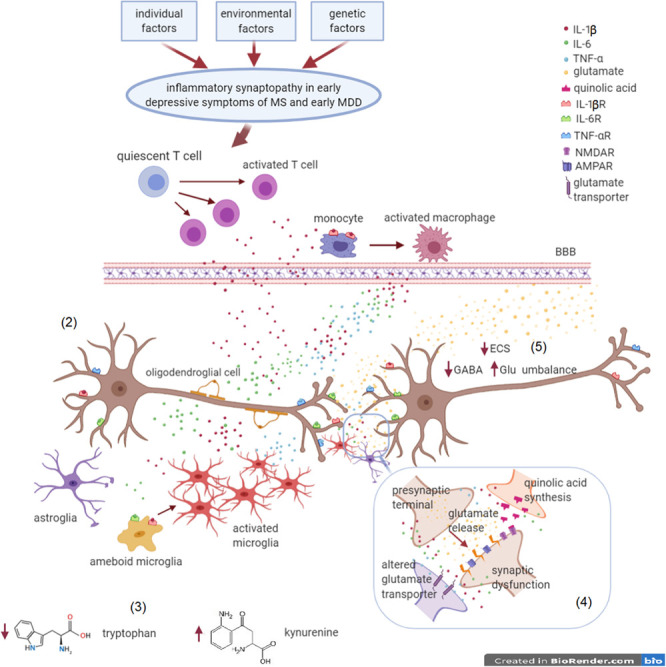
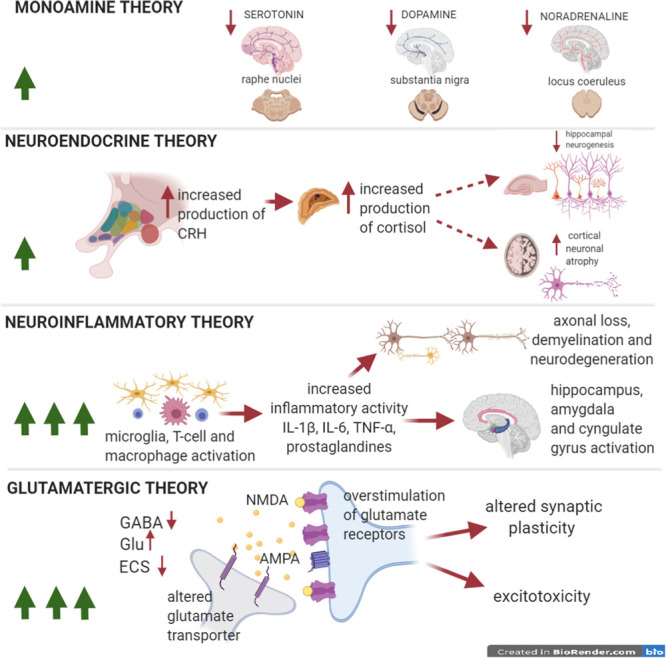
In the past years, several theories have been advanced to explain the pathogenesis of Major Depressive Disorder (MDD), a neuropsychiatric disease that causes disability in general population. Several theories have been proposed to define the MDD pathophysiology such as the classic "monoamine-theory" or the "glutamate hypothesis." All these theories have been recently integrated by evidence highlighting inflammation as a pivotal player in developing depressive symptoms. Proinflammatory cytokines have been indeed claimed to contribute to stress-induced mood disturbances and to major depression, indicating a widespread role of classical mediators of inflammation in emotional control. Moreover, during systemic inflammatory diseases, peripherally released cytokines circulate in the blood, reach the brain and cause anxiety, anhedonia, social withdrawal, fatigue, and sleep disturbances. Accordingly, chronic inflammatory disorders, such as the inflammatory autoimmune disease multiple sclerosis (MS), have been associated to higher risk of MDD, in comparison with overall population. Importantly, in both MS patients and in its experimental mouse model, Experimental Autoimmune Encephalomyelitis (EAE), the notion that depressive symptoms are reactive epiphenomenon to the MS pathology has been recently challenged by the evidence of their early manifestation, even before the onset of the disease. Furthermore, in association to such mood disturbance, inflammatory-dependent synaptic dysfunctions in several areas of MS/EAE brain have been observed independently of brain lesions and demyelination. This evidence suggests that a fine interplay between the immune and nervous systems can have a huge impact on several neurological functions, including depressive symptoms, in different pathological conditions. The aim of the present review is to shed light on common traits between MDD and MS, by looking at inflammatory-dependent synaptic alterations associated with depression in both diseases.
在过去几年中,已经提出了几种理论来解释重度抑郁症(MDD)的发病机制,MDD是一种在普通人群中导致残疾的神经精神疾病。已经提出了几种理论来定义MDD的病理生理学,例如经典的“单胺理论”或“谷氨酸假说”。最近,所有这些理论都被证据整合,这些证据突出了炎症在抑郁症状发展中的关键作用。促炎细胞因子确实被认为会导致应激诱导的情绪障碍和重度抑郁症,表明炎症的经典介质在情绪控制中具有广泛作用。此外,在全身性炎症疾病期间,外周释放的细胞因子在血液中循环,到达大脑并引起焦虑、快感缺失、社交退缩、疲劳和睡眠障碍。因此,与普通人群相比,慢性炎症性疾病,如炎症性自身免疫疾病多发性硬化症(MS),与MDD的较高风险相关。重要的是,在MS患者及其实验性小鼠模型实验性自身免疫性脑脊髓炎(EAE)中,抑郁症状是MS病理的反应性附带现象这一观点最近受到了挑战,因为有证据表明抑郁症状甚至在疾病发作之前就已早期出现。此外,与这种情绪障碍相关的是,在MS/EAE大脑的几个区域中观察到了与炎症相关的突触功能障碍,且与脑损伤和脱髓鞘无关。这一证据表明,在不同的病理条件下,免疫系统和神经系统之间的精细相互作用会对包括抑郁症状在内的几种神经功能产生巨大影响。本综述的目的是通过研究与这两种疾病中的抑郁症相关的炎症依赖性突触改变,来阐明MDD和MS之间的共同特征。