School of Kinesiology, Shanghai University of Sport, Shanghai, China.
Biomed Res Int. 2019 Nov 24;2019:5697380. doi: 10.1155/2019/5697380. eCollection 2019.
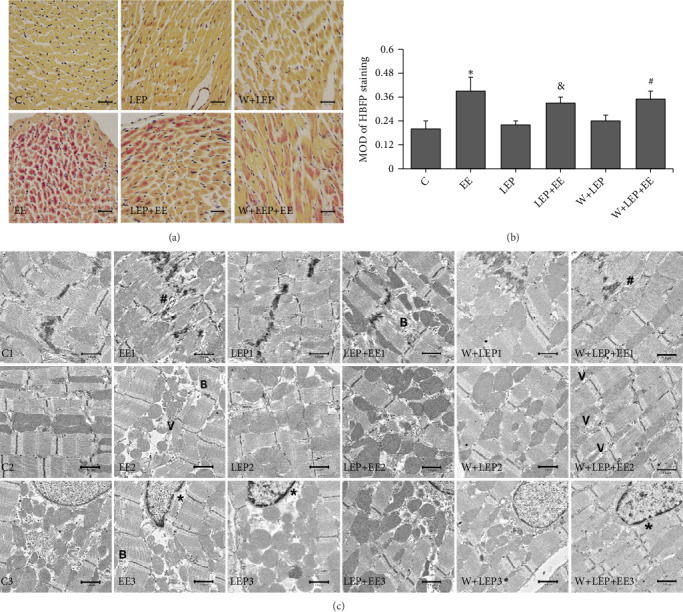
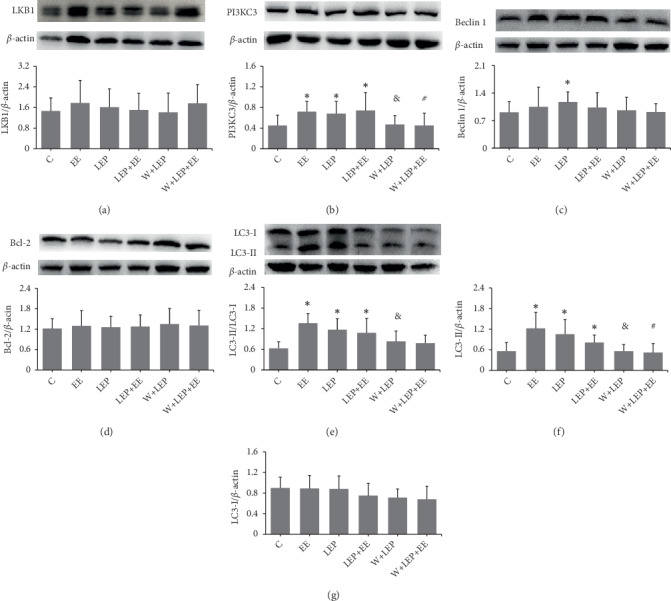
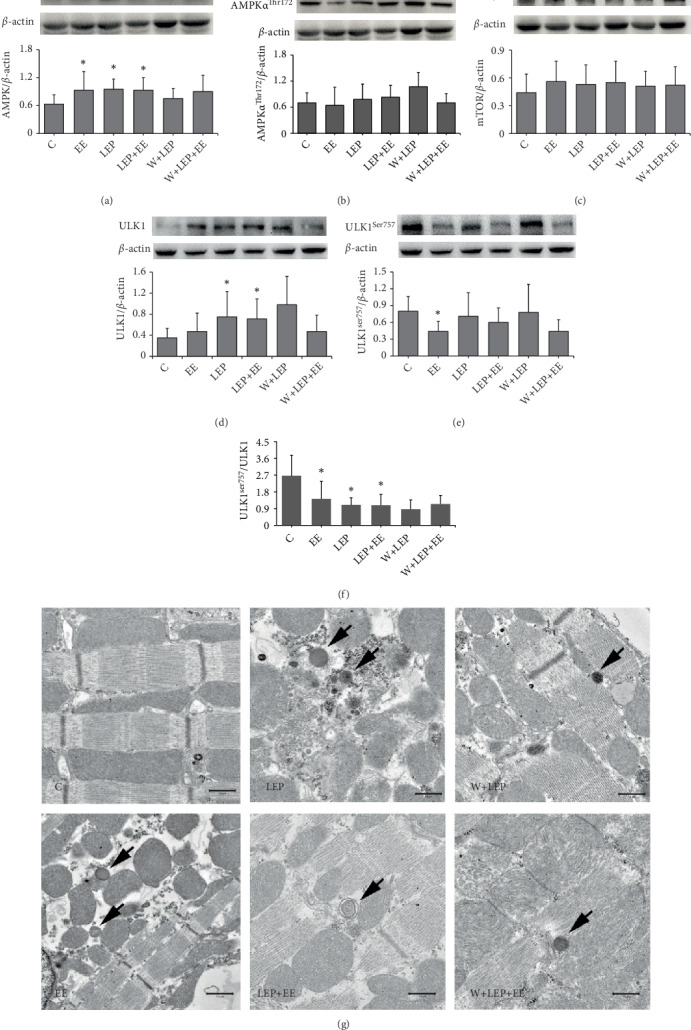
Accumulating evidence shows that the AMPK-mTOR pathway modulates autophagy via coordinated phosphorylation of ULK1. The aim of the present study was to investigate the relationship between AMPK, mTOR, and ULK1 during late exercise preconditioning (LEP), and to explore whether LEP-induced myocardial protection is related to the autophagy. The exercise preconditioning (EP) protocol was as follows: rats were instructed to for run four repeated in duration of 10 minutes (including 10 minutes rest between each period) on a treadmill. Exhaustive exercise (EE) after LEP pretreatment and administration of wortmannin (an autophagy inhibitor that suppresses Class III PI3K-kinase (PI3KC3) activity) were added to test the protective effect. Cardiac troponin I (cTnI), and transmission electron microscopy (TEM), along with hematoxylin-basic fuchsin-picric acid (HBFP) staining, were used to evaluate the myocardial ischemic-hypoxic injury and protection. Western blot was used to analyze the relationship of autophagy-associated proteins. Exhaustive exercise caused severe myocardial ischemic-hypoxic injury, which led to an increase in cTnI levels, changes of ischemia-hypoxia, and cells ultrastructure. Compared with the EE group, LEP significantly suppressed exhaustive exercise-induced myocardial injury. However, wortmannin attenuated LEP-induced myocardial protection by inhibiting autophagy. Compared with the C group, AMPK was increased in the LEP, EE, and LEP+EE groups, but phosphorylation of AMPK at Thr172 was not significantly changed. Exercise did not have any effect on mTOR expression. Compared with the C group, ULK1 was increased and the ULK1/ULK1 ratio was decreased in the LEP and LEP+EE groups. ULK1 was not significantly affected in the EE group, however, phosphorylation of ULK1 at Ser757 was remarkably decreased. To sum up, our results suggested that LEP promoted autophagy through the activation of AMPK-mTOR-ULK1 pathway, and that activated autophagy was partially involved in myocardial protection against EE-induced myocardial ischemic-hypoxic injury.
越来越多的证据表明,AMPK-mTOR 通路通过协调 ULK1 的磷酸化来调节自噬。本研究旨在探讨晚期运动预处理 (LEP) 过程中 AMPK、mTOR 和 ULK1 之间的关系,并探讨 LEP 诱导的心肌保护是否与自噬有关。运动预处理 (EP) 方案如下:指导大鼠在跑步机上进行 4 次 10 分钟的重复跑步(每次跑步之间休息 10 分钟)。在 LEP 预处理后进行力竭运动 (EE),并添加渥曼青霉素(一种自噬抑制剂,可抑制 III 类 PI3K-激酶 (PI3KC3) 活性),以测试保护作用。心肌肌钙蛋白 I (cTnI)、透射电子显微镜 (TEM) 以及苏木精-碱性品红-苦味酸 (HBFP) 染色用于评估心肌缺血缺氧损伤和保护。Western blot 用于分析自噬相关蛋白的关系。力竭运动导致严重的心肌缺血缺氧损伤,导致 cTnI 水平升高、缺血缺氧改变和细胞超微结构改变。与 EE 组相比,LEP 显著抑制了力竭运动引起的心肌损伤。然而,渥曼青霉素通过抑制自噬减弱了 LEP 诱导的心肌保护作用。与 C 组相比,LEP、EE 和 LEP+EE 组的 AMPK 增加,但 AMPK 在 Thr172 处的磷酸化没有明显变化。运动对 mTOR 表达没有影响。与 C 组相比,LEP 和 LEP+EE 组的 ULK1 增加,ULK1/ULK1 比值降低。EE 组 ULK1 没有明显变化,但 ULK1 在 Ser757 处的磷酸化显著降低。总之,我们的结果表明,LEP 通过激活 AMPK-mTOR-ULK1 通路促进自噬,激活的自噬部分参与了对 EE 诱导的心肌缺血缺氧损伤的心肌保护。