Center of Medical Innovation and Translational Research (CoMIT), Osaka University Graduate School of Medicine, Suita, Yamadaoka 2-2, Osaka 565-0871, Japan.
Department of Gastroenterological Surgery, Graduate School of Medicine, Osaka University, Suita 565-0871, Japan.
Cells. 2020 Jul 9;9(7):1645. doi: 10.3390/cells9071645.
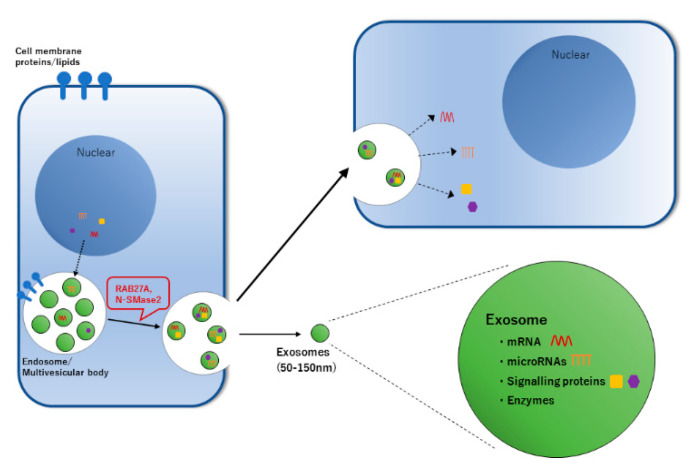
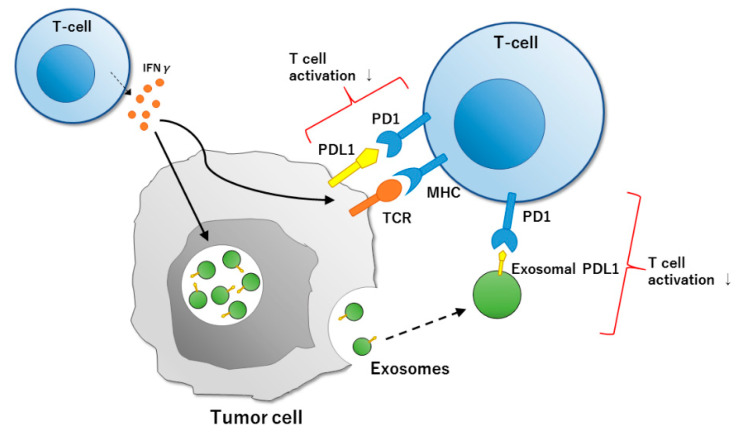
Exosomes (EXs), a type of extracellular vesicles secreted from various cells and especially cancer cells, mesenchymal cells, macrophages and other cells in the tumor microenvironment (TME), are involved in biologically malignant behaviors of cancers. Recent studies have revealed that EXs contain microRNAs on their inside and express proteins and glycolipids on their outsides, every component of which plays a role in the transmission of genetic and/or epigenetic information in cell-to-cell communications. It is also known that miRNAs are involved in the signal transduction. Thus, EXs may be useful for monitoring the TME of tumor tissues and the invasion and metastasis, processes that are associated with patient survival. Because several solid tumors secrete immune checkpoint proteins, including programmed cell death-ligand 1, the EX-mediated mechanisms are suggested to be potent targets for monitoring patients. Therefore, a companion therapeutic approach against cancer metastasis to distant organs is proposed when surgical removal of the primary tumor is performed. However, EXs and immune checkpoint mechanisms in pancreatic cancer are not fully understood, we provide an update on the recent advances in this field and evidence that EXs will be useful for maximizing patient benefit in precision medicine.
外泌体(EXs)是一种从各种细胞,尤其是癌细胞、间充质细胞、巨噬细胞和肿瘤微环境(TME)中的其他细胞分泌的细胞外囊泡,参与癌症的生物学恶性行为。最近的研究表明,EXs 内部含有 microRNAs,外部表达蛋白质和糖脂,其每个成分都在细胞间通讯中的遗传和/或表观遗传信息传递中发挥作用。也已知 microRNAs 参与信号转导。因此,EXs 可能有助于监测肿瘤组织的 TME 以及与患者生存相关的侵袭和转移过程。因为几种实体瘤分泌免疫检查点蛋白,包括程序性细胞死亡配体 1,所以 EX 介导的机制被认为是监测患者的有效靶点。因此,当进行原发性肿瘤切除时,建议采用针对癌症转移到远处器官的伴随治疗方法。然而,胰腺癌中的 EXs 和免疫检查点机制尚未完全阐明,我们提供了该领域的最新进展和证据,证明 EXs 将有助于在精准医学中最大限度地提高患者的受益。