Friedmann Erika, Gee Nancy R, Simonsick Eleanor M, Studenski Stephanie, Resnick Barbara, Barr Erik, Kitner-Triolo Melissa, Hackney Alisha
Department of Organizational Systems and Adult Health, University of Maryland School of Nursing, Baltimore, MD, United States.
Center for Human Animal Interaction, Department of Psychiatry, School of Medicine, Virginia Commonwealth University, Richmond, VA, United States.
Front Vet Sci. 2020 Jun 25;7:293. doi: 10.3389/fvets.2020.00293. eCollection 2020.
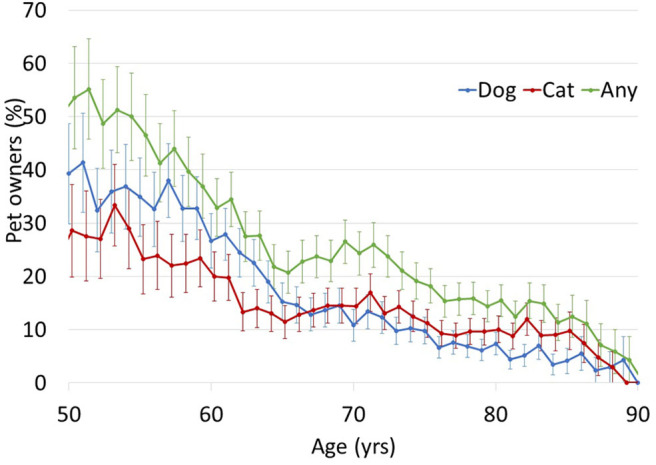
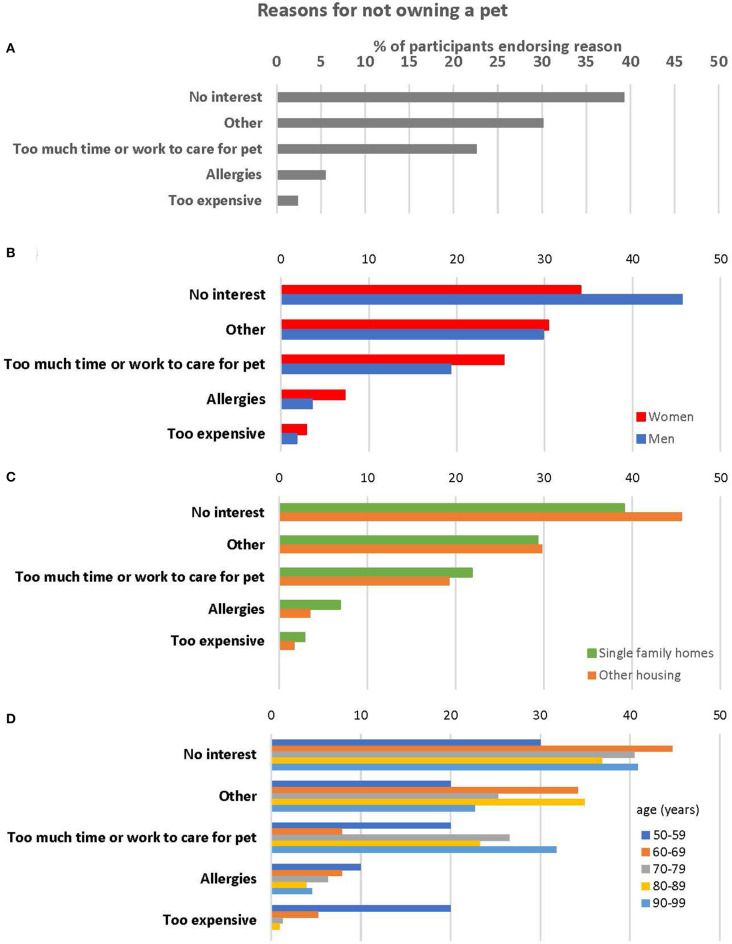
Diminishing cognitive and physical functions, worsening psychological symptoms, and increased mortality risk and morbidity typically accompany aging. The aging population's health needs will continue to increase as the proportion of the population aged > 50 years increases. Pet ownership (PO) has been linked to better health outcomes in older adults, particularly those with chronic conditions. Much of the evidence is weak. Little is known about PO patterns as people age or the contribution of PO to successful aging in community-dwelling older adults. This study examines PO patterns among healthy community-dwelling older adults and the relationship of PO to cognitive and physical functions and psychological status. Participants in the Baltimore Longitudinal Study of Aging (> 50 years old, = 378) completed a battery of cognitive, physical function, and psychological tests, as well as a PO questionnaire. Descriptive and non-parametric or general/generalized linear model analyses were conducted for separate outcomes. Most participants (82%) had kept pets and 24% have pets: 14% dogs, 12% cats, 3% other pets. The most frequent reasons for having pets included enjoyment (80%) and companionship (66%). Most owners had kept the pet they had the longest for over 10 years (70%). PO was lower in older decades ( < 0.001). Pet owners were more likely to live in single-family homes and reside with others ( = 0.001) than non-owners. Controlling for age, PO was associated independently with better cognitive function (verbal leaning/memory = 0.041), dog ownership predicted better physical function (daily energy expenditure, = 0.018), and cat ownership predicted better cognitive functioning (verbal learning/memory, = 0.035). Many older adults who did not own pets (37%) had regular contact with pets, which was also related to health outcomes. PO is lower at older ages, which mirrors the general pattern of poorer cognitive and physical function, and psychological status at older ages. PO and regular contact with pets (including PO) are associated with better cognitive status compared with those who did not own pets or had no regular contact with pets independent of age. Dog ownership was related to better physical function. Longitudinal analysis is required to evaluate the association of PO and/or regular contact with maintenance of health status over time.
认知和身体机能衰退、心理症状恶化以及死亡风险和发病率增加通常伴随着衰老。随着50岁以上人口比例的增加,老年人口的健康需求将持续上升。养宠物与老年人更好的健康状况相关,尤其是那些患有慢性疾病的老年人。然而,大部分证据并不充分。对于人们随着年龄增长的养宠模式,以及养宠物对社区居住的老年人成功老龄化的贡献,我们知之甚少。本研究调查了健康的社区居住老年人的养宠模式,以及养宠与认知和身体机能及心理状态之间的关系。巴尔的摩老龄化纵向研究的参与者(年龄>50岁,n = 378)完成了一系列认知、身体机能和心理测试,以及一份养宠调查问卷。针对不同结果进行了描述性和非参数或一般/广义线性模型分析。大多数参与者(82%)曾经养过宠物,24%的人目前养宠物:14%养狗,12%养猫,3%养其他宠物。养宠物最常见的原因包括享受(80%)和陪伴(66%)。大多数宠物主人饲养时间最长的宠物已养了超过10年(70%)。在年龄较大的几十年中养宠率较低(P < 0.001)。与非养宠者相比,养宠者更有可能居住在独栋房屋中且与他人同住(P = 0.001)。在控制年龄后,养宠与更好的认知功能独立相关(言语学习/记忆,P = 0.041),养狗预示着更好的身体机能(每日能量消耗,P = 0.018),养猫预示着更好的认知功能(言语学习/记忆,P = .......