Ozyigit Ahmet
Department of Healthcare Management, University of Mediterranean Karpasia, Sht. Ecvet Yusuf Cad, Nicosia, 99010, North Cyprus, the Republic of Cyprus.
Infect Dis Health. 2020 Nov;25(4):233-238. doi: 10.1016/j.idh.2020.07.001. Epub 2020 Jul 8.
Covid-19 pandemic is an uncharted territory for the world's population. Countries are seeing measures they would have never considered under democratic governance in an attempt to contain case numbers. The role of outside air temperatures have been implicated as a potential factor involved in disease transmission. However, to this date, there has been no clear evidence to suggest either way. Along with temperatures, infection control and protection measures as well as how well people adopt these measures are likely to play a role in disease transmission and case growth rates seen across countries.
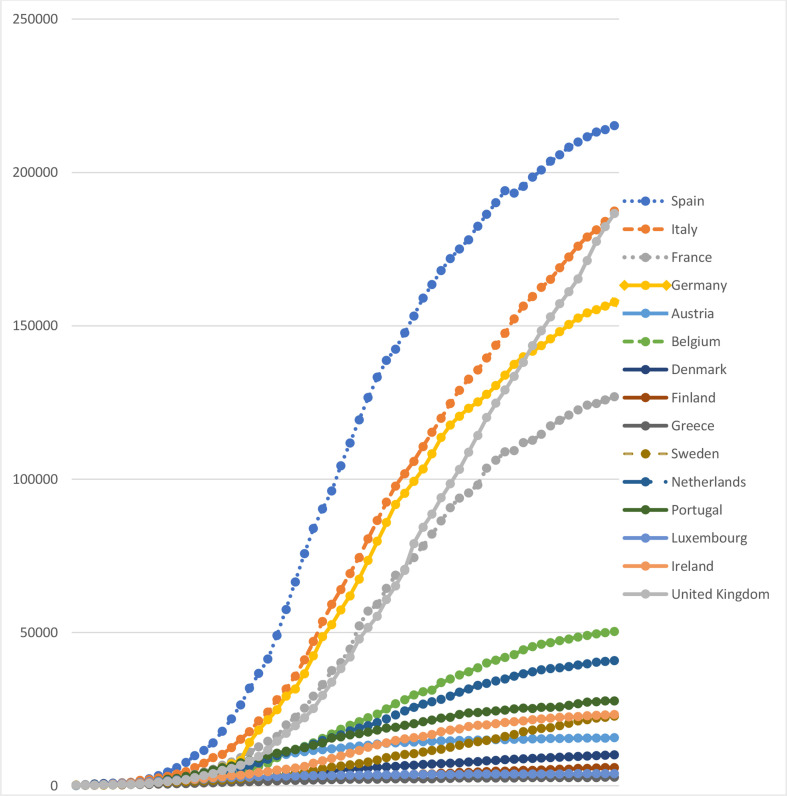
The current study uses panel data estimation for the original EU-15 countries in an attempt to explain the role of outside air temperatures, health behavior and government-imposed containment measures on Covid-19 transmission rates.
The preliminary evidence suggests that containment measures are highly effective in slowing down the spread of Covid-19. Years of education also appears to have a small but negative association with disease transmission rates suggesting that populations with higher educational attainments may be doing a better job of self-protection. Temperature appears to have a very small, but statistically significant impact on the viral transmission rate where a 1 °C increase in temperatures is estimated to reduce Covid-19 transmission by 0.9 percent.
Results are robust and clear. Temperature plays a small but significant role on Covid-19 transmission rates. However, it is quite possible that we may not have yet reached temperatures which may exert more pronounced effects on viral activity. Further research is warranted when more data becomes available, especially covering the months of July and August.
新冠疫情对于全球人口而言是一个未知领域。各国正在采取一些在民主治理下从未考虑过的措施,以试图控制病例数量。外界气温的作用被认为是疾病传播的一个潜在因素。然而,迄今为止,尚无明确证据表明其作用方式。除了气温,感染控制和防护措施以及人们对这些措施的遵守程度,可能在各国的疾病传播和病例增长率中发挥作用。
本研究使用面板数据估计法,针对最初的欧盟15国,试图解释外界气温、健康行为和政府实施的防控措施对新冠病毒传播率的作用。
初步证据表明,防控措施在减缓新冠病毒传播方面非常有效。受教育年限似乎也与疾病传播率存在微弱的负相关,这表明受教育程度较高的人群可能在自我保护方面做得更好。气温似乎对病毒传播率有非常小但具有统计学意义的影响,估计气温每升高1摄氏度,新冠病毒传播率会降低0.9%。
结果稳健且明确。气温对新冠病毒传播率有微小但显著的作用。然而,很有可能我们尚未达到可能对病毒活性产生更显著影响的温度。当有更多数据可用时,尤其是涵盖7月和8月的数据时,有必要进行进一步研究。