Matsuyama Sanae, Sawada Norie, Tomata Yasutake, Zhang Shu, Goto Atsushi, Yamaji Taiki, Iwasaki Motoki, Inoue Manami, Tsuji Ichiro, Tsugane Shoichiro
Division of Epidemiology, Department of Health Informatics and Public Health, School of Public Health, Tohoku University Graduate School of Medicine, 2-1, Seiryo-machi, Aoba-ku, Sendai, Miyagi, 980-8575, Japan.
Epidemiology and Prevention Group, Center for Public Health Sciences, National Cancer Center, Tokyo, Japan.
Eur J Nutr. 2021 Apr;60(3):1327-1336. doi: 10.1007/s00394-020-02330-0. Epub 2020 Jul 16.
The present study aimed to examine the association between adherence to the Japanese diet and the subsequent risk of all-cause and cause-specific mortality using a large-scale cohort from settings all over Japan.
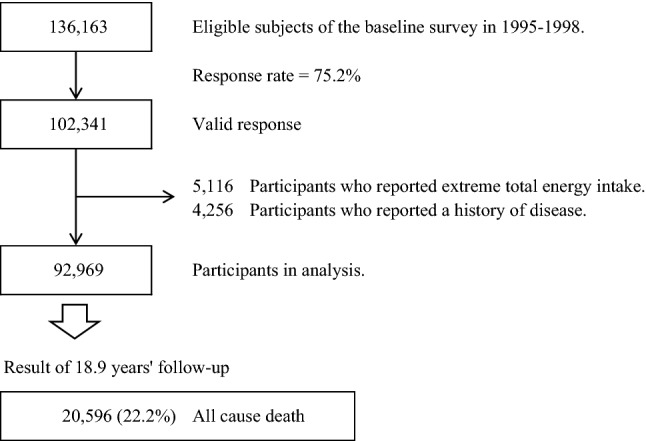
We analyzed data from a cohort study of 92,969 Japanese adults aged 45-74 years, covering 11 public health center areas nationwide. We collected dietary information using a validated 147-item food frequency questionnaire. Adherence to the Japanese diet consisting of eight components (high intake of rice, miso soup, seaweeds, pickles, green and yellow vegetables, fish, and green tea; low intake of beef and pork) was assessed using 8-item Japanese Diet Index (JDI8) score, with scores ranging from 0 to 8. The Cox proportional hazards model was used to estimate the hazard ratio (HR) and 95% confidence interval (CI) for all-cause and cause-specific mortality.
During a median follow-up of 18.9 years, we documented 20,596 deaths. A higher JDI8 score was significantly associated with a lower risk for all-cause and cardiovascular disease (CVD) mortality. The multivariable-adjusted HR of all-cause and CVD mortality for the highest JDI8 score group (score of 6-8) versus the lowest JDI8 score group (score of 0-2) were 0.86 (95% CI 0.81-0.90, P trend < 0.001), and 0.89 (95% CI 0.80-0.99, P trend = 0.007), respectively.
Adhering to the Japanese diet, as assessed by the JDI8, was associated with a decreased risk of all-cause and CVD mortality among adults living in multiple areas across Japan.
本研究旨在利用来自日本各地的大规模队列研究,探讨坚持日本饮食与全因死亡率及特定病因死亡率之间的关联。
我们分析了一项针对92969名年龄在45至74岁的日本成年人的队列研究数据,该研究覆盖了全国11个公共卫生中心区域。我们使用经过验证的147项食物频率问卷收集饮食信息。采用8项日本饮食指数(JDI8)评分评估对由八个成分组成的日本饮食(高摄入大米、味噌汤、海藻、泡菜、绿色和黄色蔬菜、鱼类以及绿茶;低摄入牛肉和猪肉)的依从性,评分范围为0至8。使用Cox比例风险模型估计全因死亡率和特定病因死亡率的风险比(HR)及95%置信区间(CI)。
在中位随访18.9年期间,我们记录了20596例死亡病例。较高的JDI8评分与较低的全因死亡率和心血管疾病(CVD)死亡率风险显著相关。最高JDI8评分组(评分6 - 8)与最低JDI8评分组(评分0 - 2)相比,全因死亡率和CVD死亡率的多变量调整后HR分别为0.86(95%CI 0.81 - 0.90,P趋势<0.001)和0.89(95%CI 0.80 - 0.99,P趋势=0.007)。
通过JDI8评估,坚持日本饮食与日本多个地区成年人的全因死亡率和CVD死亡率风险降低相关。