Suntara Chanon, Cherdthong Anusorn, Uriyapongson Suthipong, Wanapat Metha, Chanjula Pin
Tropical Feed Resources Research and Development Center (TROFREC), Khon Kaen 40002, Thailand.
Department of Animal Science, Faculty of Agriculture, Khon Kaen University, Khon Kaen 40002, Thailand.
J Fungi (Basel). 2020 Jul 15;6(3):109. doi: 10.3390/jof6030109.
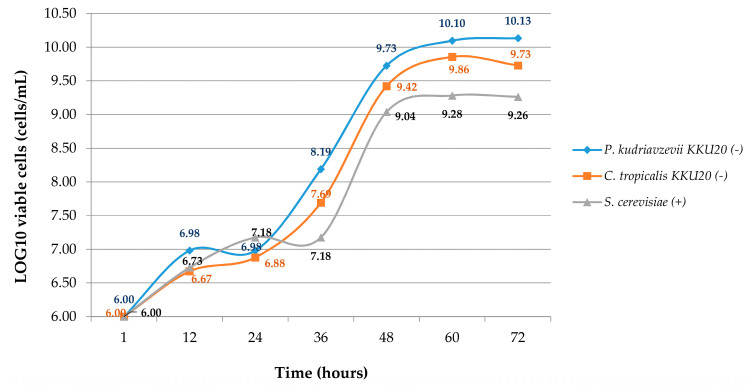
The objective of this study was to compare the effects of Crabtree-negative ruminal yeast and Crabtree-positive yeast in ensiled rice straw (RS) on the ensilage quality, nutritive value, and microorganism composition, including the evaluation of the ensiled RS using the in vitro gas production technique. The experiment was conducted in a 4 × 3 factorial arrangement in a randomized complete design. Factor A was yeast species with no inoculant, Crabtree-negative yeasts ( KKU20 and KKU20), and Crabtree-positive yeast (), whereas factor B was ensilage times (7, 14, and 21 days). The rate of growth was revealed to be lower in Crabtree-positive yeasts than the other Crabtree-negative yeast strains ( < 0.01). RS ensiled with showed decreased dry matter (DM) content by 9.0% when compared to the sample without a yeast inoculant. In addition, organic matter (OM) content was greater ( < 0.01) for KKU20 than KKU20 and without an inoculant. Neutral detergent fiber (NDF) content was significantly decreased ( < 0.01) by yeast inoculants by about 2.75% when compared to the control group. Lactic acid bacteria (LAB) and aerobic bacteria were low ( < 0.05) when yeasts were added. However, no interaction was found between yeast and ensilage times on the quality of ensiled RS ( > 0.05). The KKU20 addition was associated with the highest value ( < 0.01) of gas produced-an insoluble fraction (b), potential extent of gas production (a + b), and cumulative gas production at 96 h-when compared with or the control group. The highest in vitro dry matter digestibility and in vitro neutral detergent fiber digestibility was observed in RS ensiled with KKU20 for 14 days ( < 0.01, < 0.05). The maximum total volatile fatty acids (VFAs) at 4 and 8 h of incubation and the mean value were observed in RS ensiled with KKU20 ( < 0.01). RS ensiled with all yeast strains showed an increased propionate concentration at 8 h ( < 0.01). In conclusion, ensiling RS with isolated Crabtree-negative ruminal yeasts could benefit feed digestion and in vitro gas production more than Crabtree-positive yeast does. KKU20, an isolated Crabtree-negative ruminal yeast used to treat RS, had the highest potential for increasing cumulative gas production and enhancing in vitro digestibility.
本研究的目的是比较产朊假丝酵母阴性瘤胃酵母和产朊假丝酵母阳性酵母对青贮稻草(RS)青贮品质、营养价值和微生物组成的影响,包括使用体外产气技术对青贮RS进行评价。试验采用4×3析因设计的随机完全区组设计。因素A为酵母种类,包括不接种菌剂、产朊假丝酵母阴性酵母(KKU20和KKU20)以及产朊假丝酵母阳性酵母(),而因素B为青贮时间(7、14和21天)。结果显示,产朊假丝酵母阳性酵母的生长速率低于其他产朊假丝酵母阴性酵母菌株(P<0.01)。与未接种酵母菌剂的样品相比,接种酵母的RS青贮后干物质(DM)含量降低了9.0%。此外,KKU20处理的RS有机物质(OM)含量高于KKU20和未接种菌剂处理的RS(P<0.01)。与对照组相比,酵母菌剂使中性洗涤纤维(NDF)含量显著降低(P<0.01)约2.75%。添加酵母后,乳酸菌(LAB)和好氧菌数量较低(P<0.05)。然而,酵母和青贮时间对青贮RS品质没有交互作用(P>0.05)。与或对照组相比,添加KKU20后产生的气体量、不可溶性部分(b)、潜在产气量(a + b)以及96小时时的累积产气量最高(P<0.01)。在青贮14天的KKU20处理的RS中观察到最高的体外干物质消化率和体外中性洗涤纤维消化率(P<0.01,P<0.05)。在青贮KKU20的RS中,4小时和8小时孵育时的总挥发性脂肪酸(VFA)最高值及平均值也最高(P<0.01)。所有酵母菌株处理的RS在8小时时丙酸浓度均升高(P<0.01)。总之,用分离的产朊假丝酵母阴性瘤胃酵母青贮RS比产朊假丝酵母阳性酵母更有利于饲料消化和体外产气。用于处理RS的分离产朊假丝酵母阴性瘤胃酵母KKU20在增加累积产气量和提高体外消化率方面具有最高潜力。