Department of Ecology and Evolutionary Biology, UC Irvine, Irvine, CA.
Laboratory of Subtropical Biodiversity, Jiangxi Agricultural University, Nanchang, China.
Mol Biol Evol. 2020 Dec 16;37(12):3507-3524. doi: 10.1093/molbev/msaa185.
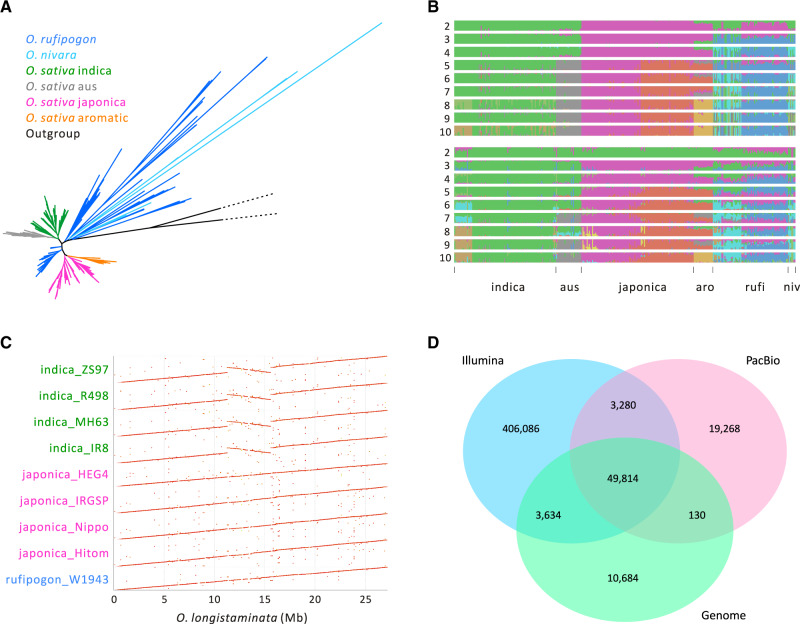
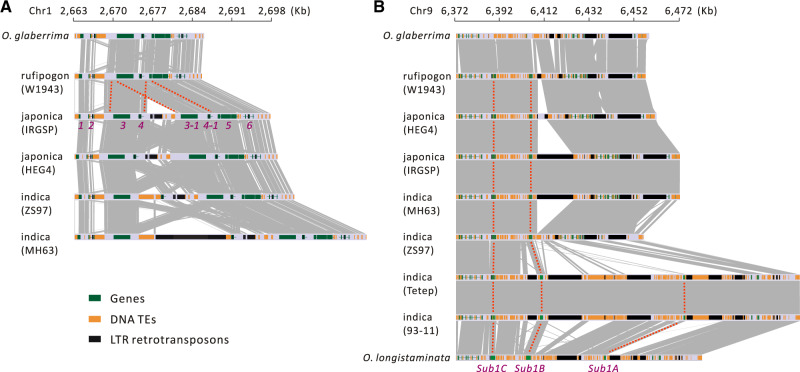
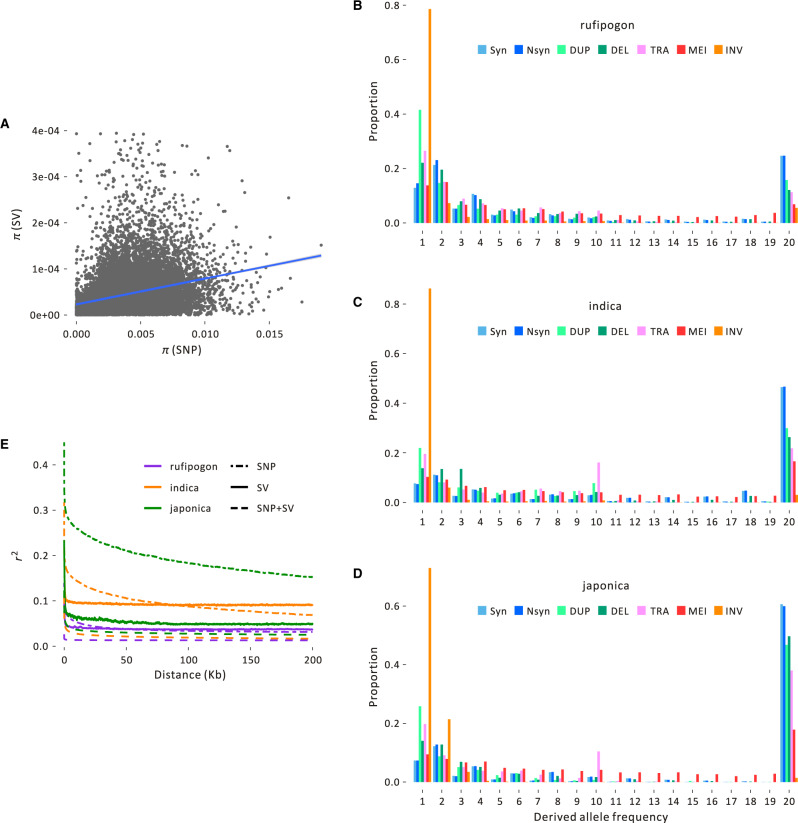
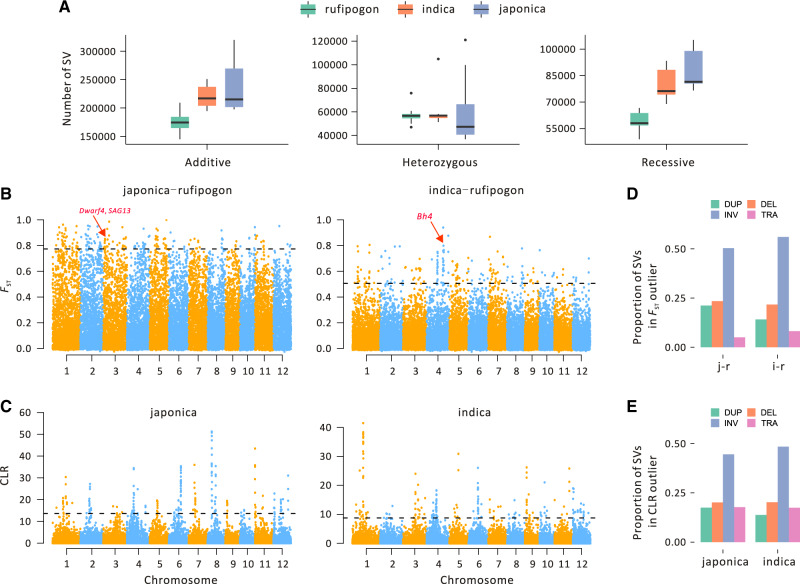
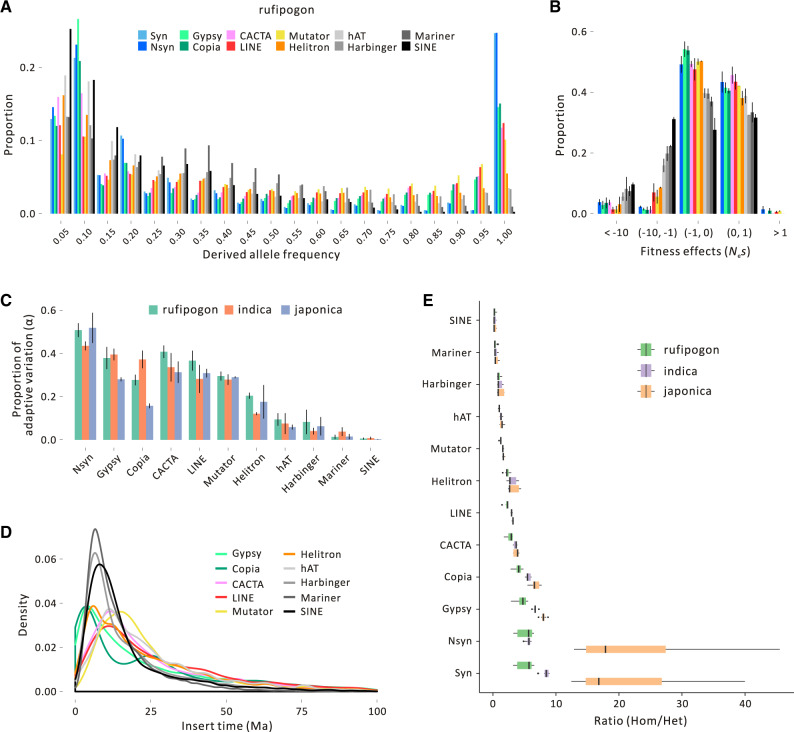
Structural variants (SVs) are a largely unstudied feature of plant genome evolution, despite the fact that SVs contribute substantially to phenotypes. In this study, we discovered SVs across a population sample of 347 high-coverage, resequenced genomes of Asian rice (Oryza sativa) and its wild ancestor (O. rufipogon). In addition to this short-read data set, we also inferred SVs from whole-genome assemblies and long-read data. Comparisons among data sets revealed different features of genome variability. For example, genome alignment identified a large (∼4.3 Mb) inversion in indica rice varieties relative to japonica varieties, and long-read analyses suggest that ∼9% of genes from the outgroup (O. longistaminata) are hemizygous. We focused, however, on the resequencing sample to investigate the population genomics of SVs. Clustering analyses with SVs recapitulated the rice cultivar groups that were also inferred from SNPs. However, the site-frequency spectrum of each SV type-which included inversions, duplications, deletions, translocations, and mobile element insertions-was skewed toward lower frequency variants than synonymous SNPs, suggesting that SVs may be predominantly deleterious. Among transposable elements, SINE and mariner insertions were found at especially low frequency. We also used SVs to study domestication by contrasting between rice and O. rufipogon. Cultivated genomes contained ∼25% more derived SVs and mobile element insertions than O. rufipogon, indicating that SVs contribute to the cost of domestication in rice. Peaks of SV divergence were enriched for known domestication genes, but we also detected hundreds of genes gained and lost during domestication, some of which were enriched for traits of agronomic interest.
结构变异(SVs)是植物基因组进化中一个很大程度上未被研究的特征,尽管 SVs 对表型有很大的贡献。在这项研究中,我们在 347 个亚洲稻(Oryza sativa)及其野生祖先(O. rufipogon)的高覆盖率重测序基因组的群体样本中发现了 SVs。除了这个短读数据集中,我们还从全基因组组装和长读数据中推断了 SVs。数据集之间的比较揭示了基因组可变性的不同特征。例如,基因组比对确定了 indica 水稻品种相对于 japonica 品种的一个大(约 4.3Mb)倒位,而长读分析表明,来自外群(O. longistaminata)的约 9%的基因是半合子的。然而,我们专注于重测序样本,以研究 SV 的群体基因组学。使用 SV 进行聚类分析再现了也从 SNP 推断出的水稻品种群体。然而,每种 SV 类型的位点频率谱-包括倒位、重复、缺失、易位和转座子插入-都偏向于低频变体,而不是同义 SNP,这表明 SV 可能主要是有害的。在转座元件中,SINE 和 mariner 插入的频率特别低。我们还使用 SV 来研究水稻和 O. rufipogon 之间的驯化。与 O. rufipogon 相比,栽培基因组包含约 25%更多的衍生 SV 和转座元件插入,这表明 SV 有助于水稻驯化的代价。SV 分歧的峰富集了已知的驯化基因,但我们也检测到驯化过程中获得和丢失的数百个基因,其中一些基因富集了农艺性状的基因。