Department of Pulmonary Medicine, Zhongshan Hospital, Fudan University, Shanghai, China.
Department of Infectious Diseases, Shanghai Public Health Clinical Center, Shanghai, China.
Ther Adv Respir Dis. 2020 Jan-Dec;14:1753466620942129. doi: 10.1177/1753466620942129.
In December of 2019, coronavirus disease 2019 (Covid-19) was reported in Wuhan, China, and has now rapidly swept around the world. Much research has been carried out since the outbreak, but few studies have focused on the dysfunction of the adaptive immunity.
In this retrospective and multi-center study, 373 patients with laboratory-confirmed COVID-19 from Shanghai Public Health Clinical Center and Affiliated Hospital of Putian University were recruited. Demographic, clinical, radiological features, and laboratory data were recorded and analyzed at admission and at discharge. Results of immunological tests were followed up until the patients were discharged.
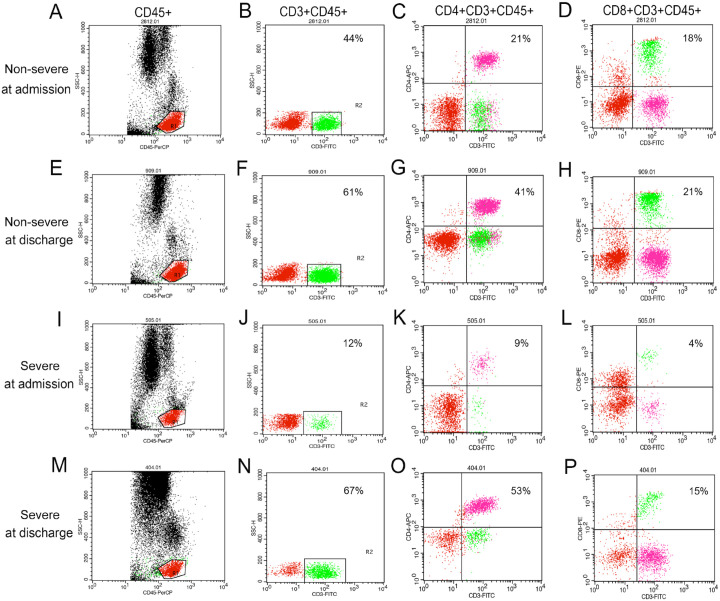
Of the 373 patients with COVID-19 pneumonia, 322 were in the non-severe group and 51 were in the severe group. Number of T cells, CD4+ and CD8+ T cells, and total lymphocytes declined remarkably upon admission and elevated when the patients were discharged. At admission, counts of total lymphocytes, T cells, CD4+ and CD8+ T cells, and levels of C3 and C4 in the severe group were lower than those in the non-severe group, whereas the neutrophil to lymphocyte ratio (NLR) was higher in the severe group. Counts of T cells, CD4+ and CD8+ T cells, and total lymphocytes were negatively correlated with lactate dehydrogenase and C-reactive protein.
COVID-19 might target adaptive immunity and cause a decrease in lymphocytes, especially T cells and subsets. Physicians should pay close attention to the adaptive immunity of patients upon admission. Monitoring NLR, T lymphocytes, and subsets would help physicians with the proper diagnosis and treatment of COVID-19.
2019 年 12 月,中国武汉报告了 2019 年冠状病毒病(Covid-19),现已迅速席卷全球。自疫情爆发以来,已经进行了大量研究,但很少有研究关注适应性免疫的功能障碍。
在这项回顾性多中心研究中,共招募了来自上海公共卫生临床中心和莆田大学附属医院的 373 例实验室确诊的 COVID-19 患者。记录并分析入院时和出院时的人口统计学、临床、影像学特征和实验室数据。随访免疫测试结果直至患者出院。
在 373 例 COVID-19 肺炎患者中,322 例为非重症组,51 例为重症组。入院时 T 细胞、CD4+和 CD8+T 细胞以及总淋巴细胞数量明显下降,出院时升高。入院时,重症组的总淋巴细胞、T 细胞、CD4+和 CD8+T 细胞计数以及 C3 和 C4 水平均低于非重症组,而重症组的中性粒细胞与淋巴细胞比值(NLR)较高。T 细胞、CD4+和 CD8+T 细胞计数和总淋巴细胞计数与乳酸脱氢酶和 C-反应蛋白呈负相关。
COVID-19 可能靶向适应性免疫并导致淋巴细胞减少,特别是 T 细胞和亚群。医生在入院时应密切关注患者的适应性免疫。监测 NLR、T 淋巴细胞和亚群有助于医生对 COVID-19 的正确诊断和治疗。