McCullough Samantha, Stanley Carolyn, Smith Helen, Scott Molly, Karia Minesh, Ndubuisi Benignus, Ross Callum C, Bates Rob, Davoren Mary
Broadmoor Hospital and West London NHS Trust, UK.
North East London Forensic Mental Health Services, Camlet Lodge, Chase Farm Hospital and Barnet, Enfield and Harringey NHS Trust, UK.
BJPsych Open. 2020 Jul 20;6(4):e74. doi: 10.1192/bjo.2020.61.
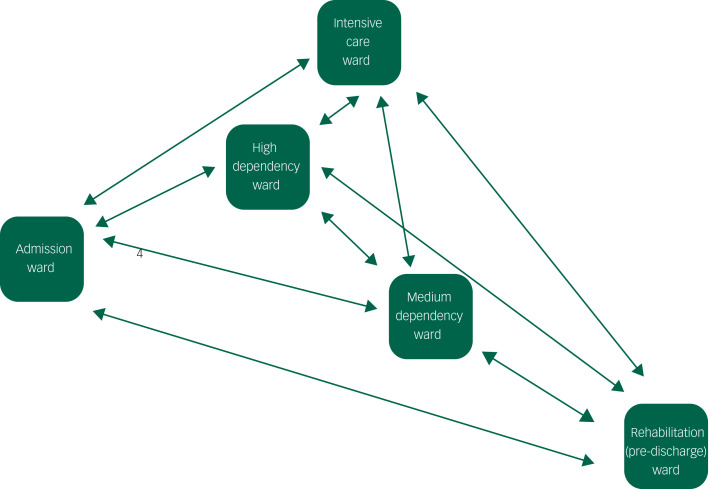
Placements within high secure forensic hospitals consist of wards providing various different levels of relational security. They should form a coherent pathway through secure care, based on individual patient risks and needs. Moves to less secure wards within high secure forensic hospitals and moves on to lower secure hospital settings have rarely been systematically studied.
The aim of this study was to ascertain if placements within Broadmoor High Secure Hospital and moves from Broadmoor to medium secure hospitals corresponded to measures of violence risk, programme completion and recovery.
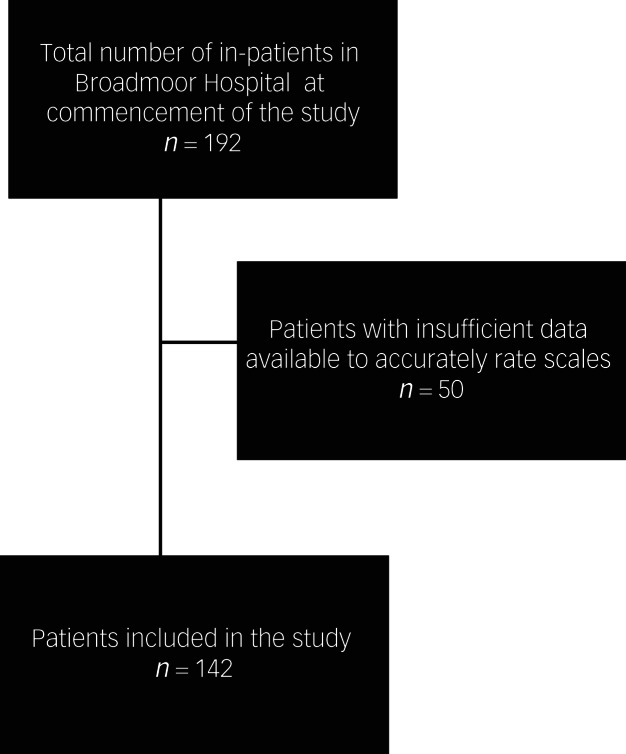
A 13-month prospective cohort study was completed. Patients (n = 142) were rated at baseline for violence risk (Historical, Clinical and Risk - 20), therapeutic programme completion and recovery (DUNDRUM tool) and overall functioning (Global Assessment of Functioning). Placements on the care pathway and moves on to medium secure hospitals were observed.
Placements on the care pathway within the high secure hospital were associated with dynamic violence risk (F = 16.324, P<0.001), therapeutic programme completion (F = 4.167, P = 0.003), recovery (F = 2.440, P = 0.050) with better scores on these measures being found in the rehabilitation wards and the poorest scores on the highest levels of dependency. Moves to medium secure hospitals were associated with better scores on dynamic risk of violence (F = 33.199, P<0.001), therapeutic programme completion (F = 9.237 P<0.001), recovery (F = 6.863, P = 0.001).
Placements within Broadmoor Hospital formed a coherent pathway through high secure care. Moves to less secure places were influenced by more than reduction in violence risk. Therapeutic programme completion and recovery in a broad sense were also important.
高度戒备的法医医院内的安置包括提供不同安全级别的病房。应根据患者个体风险和需求,形成一条贯穿安全护理的连贯路径。对于高度戒备的法医医院内转至安全级别较低的病房以及转至更低安全级别的医院环境,鲜有系统研究。
本研究旨在确定布罗德莫尔高度戒备医院内的安置以及从布罗德莫尔转至中等戒备医院是否与暴力风险、项目完成情况及康复措施相对应。
完成了一项为期13个月的前瞻性队列研究。对患者(n = 142)在基线时进行暴力风险(历史、临床和风险 - 20)、治疗项目完成情况及康复(邓德拉姆工具)以及整体功能(功能总体评估)的评分。观察护理路径上的安置情况以及转至中等戒备医院的情况。
高度戒备医院内护理路径上的安置与动态暴力风险(F = 16.324,P<0.001)、治疗项目完成情况(F = 4.167,P = 0.003)、康复(F = 2.440,P = 0.050)相关,在康复病房中这些指标得分更高,而在最高依赖级别得分最差。转至中等戒备医院与动态暴力风险(F = 33.199,P<0.001)、治疗项目完成情况(F = 9.237,P<0.001)、康复(F = 6.863,P = 0.001)得分更高相关。
布罗德莫尔医院内的安置形成了一条贯穿高度戒备护理的连贯路径。转至安全级别较低的地方受到多种因素影响,不仅仅是暴力风险的降低。治疗项目的完成以及广义上的康复也很重要。